The KT88 and the 6550 are the heavyweights of the common power tubes. They were born in the mid-1950s for hi-fi, to make a lot of power with very little distortion, and that is still what they do best. In a guitar or bass amp they mean big clean headroom, a tight, deep low end, and a tube that keeps its composure far louder than an EL34 or a 6L6GC.
They are two tubes from two countries that ended up nearly interchangeable, so this series covers them together. The Vacuum Tubes series covers how tubes work in general; this series is about these two.
DANGER: LETHAL VOLTAGE. Amps built around KT88s and 6550s are usually big amps running at 500 V and more, with large filter capacitors that hold a lethal charge long after unplugging. Never reach inside one unless you know how to drain it safely. The Cap Drain & Bleeder Calculator explains how long the charge lasts.
Two Tubes, One Job
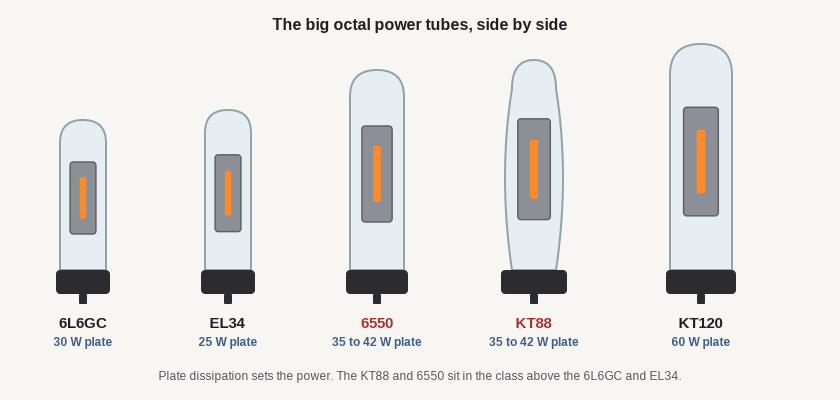
| KT88 | 6550 | |
|---|---|---|
| Origin | Britain: GEC, 1956 | United States: Tung-Sol, mid-1950s |
| Designed as | a bigger version of the KT66, for high-power hi-fi | a more powerful, more stable tube based on the 6L6 |
| Type | beam tetrode ("KT" means kinkless tetrode) | beam tetrode |
| Plate rating | 35 W originally; many later versions 42 W | 35 W; the later 6550A 42 W |
| Bottle | the largest, often with a waisted "coke bottle" shape | large, straight or slightly shaped |
Both use the same 8-pin octal base and pinout as the 6L6 and EL34 family, and both draw 1.6 A of heater current. In most amps built for one, the other works after a bias check. The original British KT88s were made until 1984; today both are made in Russia, Slovakia and China under many brand names.
What They Sound Like
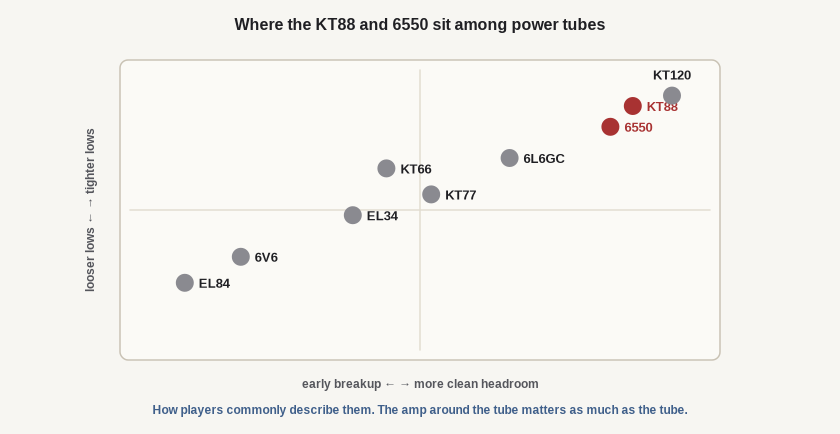
Players describe them consistently:
- Clean headroom: lots of it. A KT88 or 6550 amp stays clean at volumes where an EL34 amp is well into crunch.
- Low end: tight and deep, with a firmness that doesn't flub or blur when you dig in. This is why bass players love them.
- Midrange: less forward than an EL34. Often described as hi-fi or "big and polished" rather than gritty.
- When pushed: they do distort, and the distortion stays focused and tight rather than loose and saggy.
Between the two, KT88s are usually described as a little smoother and rounder, and 6550s as a little more aggressive in the low mids. The difference is real but smaller than the difference between either of them and an EL34.
Where You've Heard Them
- Bass: the Ampeg SVT, the 300 W bass head that has six 6550s and has been a standard of rock bass since around 1970.
- Big guitar heads: the Marshall Major, a 200 W head from 1967 to 1974 with four KT88s. Through the 1970s and much of the 1980s, many Marshalls shipped to the United States came with 6550s instead of EL34s.
- Hi-fi: a long list of tube power amplifiers, past and present. This is the tube's first home.
- Big clean amps for steel guitar, jazz and pedal platforms, where clean volume is the point.
How They Compare to Their Neighbors
| Tube | Plate rating | In one sentence |
|---|---|---|
| EL34 | 25 W | midrange crunch and early breakup: the classic British rock sound |
| 6L6GC | 30 W | big, clean American tone with sparkle on top |
| KT88 / 6550 | 35 W to 42 W | more of everything: more power, more headroom, tighter lows |
| KT120 / KT150 | 60 W to 70 W | modern descendants that push the same idea further |
Try It
Open the Tube Bias Calculator and set four 6L6GC tubes, then four KT88s, at the same plate voltage. Note how much more current the KT88 can take before reaching the same percentage: that extra room is the headroom this article describes.
Level 2 covers how the KT88 and 6550 behave in an amp: power by tube count, headroom, bias, and what the amp has to give them.