Levels 1 and 2 covered the two British KT tubes and how they behave. This level is about applications: the jobs each does best and the reasons why, where they are the wrong choice, swapping them in and out, and buying them.
Where They Shine
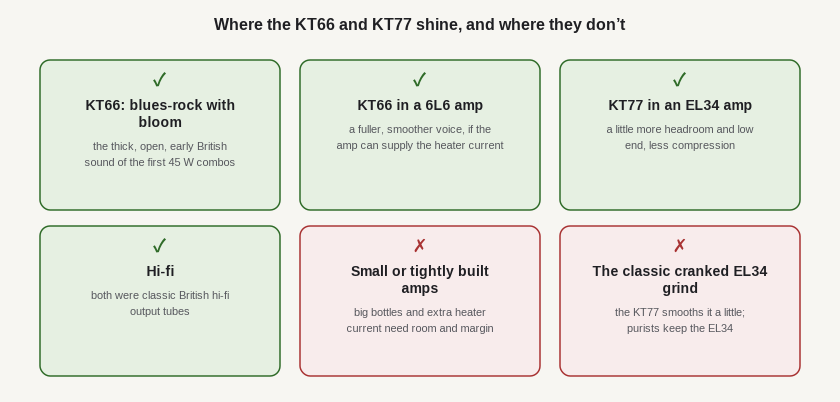
KT66: Blues-Rock With Bloom
The job: the thick, open, early British sound: a 45 W combo or head pushed into a warm overdrive that blooms as a note sustains.
Why it shines: the KT66's big low end and smooth midrange give a cranked amp weight without harshness, and it breaks up a little sooner and more smoothly than a 6L6GC. Amps modeled on the first Marshalls, the JTM45 and its 45 W combo cousin, are built around it.
KT66 in a 6L6 Amp
The job: a fuller, smoother voice from an American-style amp.
Why it shines: the KT66 fits a 6L6 socket and biases similarly. In an amp whose power transformer has heater current to spare, it trades some of the 6L6's upper-mid sparkle for a bigger, rounder sound. Some players have long used KT66s in big Fender amps for exactly that.
KT77 in an EL34 Amp
The job: an EL34 amp with a little more headroom and low end, and a little less compression.
Why it shines: the KT77 has the EL34's ratings and fits its socket, so it drops in after a rebias. Being a beam tetrode rather than a pentode, it sounds a touch cleaner and fuller. For players who find EL34s too compressed and 6550s too clean, it sits in between.
Hi-Fi
The job: smooth, detailed power for loudspeakers.
Why they shine: both were classic British hi-fi output tubes. The KT66 powered the Quad II, and the KT77 was designed with ultralinear hi-fi stages in mind.
Where They Don't
- Small or tightly built amps. Big bottles, extra heater current and extra heat need space and transformer margin that small combos often don't have.
- The classic cranked EL34 grind. A KT77 smooths the EL34's crunch a little. If that grind is the point of the amp, keep the EL34.
- Unknown amps. Fitting a KT66 to an amp whose power transformer can't supply the extra heater current risks the transformer. Check first.
Swapping Them In and Out
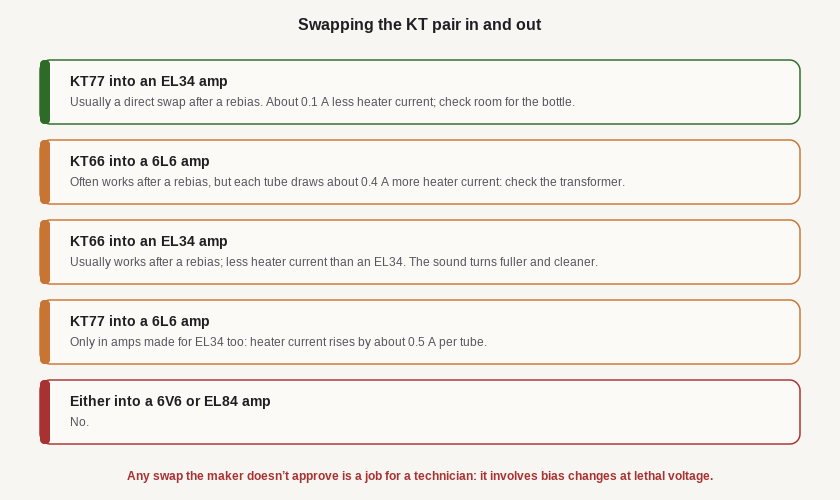
| Swap | Verdict | What to check |
|---|---|---|
| KT77 into an EL34 amp | usually a direct swap | rebias; room for the bottle |
| KT66 into a 6L6 amp | often works | rebias; about 0.4 A more heater current per tube; room |
| KT66 into an EL34 amp | usually works | rebias; less heater current than an EL34; the sound turns fuller and cleaner |
| KT77 into a 6L6 amp | only in amps made for EL34 too | about 0.5 A more heater current per tube; the amp's pin 1 wiring |
| Either into a 6V6 or EL84 amp | no | far too much for those amps |
DANGER: LETHAL VOLTAGE. Rebiasing and checking a transformer's heater capacity is work at lethal voltage. If the amp's maker doesn't say a swap is supported, have a technician check the amp.
Buying KT66s and KT77s
- Current production: both are made today in Russia, Slovakia and China, including reissues under revived British brand names.
- True KT66s: check the heater current. About 1.3 A means a true KT66 design; 0.9 A means a 6L6GC in a KT66-style bottle, easier on a transformer but not the same sound.
- Matched sets: buy matched pairs or quads, and stay with the same grade when replacing a set.
- Vintage: original GEC and M-OV KT66s and KT77s are rare and expensive, and fakes and used tubes sold as new exist. Ask for test data.
Try It
If you have an EL34 amp, try a matched set of KT77s after a proper rebias. Play the same song at the same settings and listen to the low end and how soon the amp compresses: the difference is subtle but consistent, and it is the whole case for the KT77.