Level 1 covered the two British KT tubes and the tubes they shadow. This level is about living with them: how much power they make, the numbers against their partners, the heater current that decides most swaps, and bias.
DANGER: LETHAL VOLTAGE. Bias is measured with the amp on, at lethal voltage. If you are not trained for it, have a technician do it. Never run a tube amp without a speaker or dummy load: it can destroy the output transformer (see the Output Transformers series).
Power by Tube Count
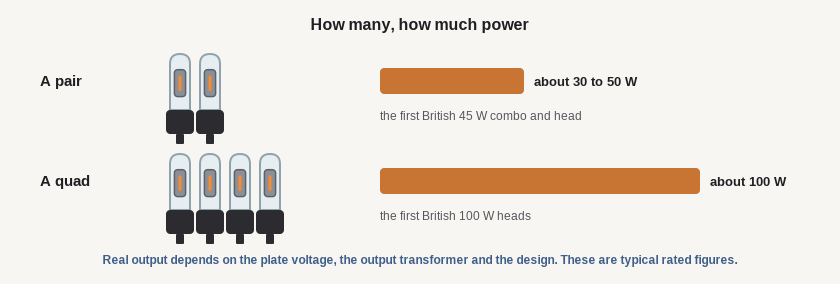
| Tubes | Typical rated power | Where |
|---|---|---|
| A pair | about 30 W to 50 W | the first Marshall 45 W heads and combos (KT66); 50 W EL34 amps refitted with KT77s |
| A quad | about 100 W | the earliest 100 W Super Leads (KT66); 100 W EL34 amps refitted with KT77s |
In hi-fi, a KT66 pair in a high-quality push-pull design can make about 50 W. Guitar amps generally run them at similar power to the 6L6 or EL34 they replace.
The Numbers
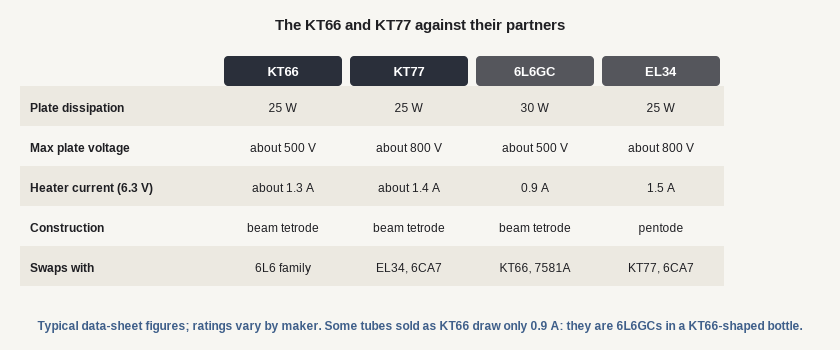
What stands out:
- Plate ratings are the same as their partners' (25 W), or close to them, so the power is similar.
- The KT77 has the EL34's high voltage rating, so it is comfortable in EL34 amps that run hot.
- The KT66 has a bigger heater than a 6L6: about 1.3 A against 0.9 A. This is the main thing to check before fitting KT66s to a 6L6 amp.
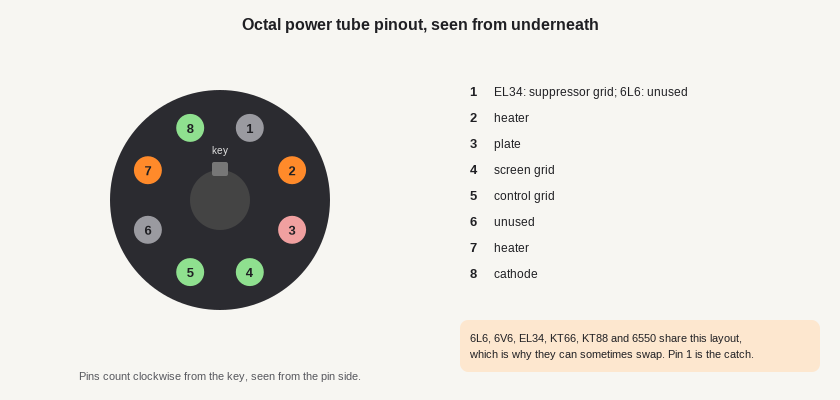
The pinout is the standard octal power tube layout:
Heater Current: the Deciding Number
Every power tube's heater runs from the power transformer's 6.3 V winding, and that winding has a limit. Changing tube type changes the load:
| Change | Extra heater current, for a quad |
|---|---|
| 6L6GC to KT66 | about 1.5 A more |
| 6L6GC to KT77 | about 2 A more |
| 6L6GC to EL34 | about 2.4 A more |
| EL34 to KT77 | about 0.4 A less |
| EL34 to KT66 | about 0.9 A less |
Moving to a tube with a smaller heater is never a problem for the transformer. Moving to a bigger one is fine only if the winding has the margin (see the Power Transformers series). A winding pushed past its rating runs hot, and the heater voltage sags.
Bias
These tubes are almost always used in fixed-bias amps, with a bias pot. The usual class AB target is 60% to 70% of the 25 W maximum plate dissipation, worked out from the plate voltage. The Tube Bias Calculator has both the KT66 and KT77 built in, and the Power (W) Calculator checks the watts from a measured voltage and current.
Rebias whenever you change between a KT tube and its partner: they draw differently, even at the same rating. Buy matched pairs or quads.
Room and Air
The KT66 especially is a tall, wide bottle. Before fitting one, check the socket spacing, the tube retainers, the height inside a combo's cabinet, and the airflow. Big tubes packed too close together run hot.
Try It
In the Tube Bias Calculator, set four EL34s at 460 V and read the target, then switch to KT77 at the same voltage. The targets match, because the ratings match: that is why the KT77 is such an easy swap in an EL34 amp.
Level 3 covers where the KT66 and KT77 shine, where they don't, swapping them in and out, and buying them.