The KT66 and KT77 are the British answers to two famous power tubes. Britain's Marconi-Osram Valve company (M-OV, part of GEC) introduced the KT66 in 1937 as a rival to RCA's 6L6, and later the KT77 as its own version of the EL34. "KT" stands for kinkless tetrode: a beam tetrode built to avoid the kink in the curves of earlier tetrodes. Both made their names in classic British hi-fi, and the KT66 went on to power Marshall's very first amps.
This series covers both, because each is best understood next to the tube it shadows. The Vacuum Tubes series covers how tubes work in general, and the 6L6GC and EL34 series cover their partners.
DANGER: LETHAL VOLTAGE. Amps using these tubes run at 400 V to 500 V and more, with filter capacitors that hold a lethal charge long after unplugging. Never reach inside one unless you know how to drain it safely. The Cap Drain & Bleeder Calculator explains how long the charge lasts.
The Pair and Their Partners
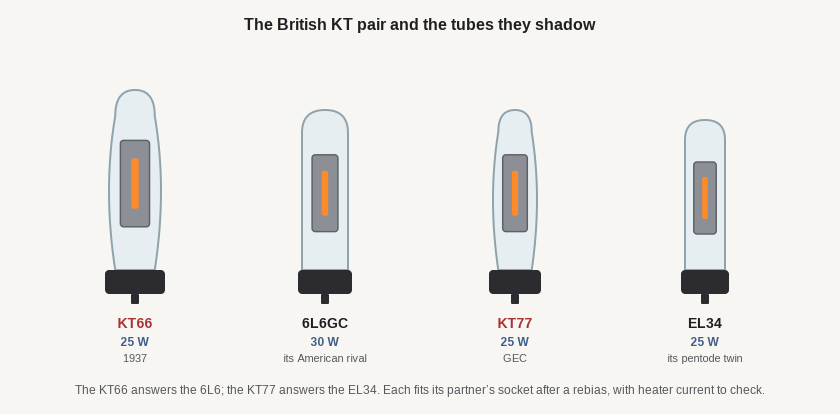
| Tube | Plate rating | Heater | Shadows | Notes |
|---|---|---|---|---|
| KT66 | 25 W | about 1.3 A | the 6L6 | a big, coke-bottle beam tetrode from 1937. It powered the Quad II hi-fi amplifier and the first Marshalls. |
| KT77 | 25 W | about 1.4 A | the EL34 | GEC's beam tetrode version of the EL34. Revived today by current makers. |
Both use the standard 8-pin octal base. The KT66 swaps with the 6L6 family, and the KT77 with the EL34 and 6CA7, after a rebias and a check of heater current and room for the bottle (Level 3 covers the details).
What They Sound Like
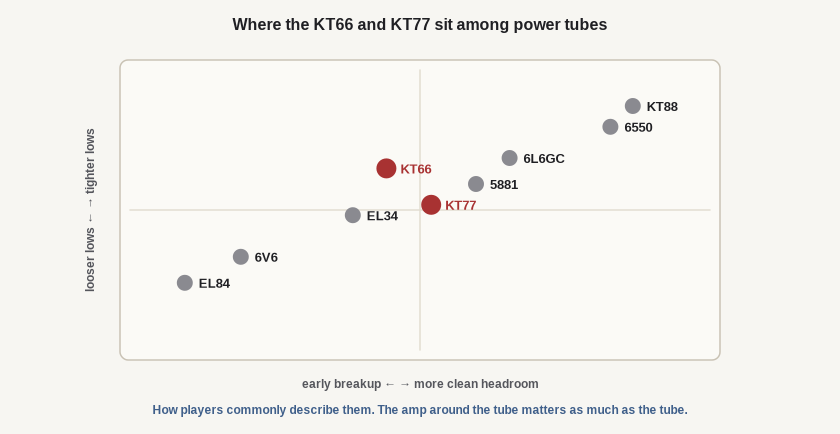
- KT66: bold and open, with a smooth midrange, a big low end and plenty of harmonic detail. Players often describe a cranked KT66 amp as thick and creamy. Next to a 6L6GC it is usually heard as fuller and smoother, with less upper-mid sparkle.
- KT77: close to the EL34, with a little more clean headroom, a fuller low end and less compression. Players often place it between an EL34 and a 6L6.
Where You've Heard Them
- KT66, the first Marshalls: Marshall's JTM45 of the early 1960s, and the 45 W combo that became known as the Bluesbreaker, used KT66s before Marshall moved to the EL34 in 1966. The earliest 100 W Super Leads used KT66s too. Eric Clapton's 1966 recordings with John Mayall's Bluesbreakers are widely believed to have been made through a KT66 Marshall combo.
- KT66, British hi-fi: the Quad II of 1952 and the LEAK amplifiers of the 1940s, among the earliest British hi-fi amps.
- KT77: British hi-fi amplifiers of the 1950s and 1960s, and today as a drop-in alternative in EL34 guitar amps.
Real and Not-So-Real KT66s
Some tubes sold as KT66 today draw only 0.9 A of heater current and behave like a 6L6GC, because that is what they are inside, in a KT66-shaped bottle. They are easy on a 6L6 amp's power transformer, but they don't sound like a true KT66. Check the heater current on the data sheet: about 1.3 A means a true KT66.
Try It
In the Tube Bias Calculator, set two KT66s at 440 V, then two 6L6GCs at the same voltage. The KT66's 25 W rating gives a lower target than the 6L6GC's 30 W, even though the KT66 is the bigger tube.
Level 2 covers how they behave in an amp: power by tube count, the numbers, and the heater current that decides most swaps.