Levels 1 and 2 covered the EL84 and how it behaves. This level is about applications: the jobs the EL84 does best and the reasons why, the jobs it is wrong for, what else fits an EL84 socket, and buying them.
Where It Shines
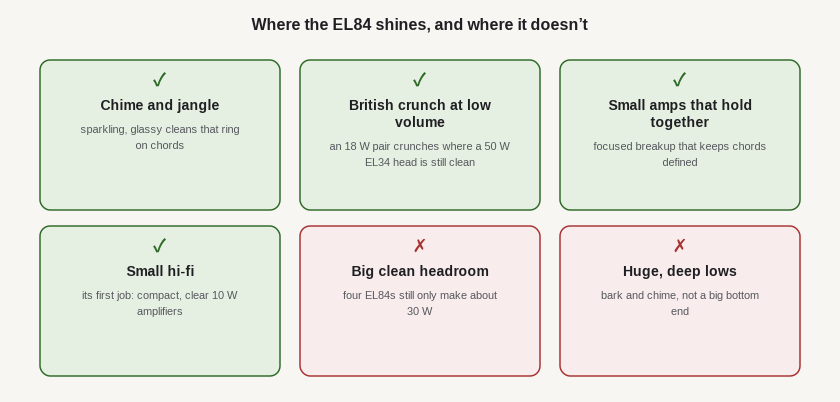
Chime and Jangle
The job: ringing, glassy chords that shimmer: 1960s British pop, jangle pop, 12-string guitar.
Why it shines: the EL84's harmonics sit in the upper midrange and highs. In a cathode-biased amp like the AC30, run just at the edge of breakup, chords ring and shimmer instead of thudding. That chime is the tube and the circuit working together.
British Crunch at Low Volume
The job: power tube crunch with a British accent, at a volume a small room can take.
Why it shines: the EL84 is the most sensitive of the common power tubes, and a pair makes only 15 W to 18 W. An 18 W EL84 amp crunches at a volume where a 50 W EL34 head would still be clean, with a similar upper-mid bark.
Small Amps That Hold Together
The job: a small amp that can be pushed into overdrive without the chords turning to mush.
Why it shines: its low end is tight and focused, so broken-up chords stay defined. Many players find an EL84 amp holds a distorted rhythm part together better than a 6V6 amp of similar size.
Small Hi-Fi
The job: a compact, clear amplifier of around 10 W for loudspeakers.
Why it shines: it is what the EL84 was designed for, and a pair in push-pull still makes a classic small hi-fi amp.
Where It Doesn't
- Big clean headroom. Even four EL84s make only about 30 W, and they break up early. For loud clean playing, a 6L6GC or KT88 amp is the right tool.
- Huge, deep lows. The EL84's character is chime and bark, not a big bottom end. For bass, or the biggest low end, look to the 6550.
- Rough handling of heat. EL84 amps that are run hot in a closed-back cabinet or a hot room wear tubes quickly (see Level 2).
What Else Fits an EL84 Socket
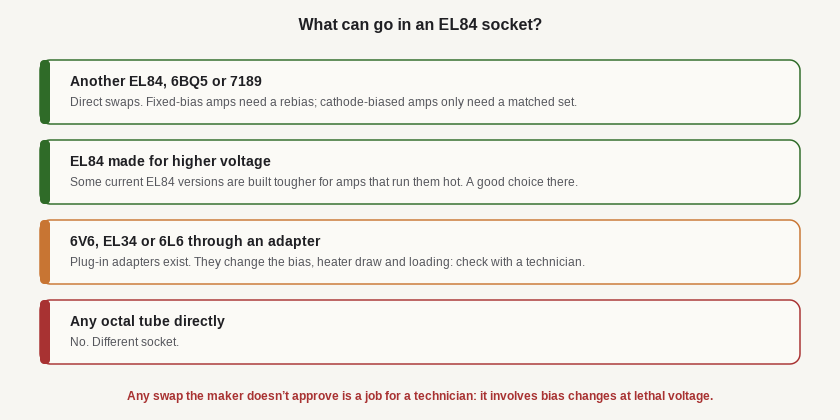
| Tube | Can it go in? | What to check |
|---|---|---|
| Another EL84 make, a 6BQ5 or a 7189 | yes | matched set for a cathode-biased amp; rebias a fixed-bias amp. A tougher version suits amps that run hot. |
| 6V6, EL34 or 6L6 through an adapter | sometimes | plug-in adapters exist. They change the heater draw, bias and loading, and a bigger tube can overload the transformers. |
| Any octal tube directly | no | different socket |
DANGER: LETHAL VOLTAGE. Fitting adapters or larger tubes can overload an amp's transformers and change its bias at lethal voltage. If the maker doesn't say a swap is supported, have a technician check the amp first.
Buying EL84s
- Current production: made in Russia, Slovakia and China under many names. Versions vary in how they handle heat and higher voltages; some are sold specifically as heavy duty.
- Matched sets: in a cathode-biased amp, where all the tubes share one cathode resistor, matching is essential. Buy matched pairs or quads, and stay with the same grade when replacing a set.
- Vintage: original British and European EL84s are prized, and fakes and used tubes sold as new exist. Ask for test data.
- Spares: EL84s in a cranked amp do fail; carry a spare matched pair to gigs.
Try It
Play a cathode-biased EL84 amp clean, then turn it up a step at a time while strumming open chords. Listen for the point where the chords start to ring and shimmer, just before they crunch: that edge is where the EL84's chime lives.