Level 1 covered the EL84 and its sound. This level is about living with it: how much power each tube count makes, why most EL84 amps are cathode biased, why they run hot, its 9-pin pinout, and the numbers.
DANGER: LETHAL VOLTAGE. EL84 amps run at around 300 V and their tubes get very hot. Bias checks are made with the amp on, at lethal voltage. If you are not trained for it, have a technician do it. Never run a tube amp without a speaker or dummy load: it can destroy the output transformer (see the Output Transformers series).
Power by Tube Count
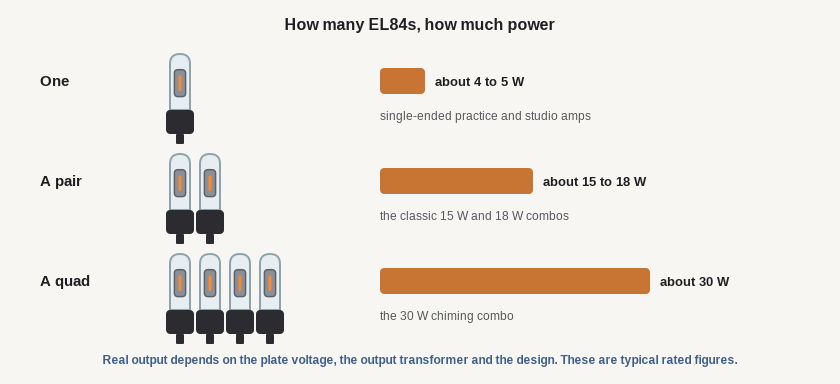
| Tubes | Typical rated power | Where |
|---|---|---|
| One, single-ended | about 4 W to 5 W | small practice and studio amps |
| A pair | about 15 W to 18 W | the classic 15 W and 18 W combos |
| A quad | about 30 W | the 30 W chiming combo, the AC30 |
A pair can make about 17 W on the data sheet; guitar amps land close to that. The AC30 was born as, in effect, a doubled AC15: same preamp, two more EL84s, twice the power.
Cathode Bias
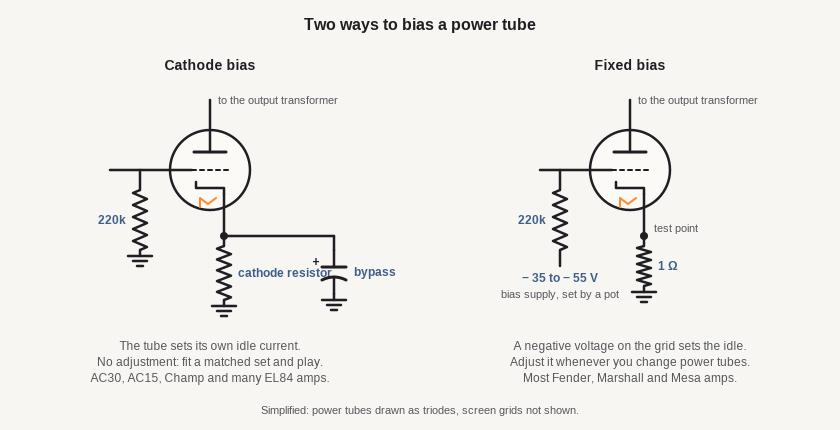
Most EL84 amps, including the AC15 and AC30, are cathode biased: the tubes share a cathode resistor and bypass cap, and set their own idle. The results:
- No bias pot. Fit a matched set and play.
- Compression and sag. As the amp is pushed, the cathode voltage rises and the bias shifts, adding the squeeze and bloom that suits the EL84's early breakup.
- Hot running. Cathode-biased tubes idle closer to their limit than fixed-bias ones. EL84 amps are known for running hot, and the heat reaches the power transformer through the heater wiring.
Some EL84 amps are fixed bias, with a bias pot. They make a little more power and sound tighter, and they need the bias checking when tubes are changed.
The 9-Pin Pinout
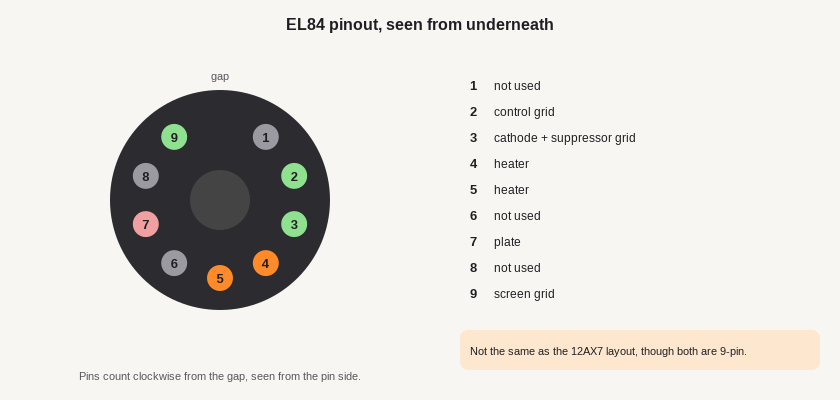
The EL84 uses a 9-pin (noval) socket like the 12AX7, but with a completely different layout. Never fit one in the other's socket.
The Numbers
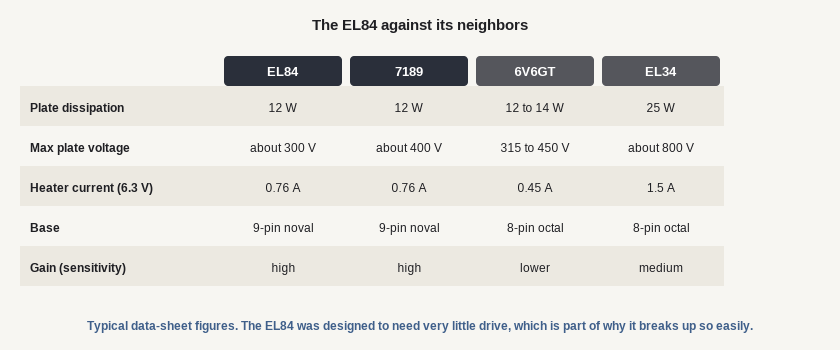
The key number is sensitivity. The EL84 was designed to need very little drive, so the phase inverter or driver can push it into overdrive easily. That is the root of its early breakup.
Running Hot and Living Long
EL84s in a cathode-biased amp turned up loud work near their limits. The maximum plate voltage is about 300 V, and some amps run them a little higher. Heat is the main enemy:
- Ventilation: keep the back of the amp open to air, and don't push a combo against a wall.
- Tougher versions: some current EL84s and the 7189 are built for higher voltages and suit amps that run them hard.
- Signs of wear: a tube that rattles, goes noisy, loses volume or red-plates. The general signs are in the Vacuum Tubes series, Level 3B.
Bias
For a cathode-biased amp, matching is everything: buy matched sets. For a fixed-bias EL84 amp, the usual class AB target is 60% to 70% of the 12 W maximum plate dissipation, worked out from the plate voltage. The Tube Bias Calculator has the EL84 built in, and the Power (W) Calculator checks the watts from a measured voltage and current.
Try It
In the Tube Bias Calculator, set four EL84s at 330 V and read the 70% target. Then imagine all four sharing one cathode resistor, as in an AC30: the tubes have to be matched, because nothing sets them individually.
Level 3 covers where the EL84 shines, where it doesn't, what else fits its socket, and buying them.