The EL84 is the small power tube of the British sound. Philips introduced it in 1953 as a 9-pin, 12 W power pentode for radios and small hi-fi amplifiers, designed with enough gain that a radio needed no separate driver tube. That same high gain made it break up easily in guitar amps, and its chiming, jangling, barking voice became the sound of the 1960s British combo amps and countless small amps since.
This series covers the EL84. The Vacuum Tubes series covers how tubes work in general, and the EL34 and 6CA7 series covers its big brother.
DANGER: LETHAL VOLTAGE. Even small EL84 amps run at around 300 V, with filter capacitors that hold a lethal charge long after unplugging. Cathode-biased EL84 amps also run hot. Never reach inside one unless you know how to drain it safely. The Cap Drain & Bleeder Calculator explains how long the charge lasts.
The EL84 and Its Relatives
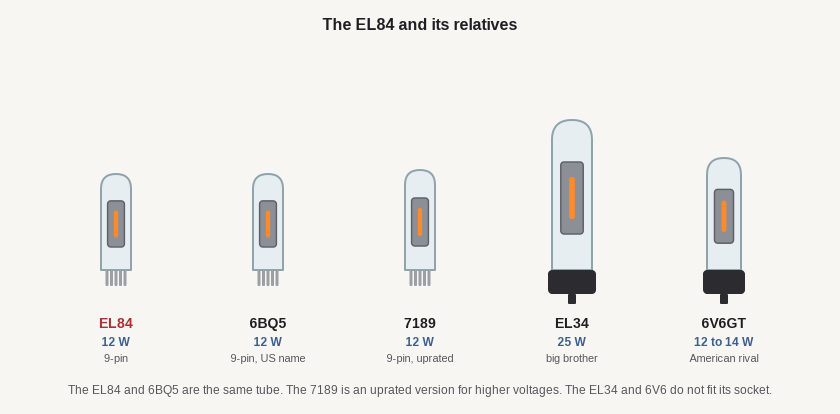
| Type | Plate rating | Notes |
|---|---|---|
| EL84 | 12 W | the European name and the standard |
| 6BQ5 | 12 W | the American name for the same tube |
| 7189 | 12 W | an uprated version for higher plate voltages |
| EL34 | 25 W | the big brother: different, larger octal tube |
| 6V6GT | 12 W to 14 W | the American rival: similar power, octal base, different sound |
The EL84 is a small 9-pin tube that draws 0.76 A of heater current. It does not share a socket with the octal power tubes, so it can only be swapped for another EL84 type without an adapter. Current production comes from Russia, Slovakia and China, under many names including revived historic brands.
What It Sounds Like
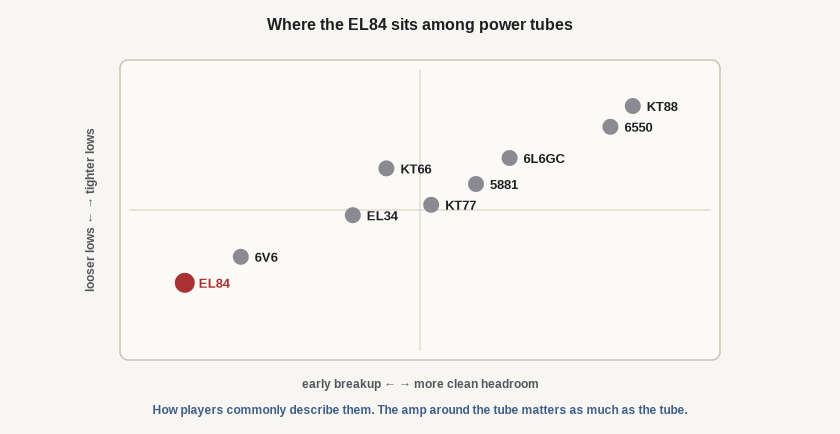
Players describe the EL84 consistently:
- Chime: glassy, shimmering highs and a ringing upper midrange, especially on clean and slightly broken-up chords.
- Breakup: the earliest of the common power tubes. It is very sensitive, so it reaches overdrive with little drive.
- Midrange: a forward upper-mid bark when pushed, a small cousin of the EL34's bite.
- Low end: tight and focused rather than big. It holds distorted chords together well.
- When cranked: a crunchy, aggressive roar that can turn harsh in some amps if pushed too far.
Where You've Heard It
- The 1960s British combos: the Vox AC15, with a pair of EL84s, and the AC30 that followed in 1960 with four. Both are cathode biased, and the AC30's chime is one of the defining sounds of 1960s British pop and rock.
- Small British-style amps since: many 15 W and 18 W amps, and small heads and combos from many British and boutique makers.
- Hi-fi: its first career, in compact 10 W hi-fi amplifiers of the 1950s and 1960s.
How It Compares to Its Neighbors
| Tube | Plate rating | In one sentence |
|---|---|---|
| EL84 | 12 W | chime, bark and the earliest breakup, in small British amps |
| 6V6 | 12 W to 14 W | the American rival: softer compression, thicker mids |
| EL34 | 25 W | the big brother: the British stack |
Try It
In the Tube Bias Calculator, pick EL84 and read the note: many EL84 amps are cathode biased and set their own idle, so there is no pot to turn. Then set four EL84s at 330 V to see the 70% target a fixed-bias EL84 amp would aim for.
Level 2 covers how the EL84 behaves in an amp: power by tube count, cathode bias, its pinout, and why EL84 amps run hot.