Levels 1 and 2 covered the EL34 and how it behaves. This level is about applications: the jobs the EL34 does best and the reasons why, the jobs it is wrong for, what else fits an EL34 socket, and buying them.
Where It Shines
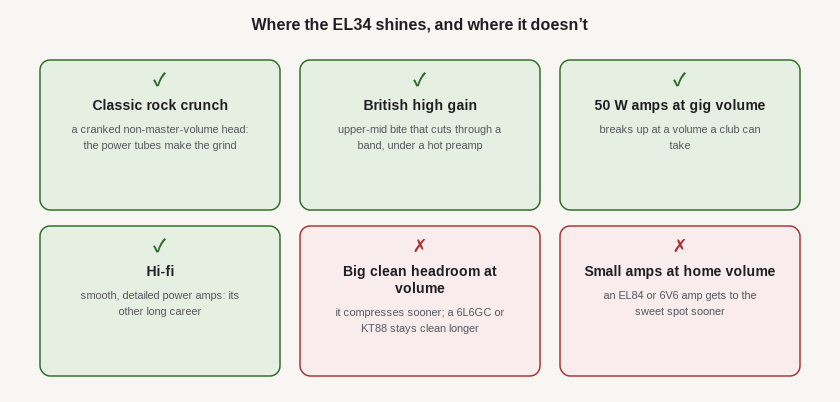
Classic Rock Crunch
The job: a non-master-volume head turned up until the power tubes distort. The late-1960s and 1970s British rock sound.
Why it shines: the EL34 starts to compress early and builds gradually, so a cranked EL34 amp has a wide, playable range between clean and roar, controlled by the guitar's volume knob and picking hand. Its upper-mid bite gives the crunch its cut. Swap 6550s into the same amp and the breakup comes later and sounds bigger but less aggressive, which is why many players disliked the 1970s US-export Marshalls.
British High Gain
The job: a hot, master-volume preamp, with a power stage that adds bite and cut rather than just volume.
Why it shines: even when the preamp makes most of the distortion, the EL34's forward upper midrange helps a high-gain sound cut through a band instead of disappearing under the bass and drums. The 1980s British master-volume heads, and many modern British-voiced high-gain amps, are built around it.
The 50 W Amp at Gig Volume
The job: an amp that breaks up at a volume a club or small hall can take.
Why it shines: a pair of EL34s makes about 50 W and starts to crunch well below full volume. A 50 W EL34 head can deliver power tube crunch at a volume where a 100 W 6L6 head would still be clean.
Hi-Fi
The job: smooth, detailed power with low distortion, driving loudspeakers.
Why it shines: the EL34 was designed for hi-fi and has stayed a favorite there, for its midrange detail and smooth character.
Where It Doesn't
- Big clean headroom at volume. For loud, clean country, jazz or pedal-platform use, a 6L6GC or KT88 amp stays clean much further. An EL34 amp will start to color the sound sooner.
- Small amps at home volume. EL34 amps are usually 50 W or more. For power tube crunch at home, an EL84 or 6V6 amp gets there sooner.
- Huge, tight lows. For bass amps and the biggest, tightest low end, the 6550 and KT88 do the job better.
What Else Fits an EL34 Socket
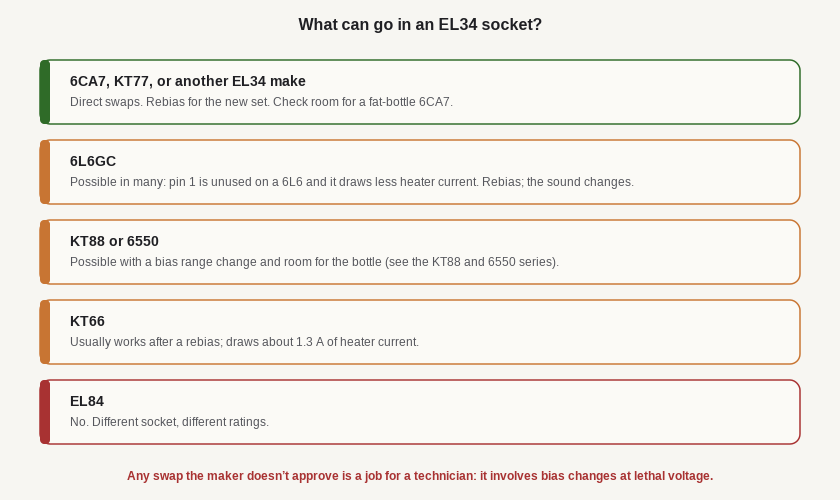
| Tube | Can it go in? | What to check |
|---|---|---|
| Another EL34 make, 6CA7 or KT77 | yes | rebias. A fat-bottle 6CA7 or KT77 needs room in the socket area. |
| 6L6GC | often | rebias. Pin 1 is unused on a 6L6 and it draws less heater current, so electrically it is usually fine. The sound changes: cleaner, fuller, less midrange. Some amps have a switch for it. |
| KT66 | usually | rebias. About 1.3 A of heater current, and room for the bottle. |
| KT88 / 6550 | sometimes, after modification | bias range and room (see the KT88 and 6550 series). Expect more headroom rather than more power. |
| EL84 | no | different socket and ratings |
DANGER: LETHAL VOLTAGE. Changing an amp's bias range or socket wiring is work at lethal voltage. If the maker doesn't say a swap is supported, have a technician check and modify the amp.
Buying EL34s
- Current production: made in Russia, Slovakia and China under many names. Different versions vary noticeably: some are smoother, some more aggressive, some sturdier for amps that run them hard.
- Stand-ins: if a particular EL34 doesn't survive your amp, a 6CA7 or KT77 is a direct swap after a rebias, often more rugged and a little cleaner.
- Matched sets: buy matched pairs or quads. Many sellers grade sets by how hard they draw; stay with the same grade when replacing a set.
- Vintage: original British and European EL34s are prized and expensive, and fakes and used tubes sold as new exist. Ask for test data.
- Spares: EL34s in a cranked amp do fail; carry a spare matched pair or the old set to gigs.
Try It
Play a 50 W EL34 amp and a 6L6 amp of similar power side by side, both with the master volume (if any) wide open, raising the volume a step at a time. Note the point where each one starts to crunch, and how wide the range is between "just breaking up" and "full roar": that difference is the EL34 in one sentence.