The EL34 is the sound of the British stack. Designed by Mullard, part of Philips, in the early to mid 1950s as a 25 W hi-fi power pentode, it became the power tube of the classic British rock amps. In a guitar amp it means a forward, biting midrange, a crunch that arrives sooner and builds more gradually than a 6L6's, and a cranked roar that defined decades of rock.
This series covers the EL34 and its stand-ins, the 6CA7 and KT77. The Vacuum Tubes series covers how tubes work in general.
DANGER: LETHAL VOLTAGE. EL34 amps commonly run at 400 V to 500 V, with filter capacitors that hold a lethal charge long after unplugging. Never reach inside one unless you know how to drain it safely. The Cap Drain & Bleeder Calculator explains how long the charge lasts.
The EL34 and Its Stand-ins
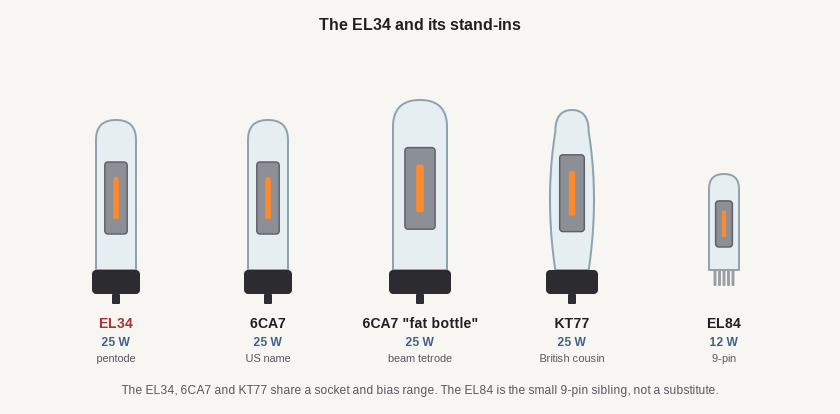
| Type | Plate rating | Notes |
|---|---|---|
| EL34 | 25 W | a true power pentode, with its suppressor grid on pin 1. The original and the standard. |
| 6CA7 | 25 W | the American name for the same tube. Most were EL34s by another name. |
| 6CA7 "fat bottle" | 25 W | an American beam tetrode version in a wider bottle, built to bias and behave like an EL34. Reissued today. |
| KT77 | 25 W | the British GEC equivalent, a beam tetrode. A direct swap in most EL34 amps. |
| EL84 | 12 W | the small 9-pin sibling, not a substitute: different socket, different amps |
All the octal types share the same base, pinout and bias range, and draw about 1.5 A of heater current. That makes them direct swaps for one another after a rebias. The EL34 is no longer made by Philips; current production comes from Russia, Slovakia and China under many names, including revived historic brands.
What It Sounds Like
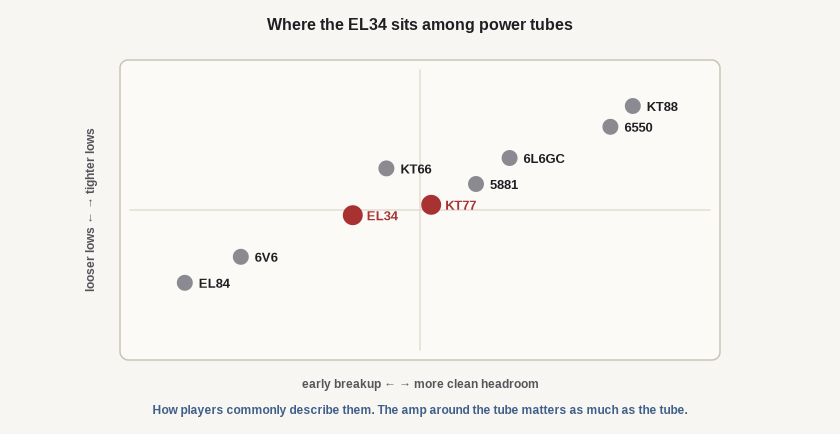
Players describe the EL34 consistently:
- Midrange: forward and biting in the upper mids, with a throaty growl lower down. It cuts through a band.
- Breakup: it starts to compress and crunch sooner than a 6L6 at the same power, and builds more gradually, with many shades of crunch on the way up.
- Cleans: good, with a bit more grit and less sparkle than a 6L6. Less clean headroom.
- Low end: tight rather than huge. Players often call it lean.
- When cranked: the classic British rock roar, rich in harmonics and sustain.
The fat-bottle 6CA7 and the KT77 are usually described as a little cleaner and fuller in the lows than an EL34: somewhere between an EL34 and a 6L6.
Where You've Heard It
- The British stack: Marshall's 100 W Super Lead appeared in 1965 with KT66s and moved to four EL34s by 1967. EL34 Marshalls became the sound of late-1960s and 1970s rock, and the JCM800 heads of the 1980s carried it on.
- Other British amps: the Hiwatt DR103, a 100 W head with four EL34s, and Orange's early amps of the 1970s are EL34 amps too.
- British-voiced high gain: many modern high-gain heads use EL34s for their midrange bite, and some let the player choose EL34 or 6L6.
- Hi-fi: the EL34 has had a long second career in tube hi-fi amplifiers.
How It Compares to Its Neighbors
| Tube | Plate rating | In one sentence |
|---|---|---|
| EL84 | 12 W | the small British tube: chime and early breakup in small amps |
| EL34 | 25 W | midrange bite and early, gradual crunch: the British stack |
| 6L6GC | 30 W | the American rival: glassier cleans, more headroom, later breakup |
| KT88 / 6550 | 35 W to 42 W | big clean power: what US-export Marshalls of the 1970s had instead |
Try It
In the Tube Bias Calculator, set four EL34s at 460 V and read the 70% target. Then switch to KT77: the same rating gives the same target, which is why they swap so easily.
Level 2 covers how the EL34 behaves in an amp: power by tube count, how it breaks up, pin 1, and bias.