Level 1 covered the EL34 and its stand-ins. This level is about living with them: how much power each tube count makes, why an EL34 breaks up the way it does, its pin 1 and heater, and bias.
DANGER: LETHAL VOLTAGE. Bias is measured with the amp on, at 400 V to 500 V. If you are not trained for it, have a technician do it. Never run a tube amp without a speaker or dummy load: it can destroy the output transformer (see the Output Transformers series).
Power by Tube Count
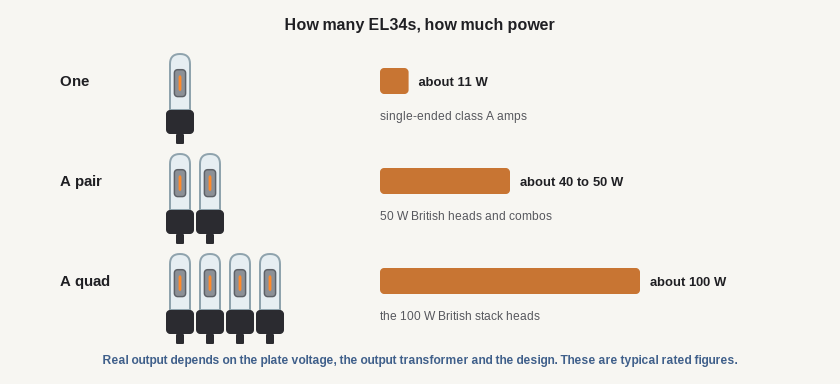
| Tubes | Typical rated power | Where |
|---|---|---|
| One | about 11 W | single-ended class A amps |
| A pair | about 40 W to 50 W | the classic 50 W British heads and combos |
| A quad | about 100 W | the 100 W British stack heads |
On paper, a pair of EL34s at very high plate voltage can make close to 100 W, but guitar amps run them more gently. How much a given amp makes depends on its plate voltage, output transformer and design.
How It Breaks Up
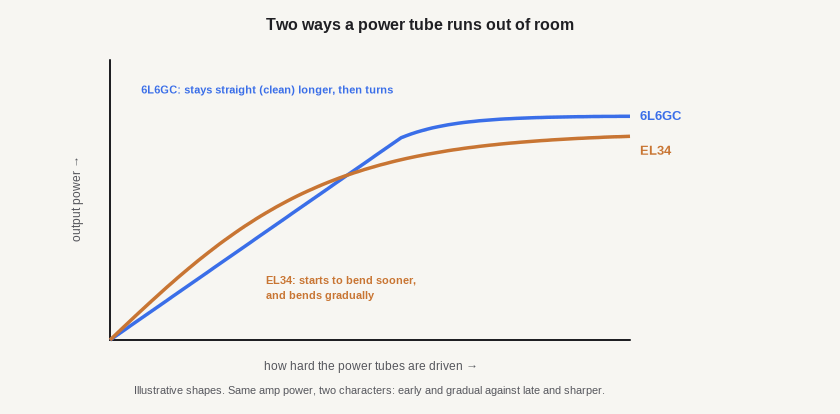
An EL34 power stage starts to compress sooner than a 6L6GC stage of the same power, and compresses more gradually. Between clean and fully cranked there is a wide range of edge-of-breakup crunch, and that range is where much of classic rock lives. Its forward upper midrange is partly the tube and partly how it interacts with the speaker: its output stage tends to fill in the midrange dip that a guitar speaker's impedance creates.
This is also why the EL34 matters most in amps where the power tubes do the distorting. In a high-gain amp with a master volume, the preamp does most of the work, and the power tube choice is subtler.
Pin 1 and the Heater
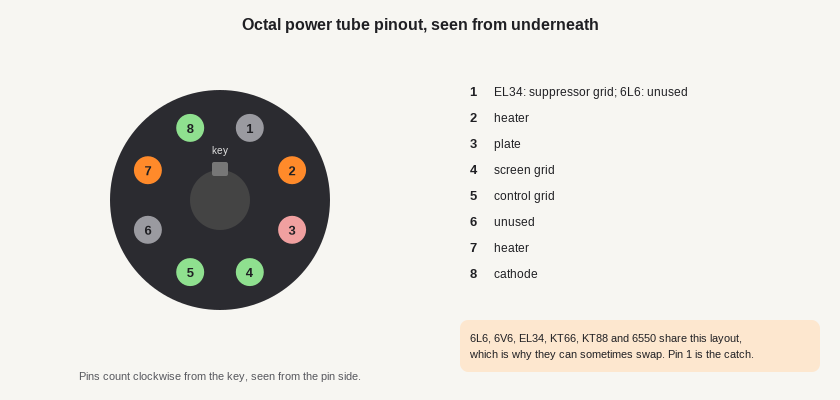
The EL34 is a true pentode, and its suppressor grid comes out on pin 1, which must be connected to the cathode (pin 8). A 6L6 leaves pin 1 unused. That one pin is the key to swapping between them:
- EL34 into an amp built for 6L6s: only safe if pin 1 is tied to the cathode or left free. Some amps use pin 1 as a tie point for other parts, which an EL34 would then connect to.
- 6L6 into an amp built for EL34s: usually fine for pin 1, since the 6L6 ignores it.
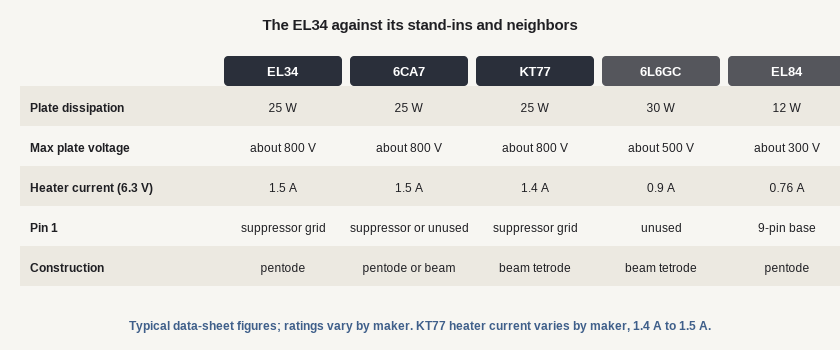
The heater draws 1.5 A, against 0.9 A for a 6L6. Four EL34s take 6 A from the power transformer's 6.3 V winding (see the Power Transformers series).
The Numbers
Bias
EL34 amps of 50 W and 100 W are almost always fixed bias, adjusted with a bias pot. The usual class AB target is 60% to 70% of the 25 W maximum plate dissipation, worked out from the plate voltage. The Tube Bias Calculator has the EL34 and KT77 built in, and the Power (W) Calculator checks the watts from a measured voltage and current.
Buy matched pairs or quads. In amps that run their EL34s hard, a set that is matched and biased correctly lasts noticeably longer.
Life
EL34s in a cranked non-master-volume head work hard and wear faster than 6L6s in a clean amp. The 1970s US-export Marshalls had 6550s fitted partly because the EL34s of the day were not surviving shipping and warranty periods. Today's EL34s are generally reliable, but a gigging amp played loud may want new ones every year or so. The general signs of wear are in the Vacuum Tubes series, Level 3B.
Try It
In the Tube Bias Calculator, set four EL34s at 460 V, then compare the 70% targets for 6L6GC and KT66 at the same voltage. Each tube type has its own target, which is why every swap needs a rebias.
Level 3 covers where the EL34 shines, where it doesn't, what else fits an EL34 socket, and buying them.