Levels 1 and 2 covered the EF86 and how it behaves. This level is about applications: where its single high-gain stage is the right choice, where it isn't, and buying them.
Where It Shines
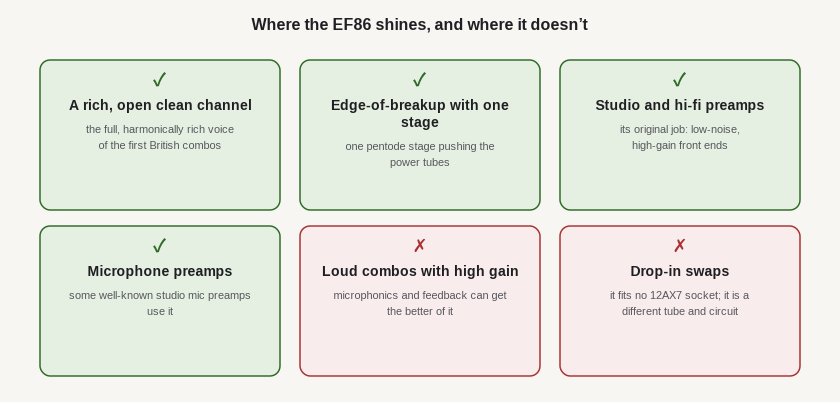
A Rich, Open Clean Channel
The job: a full, harmonically rich clean sound that fills out chords.
Why it shines: a pentode stage driven by a guitar's strong signal adds harmonics in a different way from a triode stage, giving a thicker, more open clean tone. It is the sound of the original AC15's normal channel, and of the boutique amps that offer it as a second voice.
Edge-of-Breakup With One Stage
The job: an amp that moves from clean to overdrive under the player's hands.
Why it shines: one EF86 stage can deliver enough gain to push the phase inverter and power tubes on its own. With so few stages, the amp responds directly to picking strength and the guitar's volume knob.
Studio and Hi-Fi Preamps
The job: low-noise, high-gain amplification of small signals.
Why it shines: this is what Mullard designed it for. In a well-built hi-fi or studio preamp, isolated from vibration and away from loudspeakers, its noise and microphonics are under control.
Microphone Preamps
The job: raising a microphone's tiny signal.
Why it shines: some well-known studio microphone preamps use it for its transparency and gain.
Where It Doesn't
- Loud combos with high gain. The speaker's vibration and high gain together can turn a good EF86 microphonic. This is where most EF86 complaints come from.
- Drop-in swaps. An EF86 fits no 12AX7 socket: the pinout and circuit are different. Turning a triode stage into a pentode stage is a modification, not a tube swap.
- Modern high gain. One very high-gain stage is not the same as several cascaded triode stages; the EF86 sound is about rich cleans and edge-of-breakup.
Buying EF86s
- Current production: made by a small number of factories and sold under several names. The 6267 is the same tube type.
- Grading matters more than for most tubes: buy EF86s tested and graded for low noise and low microphonics, especially for a combo.
- Vintage: original European EF86s are prized and expensive, and fakes and worn tubes are common. Ask for test data, and expect a used vintage EF86 to be noisier than a good new one.
- Spares: keep a known-good spare. Swapping it in is the quickest way to tell a noisy tube from a fault in the amp.
Try It
If your EF86 amp is a combo and the channel rings at high volume, try a damping ring on the tube, then move the amp so the speaker isn't facing a hard wall. If the ring persists, try your spare tube. One of the three usually solves it.