The EF86 is the odd one out among guitar amp preamp tubes. Where almost every amp uses dual triodes like the 12AX7, the EF86 is a single small-signal pentode: one stage per bottle, with extra grids that give it far more gain than a triode. Mullard designed it in the 1950s as a low-noise, high-gain front-end tube for hi-fi and recording equipment. In guitar amps it is best known for the rich, open clean channel of the original Vox AC15 of 1957, and for the boutique amps that revived that sound.
This series covers the EF86. The 12AX7 series covers the dual triodes it competes with, and the Vacuum Tubes series covers how tubes work in general.
DANGER: LETHAL VOLTAGE. The EF86's socket carries high voltage whenever the amp is on, and the amp's filter capacitors hold a lethal charge after unplugging. Change tubes with the amp off and unplugged, and never reach into the chassis. The Cap Drain & Bleeder Calculator explains why.
One Pentode Against Two Triodes
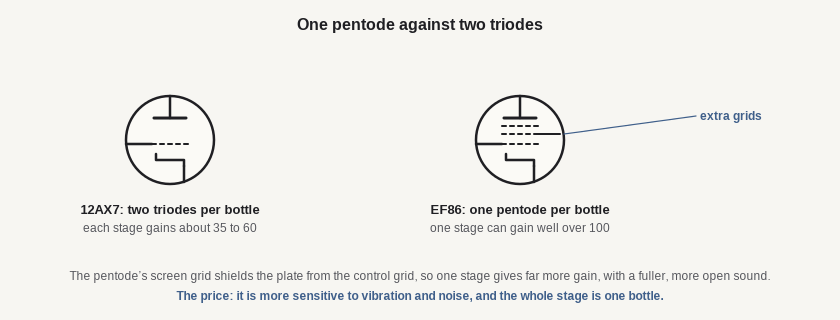
| 12AX7 | EF86 | |
|---|---|---|
| Type | two triodes | one pentode |
| Stages per bottle | two | one |
| Gain per stage | about 35 to 60 in a typical guitar amp | well over 100 is common |
| Heater | 300 mA at 6.3 V | 200 mA at 6.3 V |
| Socket | 9-pin | 9-pin, but a different pinout |
| Also sold as | ECC83, 7025 | 6267 (industrial version) |
The EF86's screen grid sits between the control grid and the plate and shields one from the other. That is what lets a single pentode stage give so much more gain than a triode. It also has an internal shield, connected through its base, and a pinout of its own: an EF86 and a 12AX7 never swap.
What It Sounds Like
Players describe an EF86 channel as full, harmonically rich and open, with a lively, touch-sensitive feel. Because one stage provides so much gain, an EF86 channel can push the power tubes into breakup with a single preamp stage, and the overdrive it produces has a character all its own: different from the chime of a triode-driven top-boost channel.
Where You've Heard It
- The original Vox AC15 of 1957, whose normal channel used an EF86, and briefly the first AC30s. Vox later replaced the pentode front end with triodes, partly because the EF86 proved troublesome in the more powerful, more vibrating AC30.
- Boutique amps that revived the sound, often as a second channel beside a triode channel.
- Hi-fi and studio gear: phono and line preamps, and some well-known studio microphone preamps.
Try It
If you have the chance, compare an EF86 channel and a triode channel on the same amp, at the same volume, with the same guitar. Listen to how much each fills out a clean chord, and how each starts to break up.
Level 2 covers how the EF86 works in a guitar amp, and the microphonics that come with its gain.