Level 1 covered what the EF86 is and why it gains so much. This level is about how it works in a guitar amp, the price of all that gain, and how to live with it.
DANGER: LETHAL VOLTAGE. Working on a pentode stage means working inside the chassis, at lethal voltage. Drain the filter caps and check with a meter first. The Cap Drain & Bleeder Calculator shows how.
The Pentode Stage
An EF86 stage looks much like a triode gain stage, with two additions: the screen grid needs its own supply, through a high-value resistor and a bypass capacitor, and the extra grid nearest the plate, the suppressor, is tied to the cathode. The plate load resistor is usually much larger than a triode's, and the stage's gain depends heavily on it and on the screen voltage.
The circuits in the first British combos were close to those in tube makers' application notes, which were written for microphones, record players and tape heads. A guitar puts out far more signal than those, so the stage runs with a great deal of gain and is driven hard: much of the EF86 sound comes from that.
Gain Has a Price
All that gain in one stage, right at the start of the amp, brings three problems:
- Microphonics. Any vibration of the tube's internal parts becomes a signal, and the stage amplifies it. In a loud combo, with the speaker inches away, a microphonic EF86 can ring or squeal.
- Noise. The first stage's hiss is amplified by everything after it, and an EF86 stage amplifies its own hiss more than a triode stage does.
- No second half. A 12AX7 holds two stages; an EF86 holds one. A bad EF86 takes the whole channel with it.
These are the reasons Vox moved away from the EF86 in the AC30, and why many later designs place a pentode stage where the signal is already larger, or isolate it carefully.
Taming It
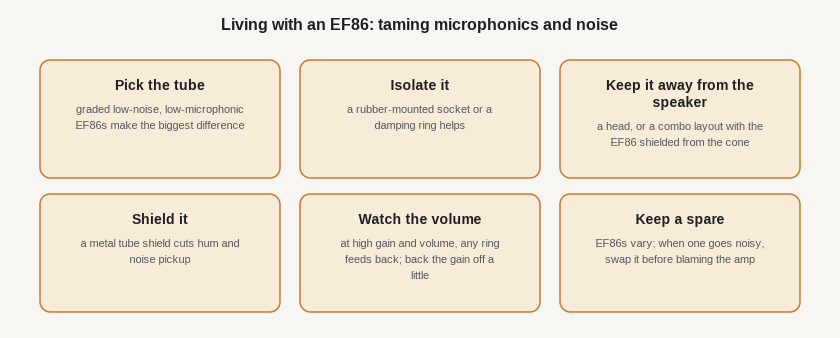
- Pick the tube. EF86s vary widely. Graded low-noise, low-microphonic tubes make the biggest difference.
- Isolate it. A rubber-mounted socket, or a damping ring on the tube, helps.
- Keep it away from the speaker. A head and separate cabinet, or a combo layout that keeps the EF86 out of the speaker's direct blast, avoids most trouble.
- Shield it. A metal tube shield cuts hum and noise pickup.
- Watch the volume. At high gain and volume, any ring feeds back. Backing the channel volume off a little often cures it.
- Keep a spare. When an EF86 goes noisy, swap it before suspecting the amp.
Bias and Life
Like other preamp tubes, an EF86 biases itself through its cathode resistor, so swapping tubes needs no adjustment. It works gently and can last for years, but it is more likely than a 12AX7 to develop noise or microphonics with age.
Try It
With an EF86 amp idling at normal volume and the channel turned up, tap the EF86 gently with a pencil eraser. A faint tick is normal; a ringing tone that sustains or feeds back means a microphonic tube.
Level 3 covers where the EF86 shines, where it doesn't, and buying them.