This level is the reference: every way a capacitor's value gets printed, tolerance and voltage codes, series and parallel, ripple and stored energy, how long electrolytics last, and how to test, buy and substitute a cap.
Every Way a Value Gets Printed
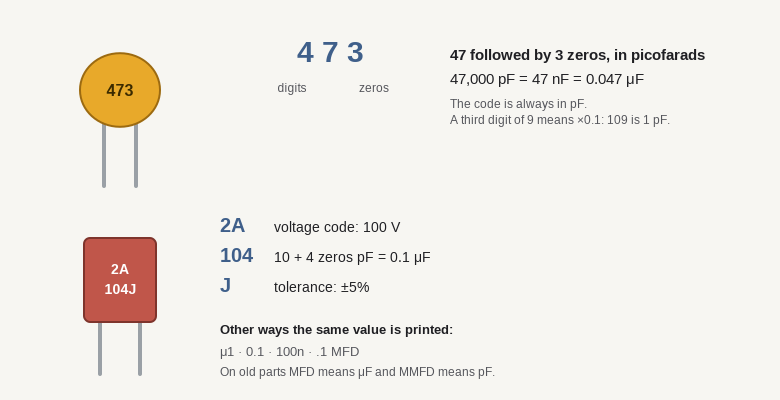
The three-digit code is always in picofarads: two digits, then the number of zeros. 222 is 2,200 pF (2.2 nF), 334 is 330,000 pF (0.33 μF). A third digit of 9 means ×0.1, so 109 is 1 pF and 479 is 4.7 pF.
The letter as decimal point is the European style, the same idea as 4k7 on a resistor:
| Marking | Value |
|---|---|
| 4p7 | 4.7 pF |
| 4n7 | 4.7 nF |
| 47n | 47 nF |
| μ1 or u1 | 0.1 μF |
| μ47 | 0.47 μF |
| 2μ2 | 2.2 μF |
A number with no unit follows a rule of thumb: a decimal below 1, like .047, means μF; a whole number on a small ceramic or mica cap, like 47 or 250, means pF. On older parts MFD means μF and MMFD means pF.
Tolerance Letters
| Letter | Tolerance | Where you see it |
|---|---|---|
| B, C, D | ±0.1, ±0.25, ±0.5 pF | very small ceramics, where a percentage makes no sense |
| F | ±1% | precision film |
| G | ±2% | precision film, mica |
| J | ±5% | film, silver mica, C0G ceramic |
| K | ±10% | film, ceramic |
| M | ±20% | electrolytics, general ceramics |
| Z | +80%, −20% | old high-K ceramic discs |
Electrolytics are loose, usually ±20%. That is fine for filtering, where more is rarely worse. For tone and timing caps, use J or K film.
Voltage Codes
Small film and ceramic caps often print the rating as a digit and a letter:
| Code | Volts | Code | Volts |
|---|---|---|---|
| 0J | 6.3 V | 2A | 100 V |
| 1A | 10 V | 2D | 200 V |
| 1C | 16 V | 2E | 250 V |
| 1E | 25 V | 2G | 400 V |
| 1V | 35 V | 2W | 450 V |
| 1H | 50 V | 2J | 630 V |
How much margin: rate a cap at least 20 to 25% above the highest voltage it will see. In a tube amp, measure that voltage, don't trust the schematic. With a solid-state rectifier, the supply can sit well above its normal voltage for the first seconds after power-on, before the tubes warm up and draw current, so filter caps must be rated for that peak.
Ceramic Temperature Codes
| Code | Behavior | Use |
|---|---|---|
| C0G (NP0) | barely changes with temperature or voltage | signal path, timing, small filter caps |
| X7R | changes about ±15% over its temperature range, and drops further with DC voltage | power supply bypass |
| Y5V, Z5U | can lose more than half its value with heat or voltage | bypass only, and better avoided |
Series and Parallel
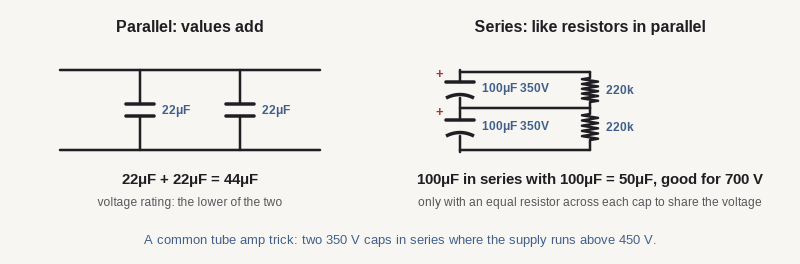
Capacitors combine the opposite way to resistors:
- Parallel: values add. C = C1 + C2. The voltage rating is the lower of the two.
- Series: 1 ÷ C = 1 ÷ C1 + 1 ÷ C2. Two equal caps make half the value. Voltage ratings add, but only if the voltage is shared evenly.
Electrolytics never share voltage evenly on their own, because each one leaks a slightly different amount. When a tube amp stacks two 350 V filter caps for a supply above 450 V, an equal resistor goes across each cap to force an even split. 220k is a common choice; it also drains the caps after power-off. The Capacitance (µF) Calculator works out series and parallel totals and the missing cap for a target value.
Ripple
A full-wave rectifier refills the first filter cap 120 times a second on 60 Hz mains (100 on 50 Hz). Between refills, the circuit drains it, and the voltage sags. That sag is ripple, heard as hum. A rough figure:
Ripple (volts, peak to peak) ≈ I ÷ (f × C)
where I is the current drawn and f is 120 or 100. A tube amp drawing 100 mA from a 47 μF first filter cap on 60 Hz mains has about 0.1 ÷ (120 × 0.000047) ≈ 18 V of ripple at that cap. That is why amps follow the first cap with a choke or resistor and more caps: each stage cuts the ripple again before it reaches the preamp. Doubling the cap halves the ripple.
A tube rectifier limits how big the first filter cap can be. Fitting a much larger one than the rectifier's maximum overloads it at switch-on. Check the rectifier tube's data before increasing that cap.
Stored Energy and Draining
The energy in a charged cap is:
E = ½ × C × V²
| Cap | Voltage | Energy |
|---|---|---|
| 100 μF pedal filter cap | 9 V | 0.004 J |
| 47 μF amp filter cap | 450 V | 4.8 J |
Voltage is squared, so the amp cap holds over a thousand times more. What makes it dangerous is the voltage, which can drive current through your body, and the energy behind it.
A bleeder resistor drains a cap with a time constant τ = R × C. After 5 time constants the cap is below 1% of its starting voltage. A 220k bleeder across 47 μF has τ ≈ 10 seconds, so the cap falls from 450 V to about 3 V in under a minute. With no bleeder, or a broken one, a filter cap can hold its charge for days.
The bleeder burns power all the time the amp is on: 450 V across 220k is about 0.9 W, so use a 2 W or larger resistor. The Cap Drain & Bleeder Calculator works out the drain time, the resistor value and its power.
DANGER: LETHAL VOLTAGE. Treat every filter cap in a tube amp as charged until your meter says otherwise. Unplug the amp, drain the caps through a resistor (never a bare screwdriver), and measure across each cap on DC volts before you touch anything.
How Long Electrolytics Last
An electrolytic's life is rated in hours at its maximum temperature, for example 2,000 hours at 105°C. Life roughly doubles for every 10°C cooler it runs, so a cap that sits well below its rating lasts many years. Heat is what ages them, and tube amps run hot.
As they age, electrolytics dry out: the value drops and their internal resistance (ESR) rises. Amp filter caps are often replaced after 20 to 30 years, or sooner if the amp hums, sags or has bulging or leaking caps. An amp that has sat unused for years may need its old caps brought up slowly on a variable transformer, or simply replaced.
Film, mica and C0G ceramic caps do not wear out the same way and rarely need replacing, with one exception: old paper and wax coupling caps in vintage amps often leak DC.
Testing
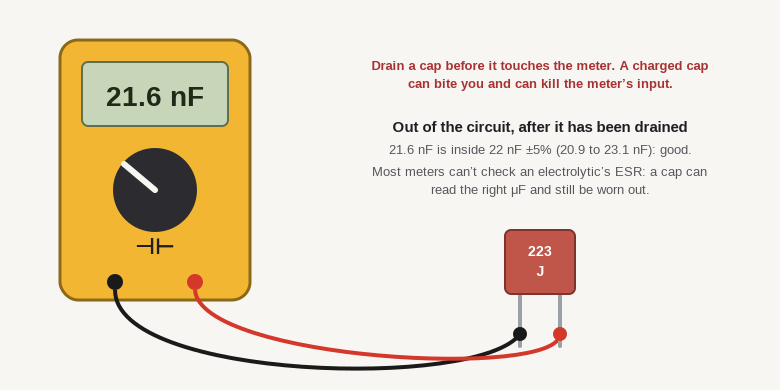
- Drain it first. A charged cap can hurt you and can damage the meter.
- Look. A domed or bulging top, crusty residue or a split sleeve on an electrolytic means replace it, whatever it measures.
- Measure the value. Lift one leg, or take it out, and use the meter's capacitance setting. It should fall inside its tolerance: a 22 nF ±5% cap should read 20.9 to 23.1 nF.
- Check ESR on electrolytics. An ESR meter shows whether an electrolytic is worn out even when its value still reads correctly, and it usually works with the cap still in the circuit.
- Check a tube amp's coupling caps for leakage. With the amp running, measure DC volts on the grid side of each coupling cap. It should read at or near 0 V. A few volts or more means the cap is leaking DC into the next tube and upsetting its bias. Replace it. This is a live measurement inside a powered amp, at lethal voltage: clip the meter's black lead to the chassis first, keep one hand away from the amp, or leave it to a tech.
Buying and Substituting
| Replacing | Match | Can change |
|---|---|---|
| Any cap | the value, within tolerance | a higher voltage rating is always fine, if it fits |
| An electrolytic | polarity, and at least the same voltage | a 105°C part in place of an 85°C one; a modestly larger value in a pedal's power filter |
| An amp filter cap | voltage with margin; size limits on the first cap after a tube rectifier | can, radial or axial style, as long as it mounts securely |
| An amp coupling cap | value and voltage (400 V or 630 V) | polypropylene film in place of old paper |
| A tone or coupling cap in a pedal | value and lead spacing (2.5, 5 or 7.5 mm are common) | polyester or polypropylene film |
| A guitar tone cap | value | any film or ceramic type: in a passive tone circuit, the value matters far more than the type |
Buy electrolytics from a known distributor. Counterfeit caps with inflated ratings are common on marketplace sites and fail early.
Try It
In Build a Circuit, measure a few capacitors one at a time with the LCR Meter on Capacitance (it reads a single part, not a network). Then use the Capacitance (µF) Calculator to work out what two of them make in series and in parallel.