Level 1 covered spotting and reading a capacitor. This level is about what it does once it is in the circuit: the jobs capacitors do in pedals, amps and guitars, how a cap and a resistor make a filter, and which type belongs where.
The One Idea: a Cap's Resistance Depends on Frequency
A capacitor blocks DC completely. To AC it acts like a resistor whose value drops as the frequency rises. That frequency-dependent resistance is called reactance:
Xc = 1 ÷ (2π × f × C)
A 0.022 μF cap is about 7,200 Ω at 1 kHz, but about 72,000 Ω at 100 Hz. So it passes treble far more easily than bass, and passes nothing at all at DC. Every job below comes from that.
The Jobs Capacitors Do
Coupling
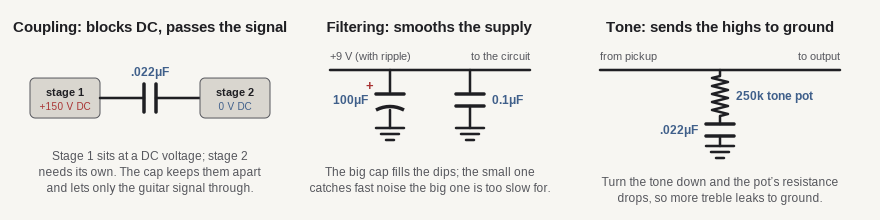
Each stage in an amp or pedal sits at its own DC voltage. A preamp tube's plate might sit at 150 V, while the next tube's grid needs to sit at 0 V. A coupling cap between them blocks the DC and passes the signal. In a tube amp, coupling caps carry the full plate voltage on one side, so they need a high voltage rating (400 V or 630 V film caps are normal). In a pedal, the input and output caps keep the circuit's DC away from your guitar and the next pedal.
Power Supply Filtering
A power supply's DC is never perfectly smooth. Filter caps across the supply fill in the dips, the way a water tower keeps the pressure steady while demand comes and goes. In a pedal, a 47 μF or 100 μF electrolytic across the power jack is typical, often with a 0.1 μF ceramic beside it to catch fast noise the big cap is too slow for. In a tube amp, filter caps of 20 μF to 100 μF at 450 V or more smooth the high-voltage supply. Tired filter caps are a classic cause of hum.
Tone
A guitar tone control is a pot and a cap going to ground. Turning the tone down lowers the pot's resistance, so more treble leaks through the cap to ground and the sound gets darker. The cap's value sets which frequencies go first:
- 0.022 μF is the classic value in humbucker guitars.
- 0.047 μF is common in single coil guitars and cuts lower, so the tone goes darker sooner.
- A bigger cap does not make the guitar duller with the tone on full. It only changes what happens as you turn it down.
Amp tone stacks work the same way, with several caps from a few hundred pF to 0.1 μF setting where bass, middle and treble act.
Bypass Caps on Tube Cathodes
A cathode resistor sets a tube's bias, but it also lowers the stage's gain. A big electrolytic across it, the cathode bypass cap, puts the gain back. A 25 μF cap brings back all the frequencies; a small one, like 0.68 μF, brings back only the upper ones, so the stage gets brighter as well as louder.
Bright Caps
A small cap, often around 100 to 500 pF, connected across an amp's volume pot lets treble skip past the pot. It has the most effect at low volume settings, which is what a bright switch switches in.
A Cap and a Resistor Make a Filter
Put a resistor and a capacitor together and you get a filter. Which way round they go decides what it does:
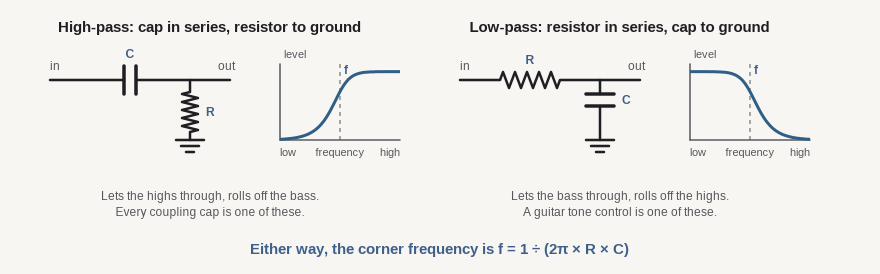
- Cap in series, resistor to ground: high-pass. Treble through, bass rolled off. Every coupling cap plus the input resistance after it is one of these.
- Resistor in series, cap to ground: low-pass. Bass through, treble rolled off. Tone controls and the small filter caps in fuzz and overdrive pedals are these.
The corner frequency, where the filter starts to bite, is:
f = 1 ÷ (2π × R × C)
Two examples worth working through:
| Circuit | R | C | Corner | What it means |
|---|---|---|---|---|
| Tube amp coupling cap into a 1M grid resistor | 1M | 0.022 μF | about 7 Hz | far below any note: the full signal passes |
| Pedal input cap into a 10k input | 10k | 0.01 μF | about 1.6 kHz | a huge bass cut: the pedal sounds thin |
The second is a common reason a homemade pedal sounds weak. The same cap into a higher input resistance, or a bigger cap into the same input, fixes it. Coupling caps are usually sized to put the corner well below the low E string (about 82 Hz), unless the designer wants to trim bass on purpose, which is common in overdrive pedals.
Choosing a Type
| Job | Use | Why |
|---|---|---|
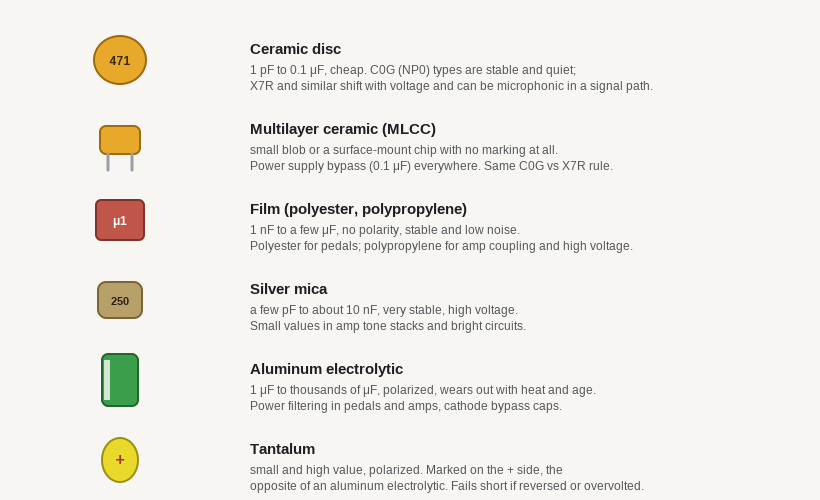
| Small values in the signal path (pF to a few nF) | C0G (NP0) ceramic or silver mica | stable, quiet, not microphonic |
| Tone, coupling and timing in pedals (1 nF to 1 μF) | polyester film | stable, cheap, no polarity |
| Coupling caps in tube amps | polypropylene film, 400 V or 630 V | handles the voltage, very low loss |
| Supply bypass next to a chip or transistor | 0.1 μF multilayer ceramic | small and fast |
| Power filtering, cathode bypass | aluminum electrolytic, 105°C rated | big values in a small can |
| Big values where space is tight | tantalum, with care | small, but fails short if reversed or overvolted |
Ceramics marked X7R, Y5V or Z5U change value with voltage and temperature and can pick up vibration like a microphone. They are fine for power supply bypass but not for tone or coupling in the signal path.
The Old Two-Prong Amp Cap
Many old amps with a two-prong power cord have a ground switch with a capacitor from the mains to the chassis. If that cap fails, the chassis, and your strings, can become live. It is often called the death cap for good reason. Have a qualified tech remove it and fit a three-prong grounded cord.
DANGER: LETHAL VOLTAGE. Filter caps in a tube amp store enough energy to kill, and they can keep it for minutes or days after the amp is off. Never reach into a chassis until the caps are drained and checked with a meter. The Cap Drain & Bleeder Calculator works out how long a bleeder takes and what resistor to use.
Common Mistakes
- An electrolytic in backwards. It gets hot, bulges and can burst. The stripe is negative.
- Too low a voltage rating. A 50 V film cap as an amp coupling cap will fail. Check the rating against the voltage on both sides.
- Mixing up units. 0.22 μF is ten times 0.022 μF. One slipped zero changes the sound completely.
- A high-K ceramic in a tone circuit. It works, but it can be noisy and microphonic. Use film.
- Leaving 40-year-old electrolytics in an amp. They dry out. Hum, weak bass and sagging are the signs, and old filter caps can fail suddenly.
Try It
In Build a Circuit, wire a resistor to a capacitor that goes to the battery's minus, then open Circuit Math: it shows the RC pair's time constant and corner frequency. Change the cap's value and open Circuit Math again to watch the corner move. To combine caps for a value you don't have, use the Capacitance (µF) Calculator.
Level 3 covers the numbers: every marking code, tolerance and voltage codes, series and parallel, ripple, stored energy, lifespan, and how to test and replace a capacitor.