A capacitor stores a small electric charge and lets it go again. That one trick does three big jobs in guitar gear: it blocks DC while letting the guitar signal through, it smooths a power supply into steady DC, and, paired with a resistor, it decides which frequencies get through. Tone controls, coupling between stages and the hum-free power in a pedal all come down to capacitors.
Back to the water picture from the Resistors series: a capacitor is a rubber sheet stretched across the pipe. Water can push the sheet back and forth, so a wave gets through, but no water flows straight past it. A steady push (DC) stretches the sheet once and then stops. A back-and-forth push (AC, like a guitar signal) keeps moving.
How to Spot One
Inside every capacitor are two conductors with a thin insulator between them. The outside varies a lot, but three shapes cover most of what you will meet:
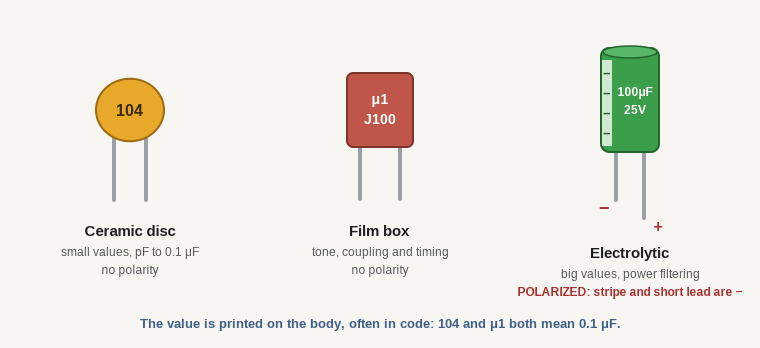
- Ceramic discs are small, round and usually orange or tan. Small values.
- Film caps are boxes or dipped drops, often red, yellow, orange or blue. Middle values, used for tone and coupling.
- Electrolytics are cans with a sleeve and a printed stripe. Big values, used for power.
Ceramic and film caps work either way round. Electrolytics are polarized: they have a positive and a negative lead, and they must go in the right way round. The stripe on the sleeve marks the negative lead, and on a new part the negative lead is the shorter one.
Fitted backwards, an electrolytic heats up, bulges and can burst. Check the stripe against the board or schematic before you solder.
The Units
Capacitance is measured in farads (F), but a whole farad is huge. Guitar gear uses three much smaller units, each 1,000 times the one before:
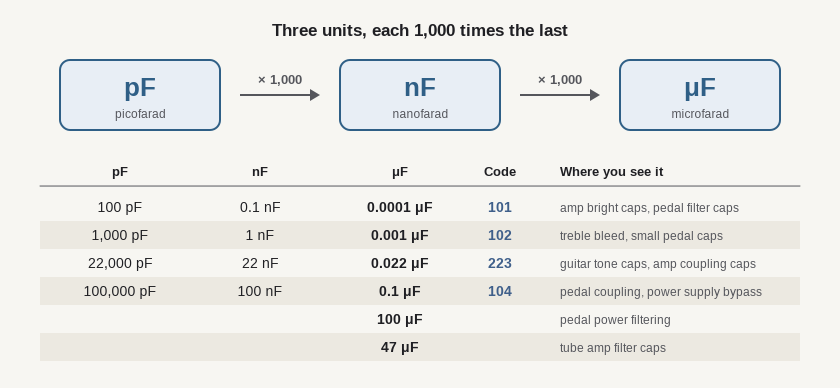
- pF, picofarad: the smallest. Bright caps, small filter caps.
- nF, nanofarad: 1,000 pF. Tone caps, treble bleeds, pedal coupling caps.
- μF, microfarad: 1,000 nF. Power filtering. Also written uF, because not every keyboard has a μ.
The same part can be written three ways. A guitar tone cap might be labeled 0.022 μF, 22 nF or 22,000 pF on three different schematics, and all three are the same cap. When values look strange, convert them before you assume a mistake.
Reading the Markings
Bigger caps print the value plainly: 47μF 450V on an amp filter cap, 100μF 25V on a pedal cap.
Small caps use a three-digit code, in picofarads: the first two digits are the value, the third is how many zeros to add.
| Code | Means | Value | Where it turns up |
|---|---|---|---|
| 101 | 10 and one zero | 100 pF | amp bright caps, pedal filter caps |
| 102 | 10 and two zeros | 1 nF | treble bleed networks |
| 223 | 22 and three zeros | 22 nF (0.022 μF) | guitar tone caps, amp coupling caps |
| 473 | 47 and three zeros | 47 nF (0.047 μF) | tone caps in many single coil guitars |
| 104 | 10 and four zeros | 100 nF (0.1 μF) | pedal coupling, supply bypass |
A letter after the code is the tolerance: J is ±5%, K is ±10%, M is ±20%. Level 3 covers every marking, including voltage codes and the European style where μ1 means 0.1 μF and 4n7 means 4.7 nF.
The Voltage Rating
Every capacitor has a voltage it can safely hold, and electrolytics and film caps print it on the body. Run a cap above its rating and the insulator inside breaks down. Always fit a cap rated above the highest voltage it will see:
- In a 9 V pedal, 16 V or 25 V electrolytics are typical.
- In a tube amp, filter caps are rated 450 V or 500 V, and coupling caps 400 V or 630 V.
A higher rating than needed is always fine. A lower one is not.
On a Schematic
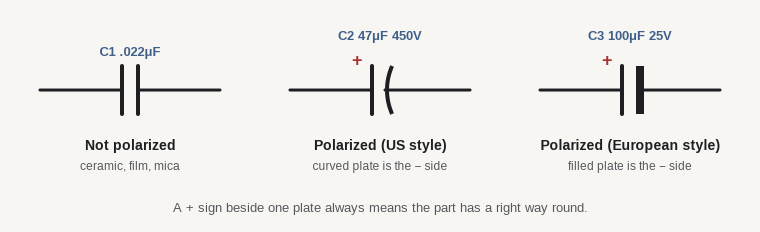
Two parallel lines is a capacitor. If one plate is curved or filled in, or there is a + beside it, the part is polarized and the + side faces the higher voltage. Caps are numbered C1, C2 and so on.
Where You Find Them
| In a... | What the capacitors are doing |
|---|---|
| Pedal | coupling caps at the input and output and between stages, tone and filter caps that shape the sound, and a big electrolytic across the power jack to smooth the supply |
| Tube amp | filter caps that turn rectified AC into smooth high-voltage DC, coupling caps between stages, cathode bypass caps that add gain, tone stack caps, and a bright cap on some volume controls |
| Guitar | the tone cap on the tone pot, and sometimes a treble bleed cap on the volume pot |
| Speaker cab | usually none in a guitar cab. Hi-fi speakers use them in crossovers |
DANGER: LETHAL VOLTAGE. A tube amp's filter caps can hold a deadly charge long after it is unplugged. Before you touch anything inside, unplug it, drain the caps and check them with a meter. The Cap Drain & Bleeder Calculator shows how.
Try It
In Build a Circuit, drop a Capacitor on the breadboard and give it a value. It understands .1uF, 100n, 47pF and 4.7u, and the Inspector shows how it read your value. Then set the LCR Meter to Capacitance and measure it.
Level 2 covers what capacitors do in a circuit: coupling, filtering, tone, and how to choose between film, ceramic and electrolytic.