Levels 1 and 2 covered the 6V6 and how it behaves. This level is about applications: the jobs the 6V6 does best and the reasons why, the jobs it is wrong for, what else fits a 6V6 socket, and buying them.
Where It Shines
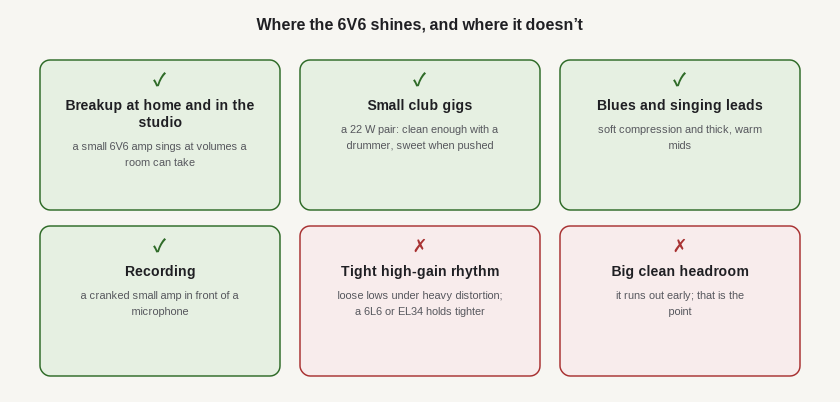
Breakup at Home and in the Studio
The job: real power tube overdrive at a volume a living room or a studio can take.
Why it shines: with a 12 W to 14 W plate and amps of 5 W to 22 W, a 6V6 power stage reaches its sweet spot without the volume of a big amp. The power tubes themselves compress and warm up, which is a different, more responsive feel than distortion from a pedal into a clean amp.
Small Club Gigs
The job: an amp that keeps up with a drummer in a small room, stays mostly clean at moderate volume, and breaks up sweetly when pushed.
Why it shines: a fixed-bias pair making about 22 W, like the Deluxe Reverb, sits right at the edge: enough clean volume for a small stage, and natural breakup when turned up or hit with a boost. That balance has made it a favorite of working players for decades.
Blues and Singing Leads
The job: a warm, compressed lead tone that sustains and responds to the volume knob.
Why it shines: soft, early compression and thick mids. The 6V6's overdrive is rich in the middle rather than glassy or gritty, which suits expressive single-note playing.
Recording
The job: a cranked small amp in front of a microphone.
Why it shines: a small 6V6 amp can be turned up to its sweet spot without overwhelming the room or bleeding into every other microphone. The Princeton Reverb's place among the most recorded amps comes from exactly that.
Where It Doesn't
- Tight high-gain rhythm. A 6V6 power stage gets loose in the lows under heavy distortion. For tight, fast, low-tuned riffs, a 6L6GC or EL34 power stage holds together better.
- Big clean headroom. A 6V6 amp runs out of clean room early. That's the point of it, but it is the wrong choice for loud, clean country or jazz.
- Big stages without miking. Even 22 W isn't enough to fill a large venue on its own. Miking a small amp is the usual answer.
What Else Fits a 6V6 Socket
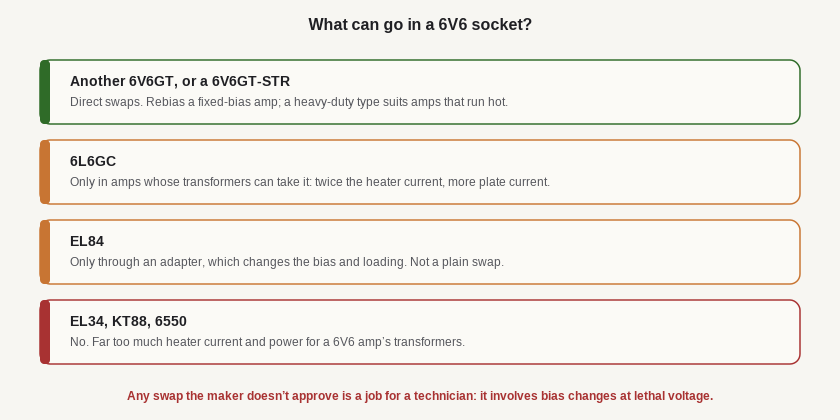
| Tube | Can it go in? | What to check |
|---|---|---|
| Another 6V6GT make, or a heavy-duty 6V6 | yes | rebias a fixed-bias amp. A heavy-duty type suits amps that run hot. |
| 6L6GC | only in amps that can take it | it draws twice the heater current (0.9 A against 0.45 A) and more plate current. Some amps are built with enough margin; many are not. |
| EL84 | only through an adapter | adapters exist, but they change the bias and loading |
| EL34, KT88, 6550 | no | far too much heater current and power for a 6V6 amp's transformers |
DANGER: LETHAL VOLTAGE. Changing an amp's bias or fitting a larger tube than it was built for is work at lethal voltage, and it can overload the transformers. If the maker doesn't say a swap is supported, have a technician check the amp first.
Buying 6V6s
- Current production: made in Russia, Slovakia and China under many names. They vary more than most types in how well they handle high plate voltage, so check the rating before fitting them to a hot-running amp.
- Heavy-duty versions: for fixed-bias amps that run at 400 V or more, a 6V6 sold as heavy duty or STR is the safer choice.
- Matched pairs: always buy matched pairs. In a cathode-biased amp, the pair shares one cathode resistor, so matching matters as much there as in a fixed-bias amp.
- Vintage: original American 6V6s are prized and expensive, and fakes and used tubes sold as new exist. Ask for test data.
- Spares: keep the old pair as a spare when you replace one.
Try It
Play a small 6V6 amp with its volume at the point where it just starts to break up. Then roll your guitar's volume knob back to about 7: a 6V6 amp should clean up smoothly. That response to the volume knob is the soft compression this series describes.