Level 1 covered the 6V6 family and its sound. This level is about living with it: how much power each arrangement makes, why cathode bias and fixed bias sound different, the voltage question, and the numbers.
DANGER: LETHAL VOLTAGE. Bias is measured with the amp on, at lethal voltage. If you are not trained for it, have a technician do it. Never run a tube amp without a speaker or dummy load: it can destroy the output transformer (see the Output Transformers series).
Power by Arrangement
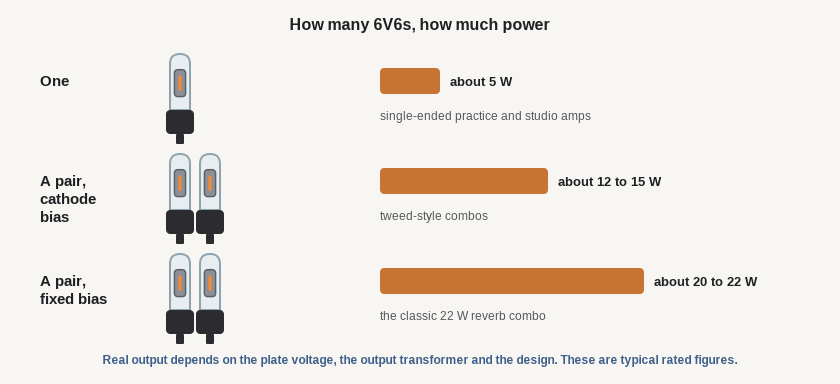
| Arrangement | Typical rated power | Where |
|---|---|---|
| One, single-ended | about 5 W | practice and studio amps like the Champ |
| A pair, cathode bias | about 12 W to 15 W | tweed-style combos like the 1950s Deluxe |
| A pair, fixed bias | about 20 W to 22 W | the classic 22 W reverb combo |
The same two tubes can make quite different power. The Princeton Reverb and Deluxe Reverb both use a pair of 6V6s, but the Deluxe makes about 22 W against the Princeton's 12 W or so, thanks to bigger transformers, higher plate voltage and a more efficient phase inverter.
Cathode Bias and Fixed Bias
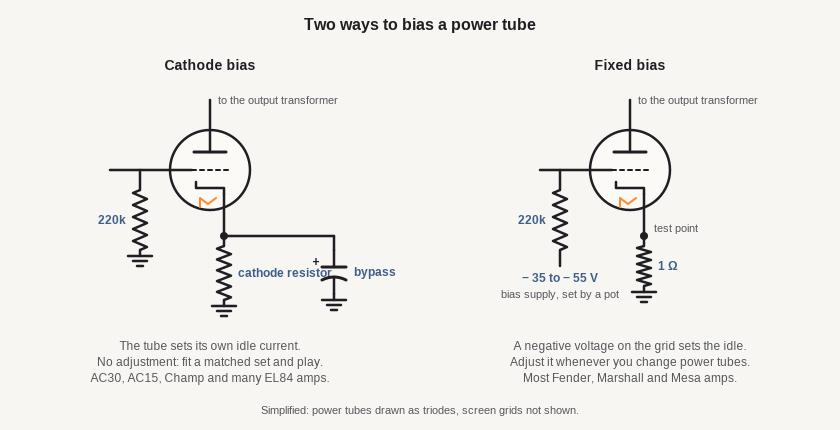
6V6 amps come both ways, and the difference is audible:
- Cathode bias (the tweed Deluxe and many small amps): the tubes set their own idle through a shared cathode resistor. As the amp is pushed, the bias shifts, adding compression and sag. Combined with no negative feedback, as in the tweed Deluxe, it gives the raw, early, very responsive overdrive tweed fans love. No bias adjustment: just fit a matched pair.
- Fixed bias (the blackface Deluxe Reverb and Princeton Reverb): a negative grid voltage sets the idle. More power and headroom from the same tubes, a tighter sound, and the bias should be checked when the tubes change.
The Voltage Question
The original 6V6 data sheets gave a 315 V maximum plate voltage, but amps like the Deluxe Reverb run their 6V6s at around 400 V or more. Good 6V6s handle it, but weaker ones can run hot, arc or fail early in those amps. For a fixed-bias Fender-style amp that runs hot, choose a 6V6 built for it, often sold as heavy-duty or STR, and bias it within its 14 W rating.
The Numbers
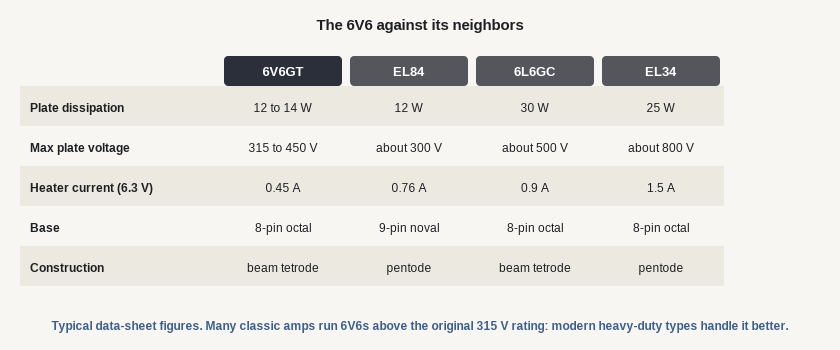
The 6V6 uses the standard octal power tube pinout, with pin 1 unused:
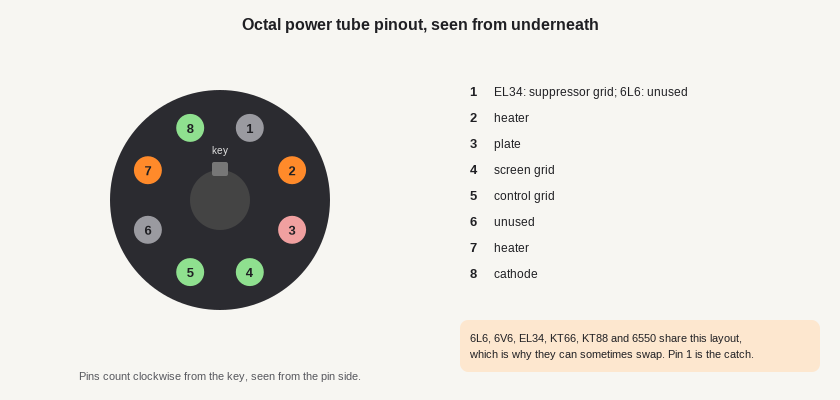
Bias
For fixed-bias amps, the usual class AB target is 60% to 70% of the tube's maximum plate dissipation: use 14 W for a modern 6V6GT, or 12 W if the tube's rating is unknown. The Tube Bias Calculator has the 6V6 built in, and its notes cover cathode-biased amps, which need no adjustment. The Power (W) Calculator checks the watts from a measured voltage and current.
Life
In a small amp played at home, 6V6s last a long time. In a Deluxe Reverb pushed hard every night, they work near their limits and wear faster. A pair that sounds thin, won't break up the way it used to, or hums more is worn. The general signs are in the Vacuum Tubes series, Level 3B.
Try It
In the Tube Bias Calculator, set two 6V6s and compare the 70% targets at 350 V and 420 V. The target current falls as the voltage rises: in an amp that runs its 6V6s hot, they must idle colder to stay within their rating.
Level 3 covers where the 6V6 shines, where it doesn't, what else fits its socket, and buying them.