The 6V6 is the 6L6's little brother: a scaled-down version that appeared in the late 1930s, with half the heater current and about half the power. It became the power tube of the small American amp, the practice amps, studio amps and small combos that break up at volumes a room can take. In a guitar amp it means soft, warm compression, thick mids, and an overdrive that sings for blues and lead playing.
This series covers the 6V6 family. The Vacuum Tubes series covers how tubes work in general, and the 6L6GC and 5881 series covers its big brother.
DANGER: LETHAL VOLTAGE. Even small 6V6 amps run at 300 V to 450 V, with filter capacitors that hold a lethal charge long after unplugging. Never reach inside one unless you know how to drain it safely. The Cap Drain & Bleeder Calculator explains how long the charge lasts.
The Family
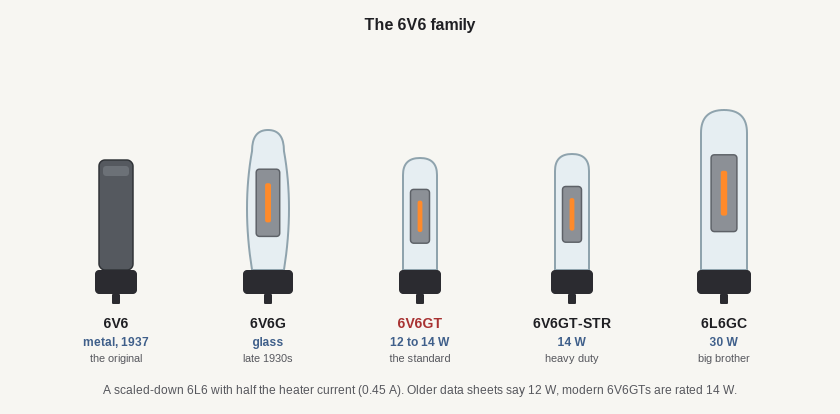
| Type | Plate rating | Notes |
|---|---|---|
| 6V6G and 6V6 | 12 W | the late-1930s originals, glass and metal |
| 6V6GT | 12 W on older data sheets, 14 W on modern ones | the standard type, in a smaller straight bottle |
| 6V6GT-STR and other heavy-duty types | 14 W | modern versions built for the higher plate voltages many amps run |
| 6L6GC | 30 W | the big brother, for comparison |
Every 6V6 uses the same 8-pin octal base and pinout as the 6L6 and draws 0.45 A of heater current. The original data sheets gave a maximum plate voltage of 315 V, but many classic amps run their 6V6s well above that. That is why the tougher modern versions matter, and why weaker 6V6s once had a reputation for failing.
What It Sounds Like
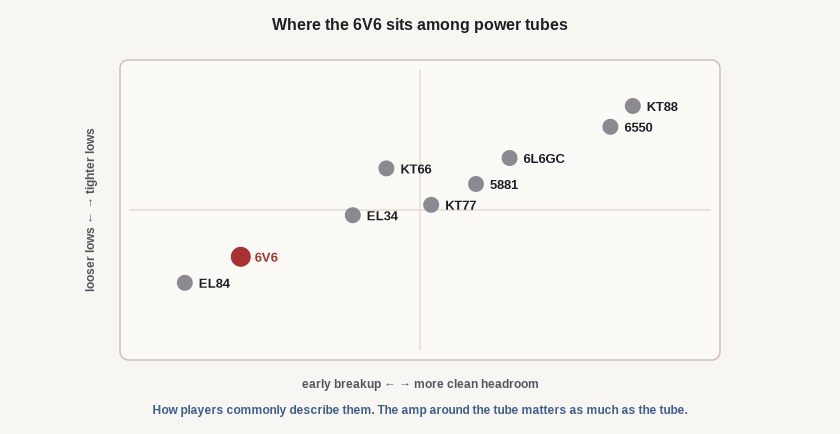
Players describe the 6V6 consistently:
- Breakup: early and soft. A 6V6 amp starts to compress and warm up at modest volume, then overdrives smoothly.
- Mids: thick and warm, with an overdrive that is rich in the middle rather than glassy on top.
- Cleans: balanced and open, with a touch of sparkle, at lower volumes.
- Low end: round and a little loose, especially under heavy distortion.
- When cranked: a singing, compressed lead tone that responds to the guitar's volume knob and picking hand.
Where You've Heard It
- Small Fender amps: the single-ended Champ (one 6V6, about 5 W), the Princeton Reverb (a pair, about 12 W), the Deluxe Reverb (a pair, about 22 W) and the tweed Deluxe of the 1950s (a pair in cathode bias, about 12 W to 15 W). The Princeton Reverb is one of the most recorded amps there is.
- Studio recordings: a small 6V6 amp turned up in front of a microphone is a recording classic.
- Many boutique small amps built on those Fender circuits, and some small British-style amps too.
How It Compares to Its Neighbors
| Tube | Plate rating | In one sentence |
|---|---|---|
| EL84 | 12 W | the small British rival: chimier, barkier, a little tighter |
| 6V6 | 12 W to 14 W | soft, warm compression and thick mids in small amps |
| 6L6GC | 30 W | the big brother: bigger cleans and far more headroom |
Try It
In the Tube Bias Calculator, set two 6V6s at 410 V and read the 70% target, then two 6L6GCs at the same voltage. The 6V6's target is less than half: that small ceiling is why it breaks up so early.
Level 2 covers how the 6V6 behaves in an amp: power by tube count, cathode and fixed bias, and the voltage question.