Levels 1 and 2 covered the 6L6 family and how it behaves. This level is about applications: the jobs the 6L6GC does best and the reasons why, the jobs it is wrong for, what else fits a 6L6 socket, and buying them.
Where It Shines
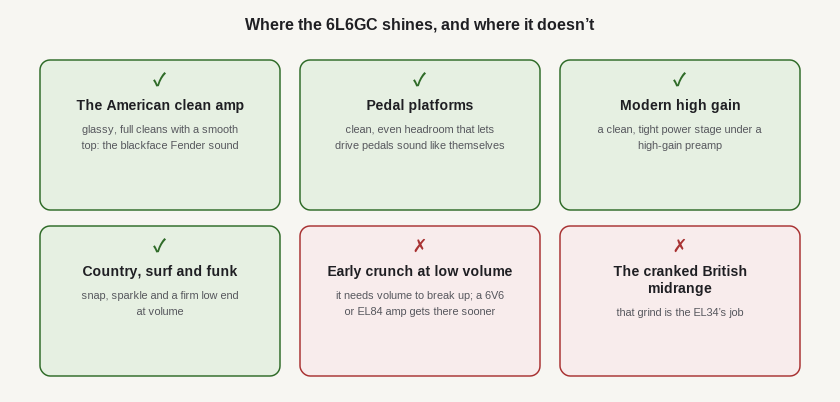
The American Clean Amp
The job: big, glassy, full clean tones at stage volume, with reverb and tremolo. The blackface Fender sound.
Why it shines: a 6L6GC power stage stays linear a long way up the volume knob, so the amp can be loud and clean at once. Its full low end and sparkle on top suit the scooped voicing of these amps, and its later, smoother breakup means that when it does overdrive, it does so warmly rather than harshly.
Pedal Platforms
The job: an amp that stays clean and lets overdrive, fuzz and modulation pedals do the coloring.
Why it shines: clean headroom and an even response. A 6L6 amp at gig volume passes a drive pedal's sound through without piling its own distortion on top, so the pedal sounds like the pedal.
Modern High Gain
The job: a preamp that makes huge distortion, and a power stage that has to stay tight and clear under it.
Why it shines: the same clean headroom and firm low end. A power stage that isn't itself distorting keeps fast riffs and low palm mutes defined. Many famous high-gain heads use four or six 6L6GCs, and some let the player choose between 6L6 and EL34.
Country, Surf, Funk and Clean Jazz
The job: snap, sparkle and a firm low end at volume: chicken picking, reverb-soaked surf, clean funk rhythm, warm jazz.
Why it shines: a 6L6 amp keeps the attack of each note intact at volume, and its glassy top end flatters single-coil pickups.
The Tweed Sound (5881)
The job: a smaller, rawer, earlier-breaking American sound.
Why the 5881 shines there: its lower ratings and earlier compression suit lower-voltage tweed-style circuits, where many players hear it as the more authentic tube.
Where It Doesn't
- Early crunch at low volume. A 6L6 amp needs volume before its power stage contributes anything. For crunch at home, a 6V6 or EL84 amp gets there sooner.
- The cranked British midrange. The upper-mid grind of a cranked British head comes largely from the EL34. A 6L6 in that role is cleaner, fuller and less aggressive.
- Maximum clean power. If even a 6L6 amp breaks up too early for you, a KT88 or 6550 amp goes further (see the KT88 and 6550 series).
What Else Fits a 6L6GC Socket
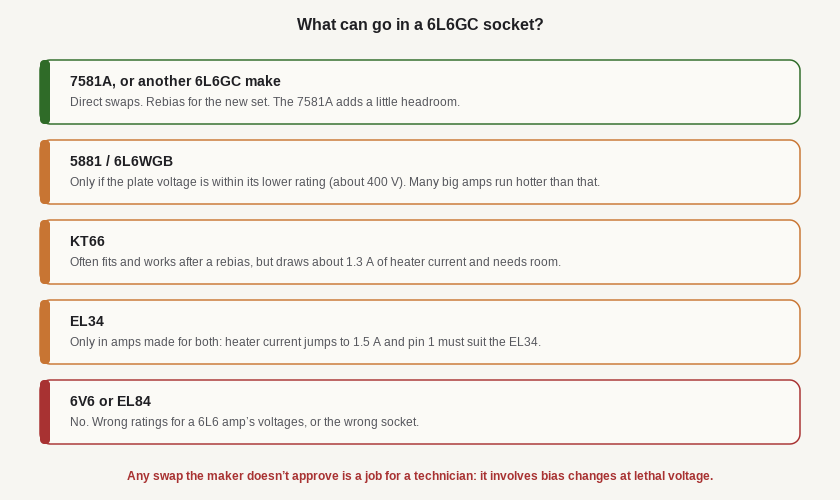
| Tube | Can it go in? | What to check |
|---|---|---|
| Another 6L6GC make, or a 7581A | yes | rebias. A 7581A adds a little headroom. |
| 5881 / 6L6WGB | sometimes | only if the plate voltage is within its lower rating (see Level 2) |
| KT66 | often | rebias, room for the bigger bottle, and about 1.3 A of heater current each against 0.9 A |
| EL34 | only in amps made for it | heater current rises to 1.5 A each, and pin 1 must suit the EL34's suppressor grid. Some amps have a switch for this. |
| KT88 / 6550 | sometimes, after modification | heater current, bias range and room (see the KT88 and 6550 series) |
| 6V6 | no, unless the maker says so | its ratings are far below a 6L6 amp's voltages |
DANGER: LETHAL VOLTAGE. Changing an amp's bias range or socket wiring is work at lethal voltage. If the maker doesn't say a swap is supported, have a technician check and modify the amp.
Buying 6L6GCs
- Current production: made in Russia, Slovakia and China under many names. Each version has its own character; some are sold specifically as 6L6GC-STR or similar heavy-duty types.
- Read the rating: 30 W for a 6L6GC, 23 W for a true 5881, 35 W for a 7581A. Some tubes sold as 5881 are really 6L6GC-rated.
- Matched sets: buy matched pairs or quads. Many sellers grade sets by how hard they draw; stay with the same grade when replacing a set.
- Vintage: original American 6L6GCs and 5881s are prized and expensive, and fakes and used tubes sold as new are common. Ask for test data.
- Spares: keep the old set as a spare when you replace one.
Try It
Put a drive pedal in front of the cleanest amp you can play, first at bedroom volume and then at gig volume. With a 6L6 amp, the pedal's sound should stay much the same as the volume rises: that is the clean headroom at work.