Level 1 covered the 6L6 family and its sound. This level is about living with it: how much power each tube count makes, how a 6L6 breaks up compared with an EL34, the numbers that matter, and the catch with fitting 5881s.
DANGER: LETHAL VOLTAGE. Bias is measured with the amp on, at 400 V to 500 V. If you are not trained for it, have a technician do it. Never run a tube amp without a speaker or dummy load: it can destroy the output transformer (see the Output Transformers series).
Power by Tube Count
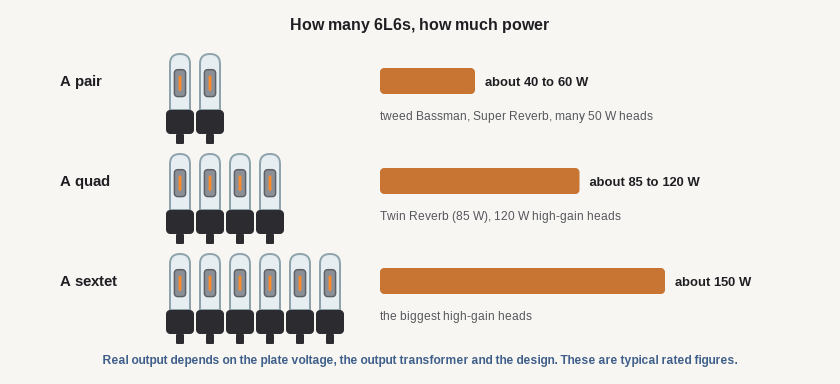
| Tubes | Typical rated power | Where |
|---|---|---|
| One | about 10 W to 15 W | single-ended amps |
| A pair | about 40 W to 60 W | the tweed Bassman (about 40 W), Super Reverb-style combos, 50 W heads |
| A quad | about 85 W to 120 W | the Twin Reverb (85 W), 100 W and 120 W heads |
| A sextet | about 150 W | the biggest high-gain heads |
How much a given amp makes depends on its plate voltage, output transformer and design. Fender's early Twin went from two 6L6s and 25 W to four 5881s and 80 W in 1957.
How It Breaks Up
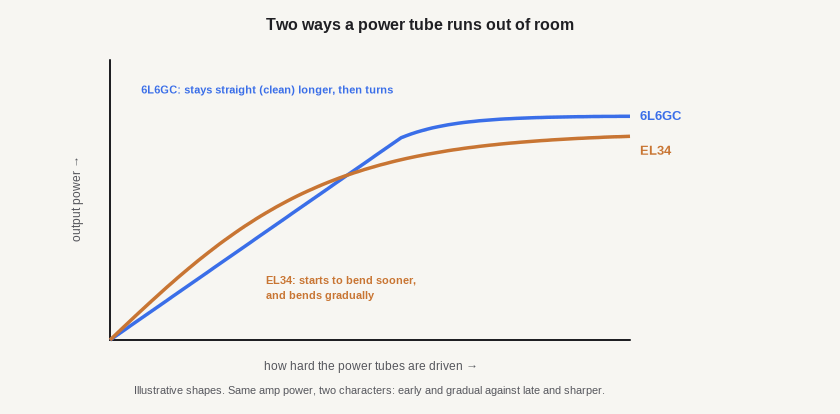
A 6L6GC power stage stays clean and linear further up the volume knob than an EL34 stage of the same power, then turns into overdrive more abruptly. An EL34 starts to bend sooner and compresses more gradually, which gives it more shades of crunch on the way up. That difference, more than raw power, is the root of the "American clean, British crunch" description.
In a high-gain amp the preamp makes the distortion and the power stage is meant to stay clean, which is exactly what a 6L6GC does well. That is why so many high-gain heads use them.
The Numbers
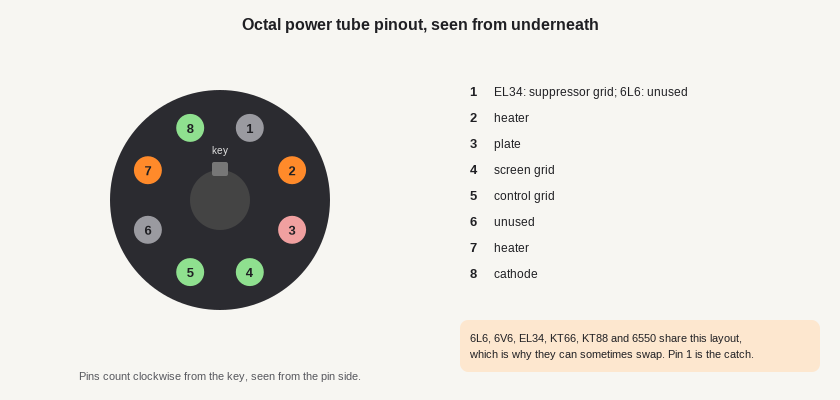
The pinout is the standard octal power tube layout. Pin 1 is unused on the 6L6 family, which matters when swapping with EL34s:
The 5881 Voltage Catch
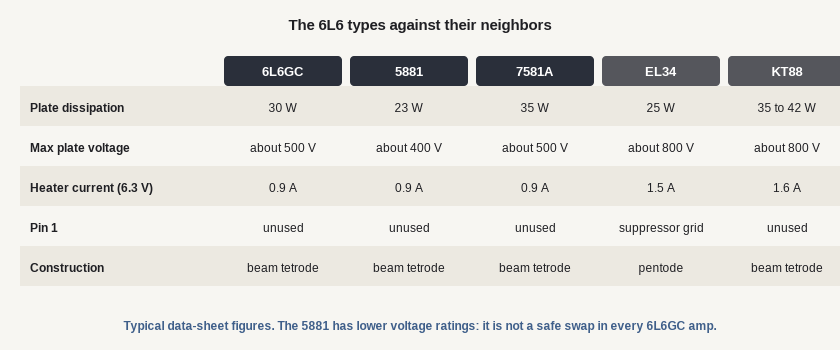
The 5881 and the 6L6GC fit the same socket and bias similarly, but the 5881 is rated for a lower plate voltage (about 400 V against 500 V) and less plate dissipation (23 W against 30 W). In an amp that runs its 6L6GCs at 450 V or more, a 5881 is over its ratings: it may run hot, arc or fail early.
- Safe: amps whose plate voltage sits around 400 V or below, such as tweed-style circuits. Many players prefer the 5881's slightly earlier, more compressed breakup there.
- Not safe: big, high-voltage amps built around 6L6GCs. Check the plate voltage first, or ask a technician.
Some tubes sold as "5881" today are really 6L6GC-rated designs and others are true 23 W types. Check the maker's rating.
Bias
Most 6L6 amps above about 20 W are fixed bias, with a bias pot; smaller ones are often cathode biased. The usual class AB target is 60% to 70% of maximum plate dissipation, worked out from the plate voltage. Bias for the tube you actually have: 30 W for a 6L6GC, 23 W for a true 5881, 35 W for a 7581A. The Tube Bias Calculator has the 6L6GC and 5881 built in, and the Power (W) Calculator checks the watts from a measured voltage and current.
Buy matched pairs or quads, so both sides of the output transformer draw the same current.
Life
6L6GCs are tough tubes. In an amp played loud every night, expect to replace them every year or two; at home they last much longer. A set that starts to sound thin, hums more, or won't hold its bias is worn. The general signs are in the Vacuum Tubes series, Level 3B.
Try It
In the Tube Bias Calculator, set four 6L6GC tubes at 460 V and note the 70% target. Switch to 5881: the target drops, and the calculator's note says to bias it for its own, lower rating.
Level 3 covers where the 6L6GC shines, where it doesn't, what else fits a 6L6 socket, and buying them.