The 6L6 is the oldest power tube still in everyday use, and the sound of the American guitar amp. It was the first successful beam power tube when it appeared in 1936, and some version of it has been made ever since. In guitar amps it means big, glassy cleans, a full and firm low end, and lots of clean headroom before it breaks up: the sound of the classic Fender amps, and the power section of many modern high-gain heads too.
This series covers the 6L6 family, mainly the 6L6GC and the 5881 that came before it. The Vacuum Tubes series covers how tubes work in general.
DANGER: LETHAL VOLTAGE. 6L6 amps commonly run at 400 V to 500 V, with filter capacitors that hold a lethal charge long after unplugging. Never reach inside one unless you know how to drain it safely. The Cap Drain & Bleeder Calculator explains how long the charge lasts.
The Family
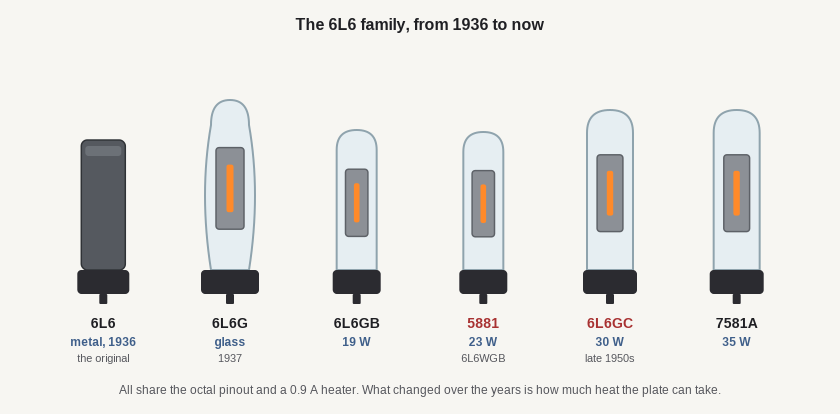
| Type | Plate rating | Notes |
|---|---|---|
| 6L6 | RCA's original of 1936, in a metal shell | |
| 6L6G, 6L6GA, 6L6GB | about 19 W for the GB | glass versions through the 1940s and 1950s |
| 5881 / 6L6WGB | 23 W | a tougher, uprated 6L6 from the early 1950s, first made for military and industrial use. It powered the tweed Fender Bassman. |
| 6L6GC | 30 W | the late-1950s version with a stronger plate and a 500 V rating. The standard type today. |
| 7581A | 35 W | an uprated 6L6GC with a bigger plate, for extra headroom |
| KT66 | 25 W | the British cousin: very similar, with a bigger heater |
All of them use the same 8-pin octal base and pinout, and all but the KT66 draw 0.9 A of heater current. What grew over the years was how much heat the plate could take, and so how hard an amp could drive it. Current production comes from Russia, Slovakia and China, under many names including revived historic brands.
What It Sounds Like
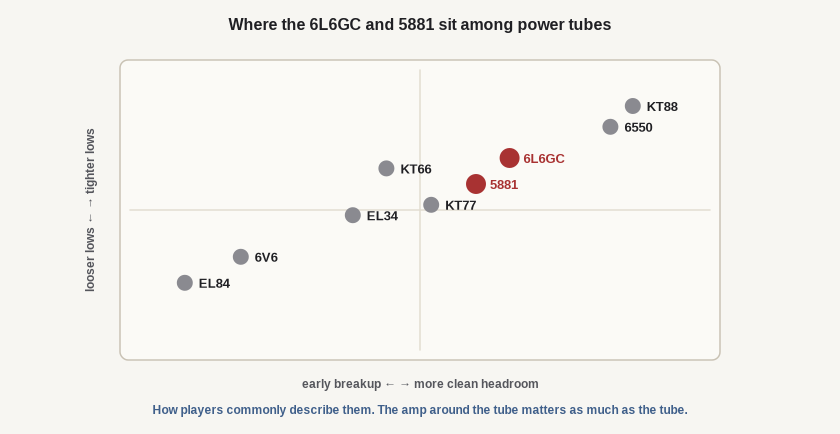
Players describe the 6L6GC consistently:
- Cleans: big, glassy and full, with sparkle on top. This is the tube most associated with the classic American clean sound.
- Headroom: plenty. A 6L6 amp stays clean louder than the same amp with EL34s.
- Low end: full and firm, holding together at volume.
- Midrange: less forward than an EL34, so a 6L6 amp often sounds scooped or "smiley" next to a British one, partly by design: Fender voiced its amps that way.
- When pushed: it stays clean, then breaks up more suddenly than an EL34. The overdrive is smooth and warm rather than gritty.
The 5881 sounds much like a 6L6GC, but with its lower rating it compresses and breaks up a little sooner. Many players like that in tweed-style amps.
Where You've Heard It
- The Fender sound: the tweed Bassman of the late 1950s, with two 5881s and about 40 W, and the blackface Twin Reverb of 1963 onward, with four 6L6s and 85 W. Most big Fenders since have used them.
- The first Marshalls: Marshall's first amp, the JTM45, was based on the tweed Bassman circuit and used 5881s or KT66s before Marshall moved to the EL34.
- Modern high gain: many famous high-gain heads run four or six 6L6GCs, such as 120 W heads with four and 150 W heads with six. A clean, tight power section keeps a high-gain preamp's distortion defined.
- Bass and keyboard amps: many vintage bass amps and organ amplifiers used 6L6 family tubes.
How It Compares to Its Neighbors
| Tube | Plate rating | In one sentence |
|---|---|---|
| 6V6 | 14 W | the 6L6's little brother: smaller amps that break up sooner |
| EL34 | 25 W | the British rival: more midrange, earlier and grittier breakup |
| 6L6GC | 30 W | big, glassy American cleans and a firm low end |
| KT88 / 6550 | 35 W to 42 W | more of the same: even more power and headroom |
Try It
In the Tube Bias Calculator, set two 6L6GC tubes at 450 V and read the 70% target. Then switch to 5881 at the same voltage: the lower rating means a lower target, and that lower ceiling is why the 5881 breaks up sooner.
Level 2 covers how the 6L6GC behaves in an amp: power by tube count, how it breaks up, bias, and the 5881 voltage catch.