Levels 1 and 2 covered the 5Y3 and how it behaves. This level is about applications: where it is the right rectifier and why, where it isn't, swapping it, and buying them.
Where It Shines
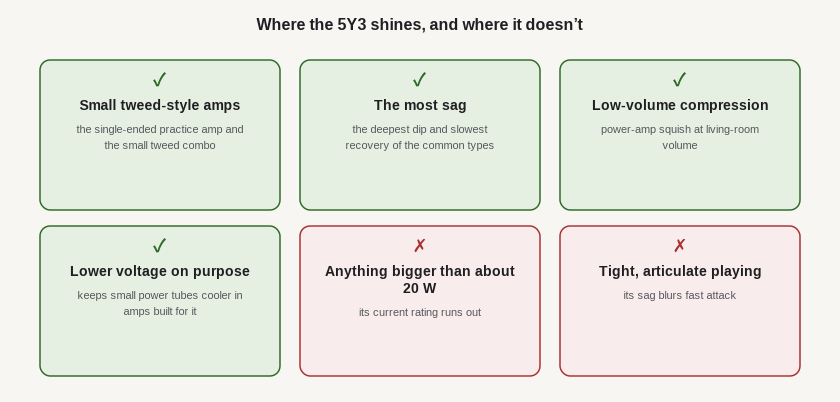
Small Tweed-Style Amps
The job: powering a single-ended practice amp or a small push-pull 6V6 combo.
Why it shines: these amps need little current, and their character depends on a soft, sagging supply. The 5Y3 provides both, which is why the small tweed amps used it and why their descendants still do.
The Most Sag
The job: maximum compression and bloom from the power supply.
Why it shines: it has the biggest drop and slowest recovery of the common types. Blues and roots players often describe it as making a small amp feel alive under the fingers.
Low-Volume Compression
The job: power-amp breakup at living-room or studio volume.
Why it shines: the lower supply voltage brings breakup on sooner, and the sag adds compression, so a small amp gives its full character without being loud.
Lower Voltage on Purpose
The job: keeping small power tubes comfortable.
Why it suits: in amps designed around it, the 5Y3's drop holds the plate voltage where 6V6s run cool and last.
Where It Doesn't
- Anything bigger than about 20 W. Its current rating runs out.
- Tight, articulate playing. Its sag blurs fast attack; a firmer amp suits that better.
- High-gain or clean-headroom designs. Both want a stiffer supply.
Swapping
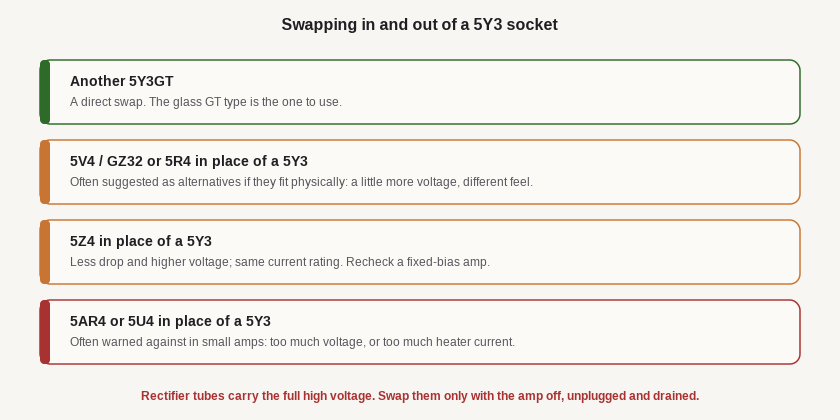
| Swap | Effect | Check |
|---|---|---|
| Another 5Y3GT | the same | none, beyond a normal bias check |
| 5V4 / GZ32 or 5R4 | a little more voltage, different feel | physical fit, and the current needed |
| 5Z4 | less drop, higher voltage | recheck a fixed-bias amp |
| 5AR4 or 5U4 | much higher voltage, or 3 A of heater | widely warned against |
DANGER: LETHAL VOLTAGE. Swap rectifiers only with the amp off, unplugged and drained. If you are unsure whether a different rectifier suits your amp, have a technician check.
Buying
- Current production: the 5Y3GT is made in Russia, Slovakia and China under several names, and is usually inexpensive.
- Vintage: old American 5Y3s are plentiful and often cheap; test them, since a worn one drops more voltage.
- Spares: keep one with any 5Y3 amp. They are small and cheap, and an amp stops completely without one.
Try It
Play the same riff on a small 5Y3 amp at two volumes: just clean, and just breaking up. Notice how much more the attack softens and the sustain blooms at the higher setting. That change is the 5Y3 doing what small amps are known for.