Level 1 covered what the 5Y3 is and how it feels. This level is about how it behaves: deep sag, its fast warm-up, its small current rating, and why the bigger rectifiers don't belong in its socket.
DANGER: LETHAL VOLTAGE. Everything in this article sits at the full high-voltage supply. Never measure or work on it unless you are trained to, and always drain the filter caps first. The Cap Drain & Bleeder Calculator shows how.
Deep Sag
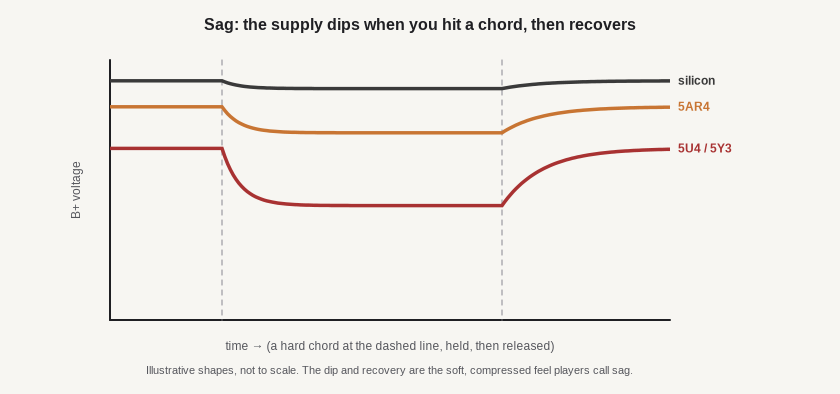
The 5Y3 has the highest internal resistance of the common rectifiers. When the power tubes draw more current on a hard note, the supply dips further than with any other common type and takes longer to recover. Small amps often pair it with small filter caps, which deepens the effect. The result is the compression and bloom players associate with small tweed-style amps turned up.
Fast Warm-Up
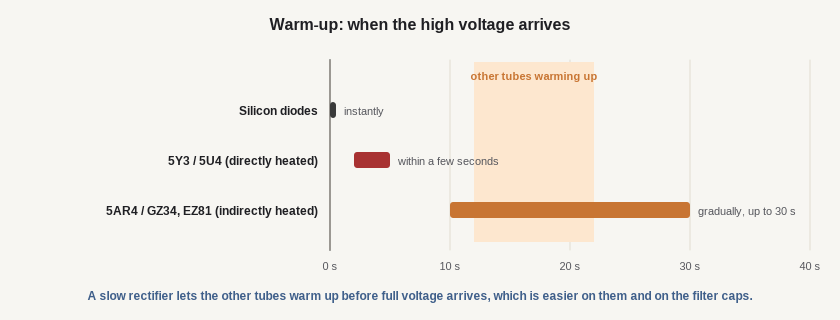
Like the 5U4, the 5Y3 is directly heated, so it conducts within a few seconds, before the other tubes have warmed. With nothing drawing current, the supply briefly rises above its working voltage. Small amps built around a 5Y3 have filter caps rated for that.
The Current Limit
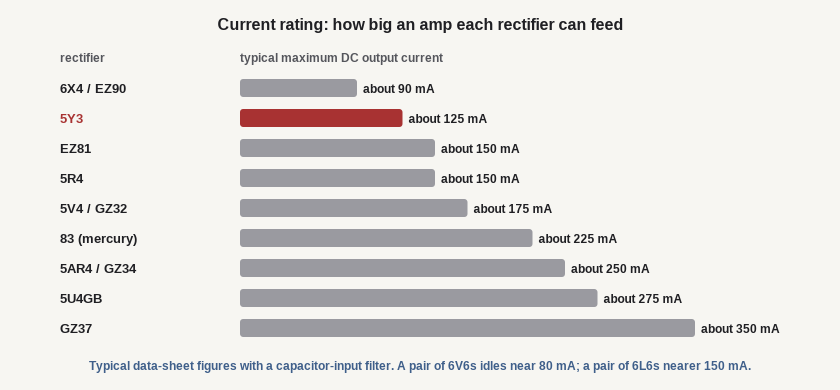
At about 125 mA, the 5Y3 suits amps up to roughly 20 W: a single 6V6, a pair of 6V6s, or a pair of 6L6s run gently. Asked for more, it runs hot, its drop grows further, and its life shortens.
Why the Big Rectifiers Don't Belong
A 5Y3 amp's power tubes, filter caps and bias were chosen around its large drop. A 5AR4 in its place raises the supply by roughly 40 V or more, which can push small power tubes and the filter caps past their ratings. A 5U4 needs 3 A from a 5 V winding built for 2 A. Tube suppliers and amp makers widely warn against both swaps in 5Y3 amps.
Heater Current Matters Both Ways
A rectifier's heater is part of the power transformer's load. A replacement that draws less current than the original lets the 5 V winding's voltage rise; one that draws more pulls it down and heats the transformer. Either way, it is worth matching the original where you can.
Signs of Wear
A worn 5Y3 drops more voltage than usual, so the amp gets quieter and mushier. A failing one may arc, hum or blow the fuse. Replace an arcing rectifier at once and have the filter caps and fuse checked.
Try It
On a small 5Y3 amp at a volume where it starts to break up, hit a chord hard and hold it. Listen for the note squeezing down and blooming back: that is the 5Y3's sag at work.
Level 3 covers where the 5Y3 shines, swapping it, and buying them.