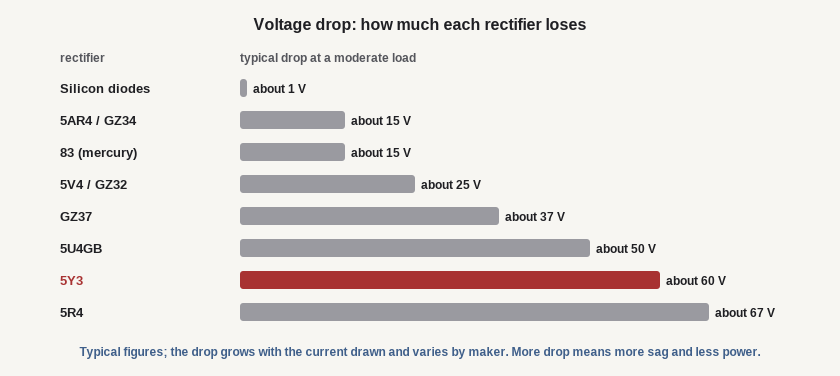
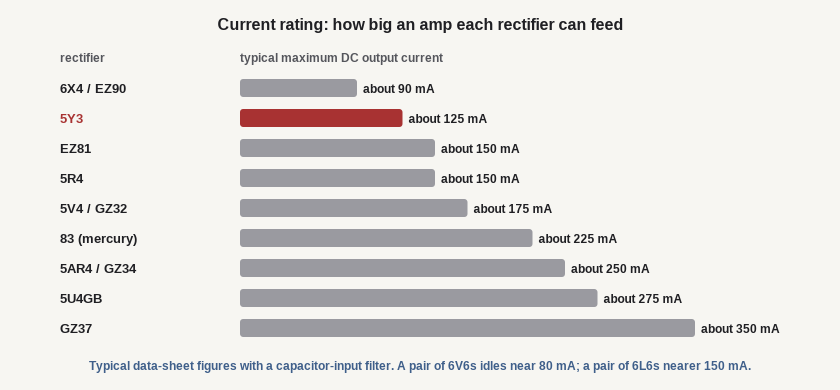
The 5Y3 is the rectifier of small tube amps. It drops the most voltage of the common types, about 50 V to 60 V, and can supply only about 125 mA, so it belongs in practice amps and small combos with one or two 6V6s. In those amps, its heavy sag is a large part of the sound: the squeeze, bloom and soft attack players describe in small tweed-style amps. The glass 5Y3GT is the form used today.
This series covers the 5Y3. The Rectifier Tubes series compares all the common types.
DANGER: LETHAL VOLTAGE. A rectifier tube carries the full high-voltage supply, and its socket is live whenever the amp is on. The filter capacitors it charges hold a lethal charge long after unplugging, even in a small amp. The Cap Drain & Bleeder Calculator explains how long the charge lasts.
The Tube and Its Relatives
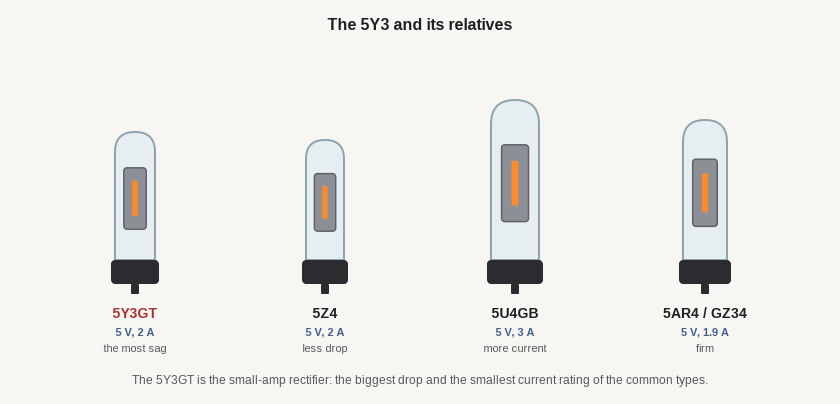
| 5Y3GT | |
|---|---|
| Heater | 5 V, 2 A |
| Cathode | directly heated: the filament is the cathode |
| Voltage drop | the largest common drop, about 50 V to 60 V |
| Current rating | about 125 mA |
| Warm-up | fast, within a few seconds |
| Base | octal |
What It Feels Like
Players describe a 5Y3 amp as soft, spongy and compressed when pushed: the note dips as you hit it and swells as it sustains. Because the supply runs lower, a small amp breaks up sooner and at lower volume, which is part of why small 5Y3 amps are favorites for recording and for playing at home.
Where You've Heard It
- The small tweed amps: the single-ended tweed Champ, the tweed Princeton and the 5E3 tweed Deluxe all use a 5Y3.
- The blackface Deluxe Reverb and Princeton-class amps that followed, and their reissues.
- Countless small builds based on those circuits.
How It Compares
| Rectifier | Drop | Current | In one sentence |
|---|---|---|---|
| 5AR4 / GZ34 | about 10 V to 17 V | about 250 mA | firm, for medium amps |
| 5U4GB | about 50 V | about 275 mA | lots of sag, for medium amps |
| 5Y3GT | about 50 V to 60 V | about 125 mA | the most sag, for small amps |
Try It
In the Power (W) Calculator, work out the plate dissipation of a single 6V6 at 340 V and 40 mA, then at 300 V. The lower figure shows how a 5Y3's drop keeps small power tubes cooler as well as softening the feel.
Level 2 covers how the 5Y3 behaves: sag, warm-up, its current limit, and why the bigger rectifiers don't belong in its socket.