The Stringing tool turns a string change into a checklist built for your guitar. Pick the guitar, its bridge and tuners, the strings you're putting on, and how you wind them, then tick off each step as you go. It covers what you'll need, what changes if you switch gauge, and when a guitar needs a setup rather than just new strings.
What it covers
- Guitars: electric with a fixed bridge, electric with a tremolo, Floyd Rose and locking tremolos, steel-string acoustic, and classical (nylon).
- Bridges: strings through the body, top-load, tune-o-matic and stopbar, trapeze, Strat-style tremolo and Bigsby.
- Tuners: standard (a hole through the post), vintage split-shaft (a slotted post), locking, and classical rollers.
- Winding: by hand, a hand crank winder, a battery-powered winder, or a drill with a winder bit.
All at once or one at a time?
All at once lets you clean the fretboard and is fine on most fixed bridges and acoustics. One at a time is best on tremolos, which are balanced against springs, on tune-o-matics, which can lift off their posts, and on archtops whose bridge is held only by string pressure. A Floyd Rose is changed one at a time with the bridge blocked.
Wraps on the post
| Tuner | How | Wraps |
|---|---|---|
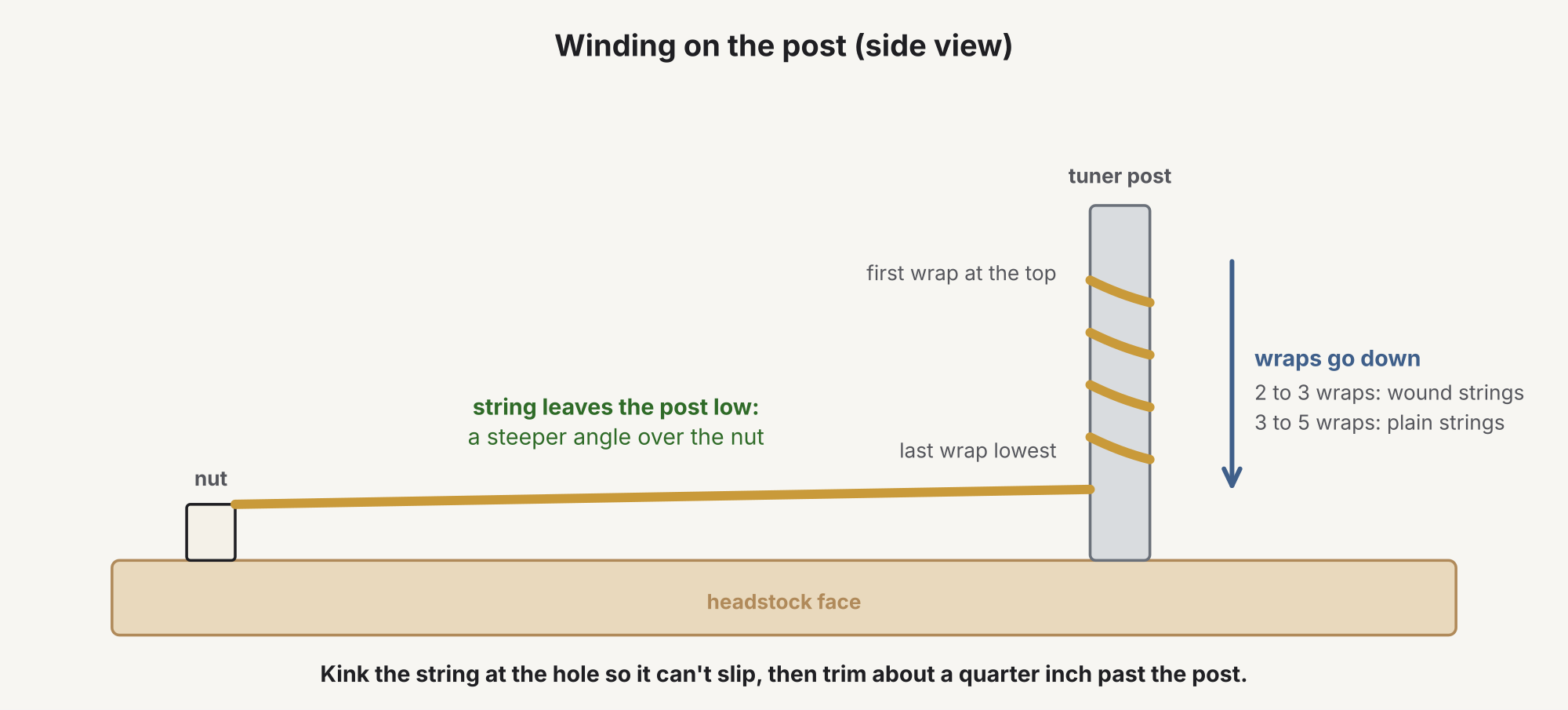
| Standard | pull tight, back off to the next post along, then wind downward | 2 to 3 on wound strings, 3 to 5 on plain |
| Split-shaft | cut to length first, push the end into the center hole, bend into the slot | 2 to 3 on wound strings, more on plain |
| Locking | pull through tight, lock, tune up | less than one |
| Classical roller | through the hole, over itself once to lock, wraps side by side | plenty; nylon is slippery |
Downward wraps make the string leave the post low, which gives it a good angle over the nut and helps it stay in tune.
String gauges
Electric sets run from 8-38 to 13-56, with 9-42 and 10-46 the most common. Acoustic sets run from 10-47 extra light to 13-56 medium. Classical strings are sold by tension, normal or high. Changing gauge changes how hard the strings pull on the neck and the bridge, so it usually means a setup.
Winders
A winder saves time; a powered one saves more. With a battery winder or a drill bit, take up the slack only and finish by hand. On a drill, use the lowest speed and the lowest clutch setting, check the direction first, and never tune to pitch with it.
How to use it
- Pick your guitar, then its bridge.
- Pick the strings and whether they're the same, heavier or lighter than before.
- Pick your tuners and how you wind.
- Follow the checklist and tick off each step. Your picks and progress stay in your browser.
Things worth knowing
- Slacken before you cut. A string cut at full tension whips and can mark the finish.
- Stretch new strings in and retune two or three times; nylon takes a day or two to settle.
- Strings or setup? If the guitar buzzes, the action feels high, or notes high on the neck sound out of tune with fresh strings, it needs a setup: see the Guitar Setup tool. The library's On the Bench: Restringing series covers every bridge in detail.