The Guitar Setup tool answers the question behind every buzz, every stiff-feeling neck and every out-of-tune chord high up the fretboard: is my guitar set up right? Pick your guitar, enter what you measured, and each reading turns green inside the starting-point range, orange when it is close, and red when it is well off, with what it means and what to adjust.
What a setup is
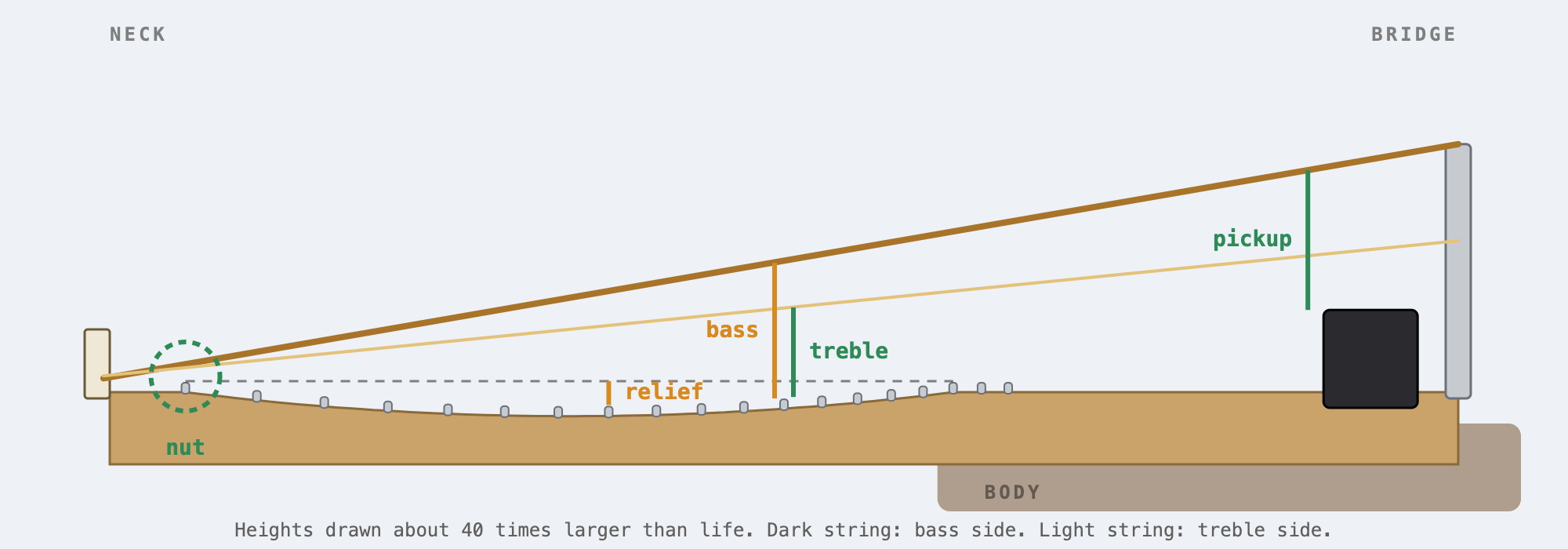
A setup is the set of small adjustments that decide how a guitar plays: the bow in the neck (relief), how high the strings sit (action), how deep the nut slots are, how close the pickups are to the strings, and whether the guitar plays in tune up the neck (intonation). Every guitar needs one after a change of string gauge, a change of season, or a few months of playing.
Starting-point specs
These are places to start, close to what each maker ships, not rules. Action is measured at the 12th fret, from the top of the fret to the bottom of the string.
| Measurement | Fender-style (9.5 in radius) | Gibson-style | PRS |
|---|---|---|---|
| Neck relief | 0.010 in (0.25 mm) | 0.010 in (0.25 mm) | 0.005 to 0.010 in |
| Action, treble side | 1.6 mm (about 4/64 in) | 1.2 mm (3/64 in) | 1.4 to 1.8 mm |
| Action, bass side | 2.0 mm (about 5/64 in) | 2.0 mm (5/64 in) | 1.5 to 1.9 mm |
| Nut clearance | 0.002 to 0.004 in at fret 1 | same | same |
| Bridge pickup, bass side | 2.4 mm (6/64 in) | 2.4 mm (3/32 in) | 2.8 mm |
| Bridge pickup, treble side | 2.0 mm (5/64 in) | 1.6 mm (1/16 in) | 2.0 mm |
| Tremolo float | about 1/8 in at the back edge | about 1/16 in, level |
Fender's relief changes with the fretboard radius: about 0.012 in on a vintage 7.25 in neck and 0.008 in on a flat 15 to 17 in neck.
The guitars in the tool
Fender Telecaster and Stratocaster; Gibson Les Paul, SG, ES-335 and ES-330; PRS Custom 24, Custom 22 and Modern Eagle. Each has its own starting points, and each links to its own step-by-step setup page in the PALMATOWN Library. Acoustic and Floyd Rose guitars are coming.
How to measure
- Relief: capo at the first fret, hold the low E down where the neck meets the body, and slide feeler gauges under the string at the 7th or 8th fret.
- Action: a steel rule at the 12th fret, top of the fret to the bottom of the string, on the high E and the low E.
- Nut: fret each string at the 3rd fret and look at the gap over the 1st. It should be just visible.
- Pickup height: hold the string at the last fret and measure from the bottom of the string to the top of the pole piece.
How to use it
- Pick your guitar.
- Move each slider, or type the number you measured, in millimeters or inches.
- Work through anything orange or red in order: tremolo float first on a tremolo guitar, then relief, action, nut and pickups.
- Your numbers stay in your browser, so you can come back after each adjustment.
Things worth knowing
- Order matters. Relief changes the action, and the action changes the pickup height. Set them in that order.
- Turn truss rods slowly: an eighth of a turn, retune, measure again. A rod that won't move is a job for a technician.
- Starting points, not rules. If the guitar feels and sounds right to you, it is right. The full walkthrough is in the library's On the Bench: Guitar Setup series.