The Speaker Wire (AWG) Calculator answers a question every amp-to-cab run raises: how thick does my speaker cable need to be? Enter the speaker's impedance (4, 6 or 8 Ω) and the one-way length of the run, and it gives the wire gauge from two published tables, side by side. Already have a cable? Pick its gauge and it tells you whether it is long enough.
Why the gauge matters
A speaker cable is a small resistor in series with the speaker. The thinner and longer it is, the more of the amp's power turns into heat in the cable instead of sound, and the less control the amp has over the speaker. Lower-impedance speakers are hit hardest, because the cable is a bigger share of the total load.
In AWG, a smaller number means thicker wire: 10 AWG is thick, 18 AWG is thin.
Two tables, on purpose
Published gauge charts disagree, because each accepts a different amount of loss. The tool shows both, so you can see the range:
- Audioholics (strict): under about −0.2 dB of loss and a damping factor above 50, with a 20% safety margin built in. Aimed at critical listening.
- SatMaximum (relaxed): a more permissive tolerance, aimed at general home audio. For stranded copper.
Longest recommended one-way run
| Gauge | 4 Ω strict | 4 Ω relaxed | 8 Ω strict | 8 Ω relaxed |
|---|---|---|---|---|
| 18 AWG | 5 ft | 16 ft | 10 ft | 32 ft |
| 16 AWG | 10 ft | 24 ft | 20 ft | 48 ft |
| 14 AWG | 20 ft | 40 ft | 35 ft | 80 ft |
| 12 AWG | 30 ft | 60 ft | 60 ft | 120 ft |
| 10 AWG | 50 ft | 100 ft | 100 ft | 200 ft |
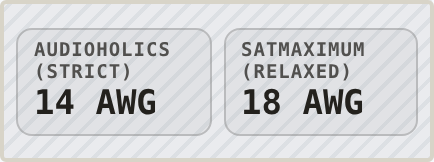
The tool also covers 6 Ω. Example: an 8 Ω cab 25 feet from the amp needs 14 AWG by the strict table, or 18 AWG by the relaxed one.
For the full side-by-side tables and the reasons they differ, see the library article Speaker Wire: AWG vs. Distance vs. Ohms.
How to use it
- Pick the speaker load the cable feeds: the cab's total impedance, not one speaker's.
- Enter the one-way length (amp to cab), in feet or meters.
- Read the two gauges. If you are buying, the strict answer is the safe one.
- Optional: pick the wire you already have, and it tells you whether that gauge reaches.
Things worth knowing
- Use speaker cable, never an instrument cable, between amp and cab. Instrument cable is thin, shielded and built for tiny signals; it can overheat and starve the speaker.
- Use the cab's total impedance. A 4x12 wired to 16 Ω is a 16 Ω load, even with 8 Ω speakers inside. The Cab Builder works it out.
- The tables cover 10 to 18 AWG. Past 10 AWG's longest listed run, move the amp closer.