This level is the reference: what a switch's rating means, why DC is harder to switch than AC, how much current a speaker switch really carries, rotary switch arrangements, contact materials, and how to test, buy and substitute a switch.
Reading a Rating
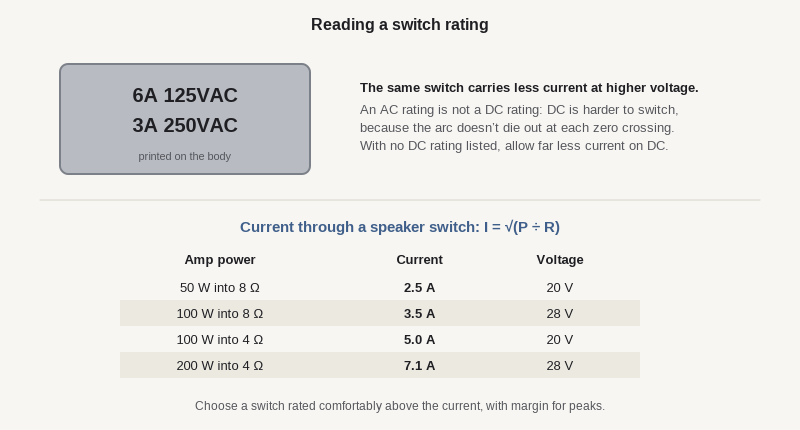
A switch's rating is printed on its body or in its data sheet as a current at a voltage, often more than one pair: for example 6A 125VAC, 3A 250VAC. The same contacts carry less current at a higher voltage, because a higher voltage draws a longer, hotter spark as the contacts open.
AC and DC are rated separately. An AC current passes through zero 100 or 120 times a second, and each zero crossing helps snuff out the spark. DC never does, so the spark lasts longer and burns the contacts. A switch rated 3 A at 250 V AC might be rated only a fraction of that at a few hundred volts DC, or not rated for high-voltage DC at all. If a switch lists no DC rating, assume it can handle far less on DC. That matters for a tube amp's standby switch, which breaks the high-voltage DC supply.
Inductive loads (coils, transformers, motors) are harder still: they kick back a voltage spike when switched off. Ratings for them are lower than for plain resistive loads.
Speaker Switch Current
A speaker switch carries the amp's full output. The current is:
I = √(P ÷ R)
where P is the amp's power and R is the speaker load.
| Amp power | Load | Current | Voltage |
|---|---|---|---|
| 50 W | 8 Ω | 2.5 A | 20 V |
| 100 W | 8 Ω | 3.5 A | 28 V |
| 100 W | 4 Ω | 5.0 A | 20 V |
| 200 W | 4 Ω | 7.1 A | 28 V |
These are average figures at full power, and a cranked amp's peaks run higher, so choose a switch rated comfortably above them. Small signal switches and mini toggles meant for guitar wiring are not speaker switches. The Power (W) Calculator works out the current and voltage for any power and load.
Rotary Switches
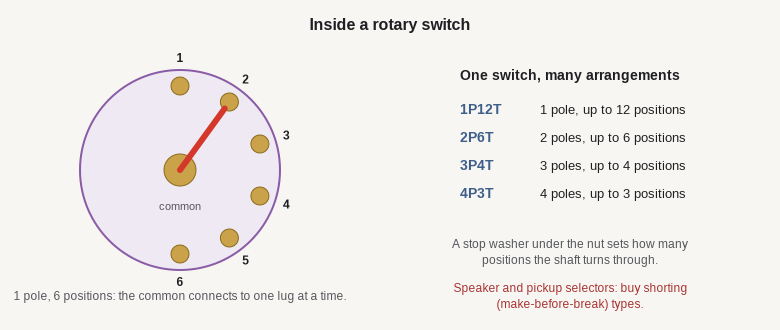
A rotary switch's common contact turns to meet one of several lugs. Most come with 12 contact positions per deck, shared between the poles:
| Code | Poles | Positions |
|---|---|---|
| 1P12T | 1 | up to 12 |
| 2P6T | 2 | up to 6 |
| 3P4T | 3 | up to 4 |
| 4P3T | 4 | up to 3 |
A stop washer under the mounting nut has a tab that drops into a numbered hole, setting how many positions the shaft turns through. A 2P6T used as a 2P4T just has its washer moved. Bigger switches stack several decks (wafers) on one shaft for more poles.
Rotaries come in shorting (make-before-break) and non-shorting (break-before-make) types. For speaker selectors on tube amps, use shorting types, rated for the speaker current.
Contact Materials
| Contacts | Good for | Watch out for |
|---|---|---|
| Silver | higher currents: power, speakers | tarnishes over time; with tiny signals and little use, can get crackly |
| Gold or gold-plated | low-level signals: guitar, pedal and line signals | the plating wears away if used for heavy current |
The rule of thumb: gold for signal, silver for power. A switch that sits unused for years and then crackles usually has tarnished silver contacts. Working it back and forth a few dozen times, or a contact cleaner made for switches, often clears it.
Contact Bounce
When metal contacts close, they bounce apart and together for a few milliseconds before they settle. In audio switching it is part of the click you hear. In a digital circuit, such as a tap tempo input or a switch driving a microcontroller, each bounce can count as a separate press, so those circuits debounce the switch with a small capacitor and resistor or in software.
Mechanical Life
Data sheets rate a switch's mechanical life in operations, often in the tens of thousands for footswitches and toggles. A gigging pedal can reach that, which is why a footswitch that starts to feel soft, stick or cut in and out is simply worn out. Relay switching with a soft-touch footswitch lasts much longer, because the footswitch carries almost no current and the relay's sealed contacts do the work.
DANGER: LETHAL VOLTAGE. Switches inside a tube amp, including power, standby and impedance selectors, can carry mains voltage and the high-voltage supply. Unplug the amp, drain the filter caps through a resistor and check each with a meter before you touch them. The Cap Drain & Bleeder Calculator shows how.
Testing
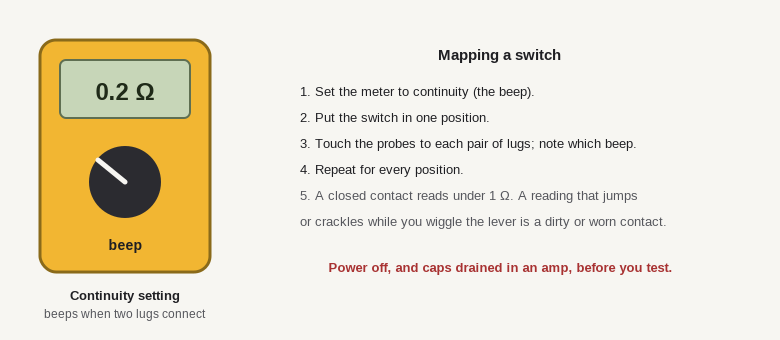
- Set the meter to continuity (the beep), or to its lowest ohms range.
- Put the switch in one position.
- Touch the probes to each pair of lugs and note which pairs beep.
- Repeat for every position, and write down a little map.
- A good closed contact reads under 1 Ω. A reading that jumps or crackles while you wiggle the lever is a dirty or worn contact.
Mapping a switch this way, before soldering, avoids most switch wiring mistakes, and it is the only way to be sure of an unusual switch's ON-ON-ON or shorting pattern.
Buying and Substituting
| Check | Common options | Notes |
|---|---|---|
| Poles and throws | SPDT, DPDT, 3PDT, 4PDT | more poles is fine: leave the extra lugs empty |
| Positions | ON-ON, ON-OFF-ON, ON-ON-ON, momentary | must match the job exactly |
| Rating | current at voltage, AC and DC | equal or higher than the original |
| Contacts | gold for signal, silver for power | |
| Mini toggle bushing | 1/4" thread (about a 6.5 mm hole) | standard toggles use a larger 15/32" bushing |
| 3PDT footswitch bushing | 12 mm thread | check the enclosure hole |
| Lugs | solder lugs, PCB pins, right-angle PCB | match the board when replacing a pedal switch |
| Lever and actuator | bat lever, flat lever, blade, push-pull | for looks and fit |
Substituting: a switch with more poles or throws than you need always works if it fits; just leave the extra lugs unconnected. A DPDT can replace an SPDT, and a 4PDT a 3PDT. A switch with a higher rating is always fine. Never substitute a lower-rated switch on mains, speakers or a standby circuit.
Try It
Work out the current your own amp puts through a speaker switch with the Power (W) Calculator. Then in Build a Circuit, place a Rotary Switch and set its poles and positions in the Inspector to match one of the arrangements above.