A switch makes or breaks a connection when you move it. That is all it does, but the variety is huge: the footswitch that turns a pedal on, the toggle that splits a humbucker, the blade that picks pickups, the rotary that selects speakers, and the rocker that powers up an amp. This level covers the names and codes that tell you what a switch does, and the main types you will meet.
Poles and Throws
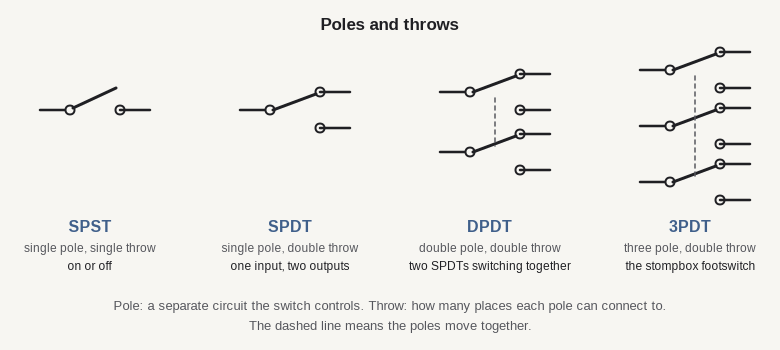
Every switch is described by two numbers:
- Poles: how many separate circuits it controls at once.
- Throws: how many places each pole can connect to.
They are written as letters: S for single, D for double, and a number for anything more.
| Code | Means | Lugs | Typical job |
|---|---|---|---|
| SPST | single pole, single throw | 2 | a plain on-off switch, a kill switch |
| SPDT | single pole, double throw | 3 | choosing between two things: two pickups, two signals |
| DPDT | double pole, double throw | 6 | two SPDTs moving together: coil splits, series and parallel wiring, phase reversal |
| 3PDT | three pole, double throw | 9 | the standard true bypass stompbox footswitch |
| 4PDT | four pole, double throw | 12 | bypass switching with extra jobs, such as switching two signals and an LED |
On a schematic, a dashed line between switch symbols means they are parts of one switch and move together.
Positions
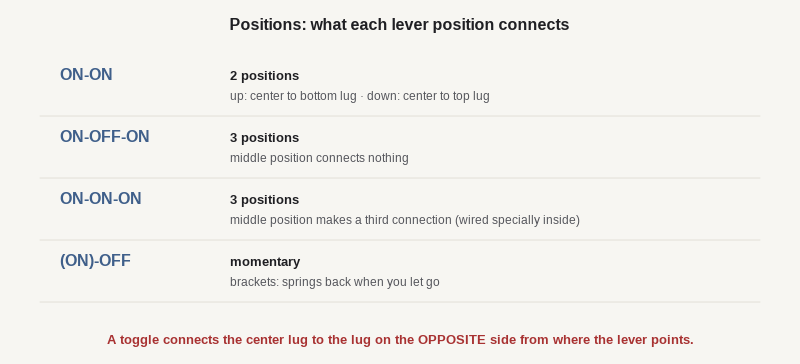
The second part of a switch's description is what each position does:
- ON-ON: two positions, each making a connection.
- ON-OFF-ON: three positions, with the middle one connecting nothing. Handy for a center-off choice, such as a three-way mode switch with a neutral middle.
- ON-ON-ON: three positions, all making connections, wired specially inside. Used in some guitar wiring mods.
- ON-OFF: a plain two-position on-off switch.
- Brackets mean momentary: (ON)-OFF stays off until you hold it, then springs back when you let go. A pushbutton is usually (ON)-OFF.
So a switch's full name might be "DPDT ON-OFF-ON mini toggle": two poles, three positions, center off.
The Main Types
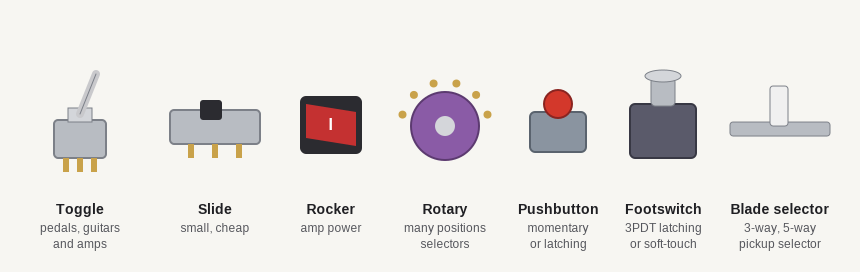
| Type | What it is | Where it turns up |
|---|---|---|
| Toggle | a lever that flips between positions; mini toggles are the small ones | pedal mode switches, guitar coil splits and pickup switches, amp bright and standby switches |
| Slide | a small slider | some pedals and amps, cheaper gear |
| Rocker | a see-saw button | amp and power strip power switches |
| Rotary | a knob with click-stop positions | pickup selectors, speaker selectors, tone and mode switches |
| Pushbutton | a button, momentary or latching (stays in until pressed again) | tap tempo, momentary effects, test buttons |
| Footswitch | a heavy-duty switch you stomp | latching 3PDT for true bypass; soft-touch momentary for relay and tap switching |
| Blade selector | a lever moving along a slot | three-way and five-way pickup selectors in many guitars |
| Three-way toggle | a large toggle with long contact blades | the pickup selector in many humbucker guitars |
Which Lug Is Which
On a toggle switch, the middle lug of each row is the common: the pole's input or output. The other two lugs are the throws. The surprising part is which one connects:
A toggle connects its center lug to the lug on the opposite side from where the lever points. Lever up joins the center to the bottom lug. Lever down joins the center to the top lug. Check with a meter before you solder.
On a 3PDT footswitch, the nine lugs are a three-by-three grid. The middle row is the three commons, and each column is one pole. Level 2 shows the wiring.
On a Schematic
A switch is drawn as a small hinged line (the blade) with circles for the contacts. The line usually shows the switch in one position; for a footswitch or relay, check the schematic's notes for which position is drawn. Switches are labeled S1, S2 or SW1, SW2, and footswitches often FS1.
Where You Find Them
| In a... | What the switches are doing |
|---|---|
| Pedal | the bypass footswitch, mode and voicing toggles, and a power switch in some |
| Guitar | the pickup selector, plus coil split, phase and series and parallel switches, often as mini toggles or push-pull pots |
| Tube amp | power, standby, bright, channel and voicing switches, and sometimes an impedance selector |
| Speaker cab | rarely, but a series and parallel switch or a speaker selector turns up in some cabs |
Try It
In Build a Circuit, wire a battery, a resistor and an LED, and put a Pushbutton in the loop. Set it to pressed in the Inspector and the LED lights; release it and the LED goes dark. Then swap in a Toggle Switch and try two and three positions per pole.
Level 2 covers what switches do in a circuit: true bypass wiring, avoiding the switch pop, pickup and guitar mods, power and standby switches, and safe speaker switching.