This is the main explainer for how series and parallel speaker wiring works, using the simplest possible case: a 2x (two-by) cabinet, with just one pair of speakers to combine. The 4x, 6x, and other higher-count articles (also under Speakers) build directly on the rules explained here rather than re-deriving them, so this is the one to read first if the basic math is new to you. There's no naming convention for a specific driver size left generic (no "2xA" or "1xA/1xB" shorthand in actual use) - manufacturers and builders just write out the real sizes - but "2x" itself is the standard shorthand for "two-driver cabinet, any size," so everything below applies equally to a 2x10, 2x12, 2x15, or any other same-size pair, and to a 1x12/1x15, 1x10/1x12, or any other mixed pair. Diagrams for the mixed-pair case are on the way - the wiring and impedance math below is current and won't change when those drawings are added.
Matched Pairs: 2x10, 2x12, 2x15, or Any Other Same-Size Pair
A 2x10, 2x12, 2x15, or any other cabinet with two identical drivers carries the same nominal impedance in both speakers. There are only two ways to wire that pair to a single jack:
- Series: the two speakers' impedances add. Two 8 Ω drivers in series present 16 Ω at the jack.
- Parallel: the two speakers' impedances combine by the reciprocal-sum rule, which for two equal-value speakers is just the value halved. Two 8 Ω drivers in parallel present 4 Ω.
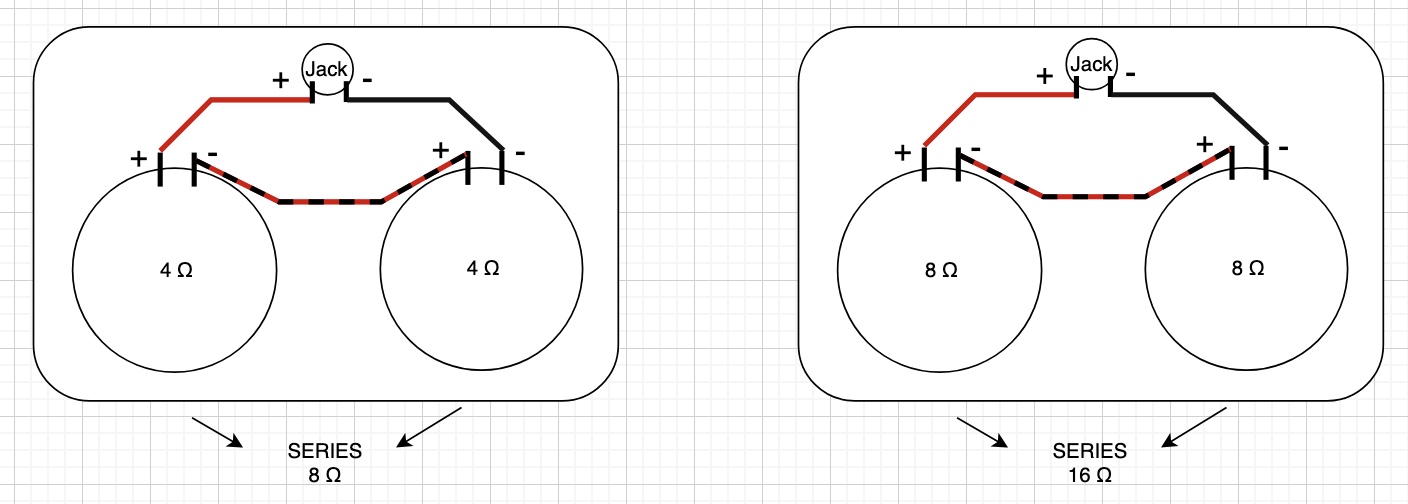
Both examples above wire straight to one jack. Parallel wiring can use that exact same single-jack setup too - both speakers land on the same two jack terminals, positive to positive and negative to negative:
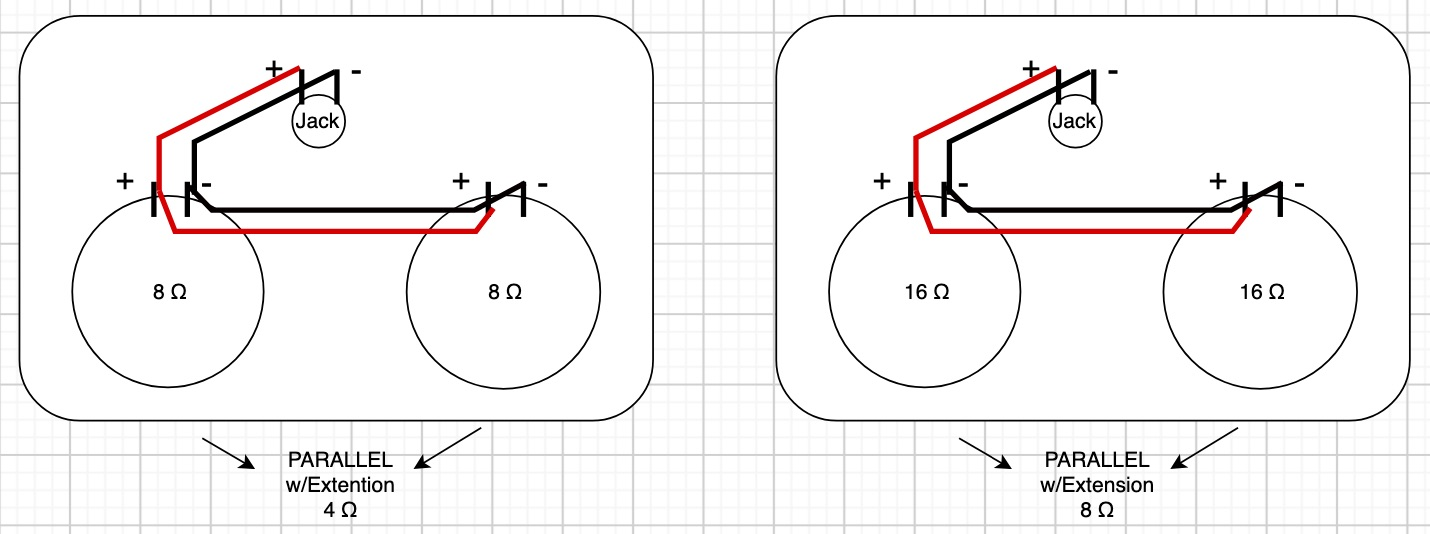
Parallel wiring is just as often done through a second, "extension" jack instead - the main jack and the extension jack are wired in parallel with each other, and a speaker sits on each one:
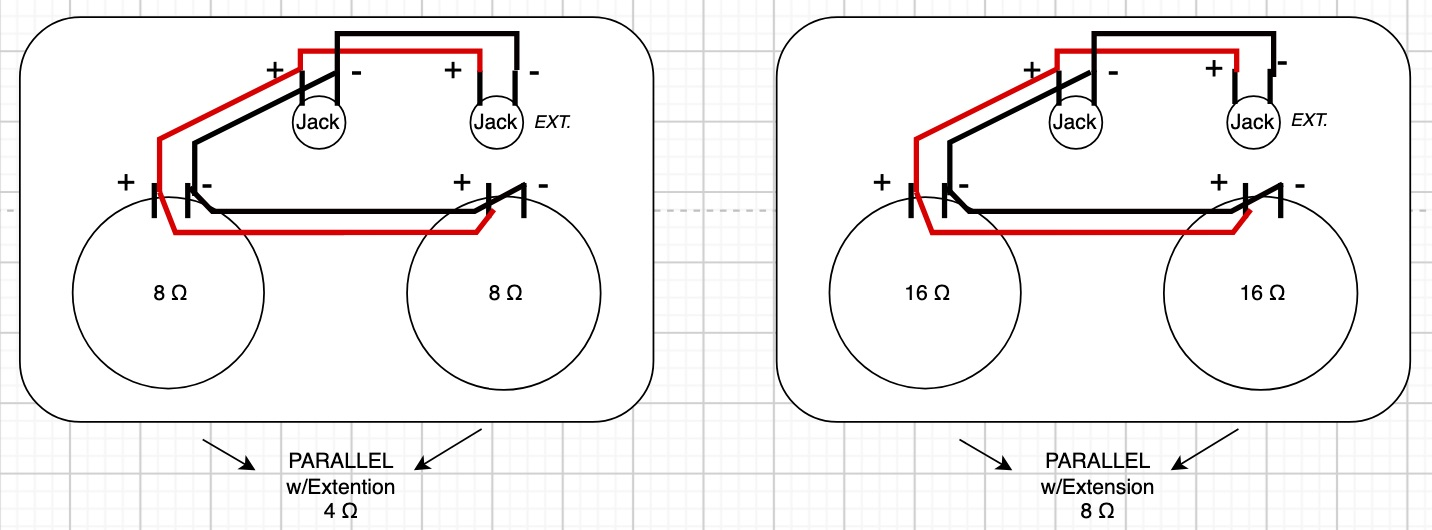
The jack arrangement (a single jack, or a main-plus-extension pair) and the wiring topology (series vs. parallel) are independent choices - any of the three layouts above could just as easily carry the other topology. These three diagrams simply each show a common real-world pairing of the two.
| Driver impedance | Series (net) | Parallel (net) |
|---|---|---|
| 4 Ω | 8 Ω | 2 Ω |
| 8 Ω | 16 Ω | 4 Ω |
| 16 Ω | 32 Ω | 8 Ω |
Mixed Pairs: 1x12/1x15, 1x10/1x12, or Any Other Combination
A 112/115 cabinet (1x12 + 1x15), a 1x10/1x12, or any other pairing of two different cone sizes doesn't change the wiring math at all - what matters electrically is each driver's nominal impedance, not its diameter. If both drivers share the same nominal impedance rating, the series and parallel formulas above apply exactly as they do for a matched pair, regardless of which two sizes are paired up.
If the two drivers carry different nominal impedance ratings (say a 12" rated at 8 Ω paired with a 15" rated at 16 Ω), the general formulas still apply, they just don't reduce to a simple "half" or "double":
- Series: the impedances add directly. An 8 Ω driver and a 16 Ω driver in series present 24 Ω.
- Parallel: use the full reciprocal-sum rule: 1 / ((1/Z1) + (1/Z2)). An 8 Ω driver and a 16 Ω driver in parallel present about 5.3 Ω.
Diagram: pending - mixed-pair series wiring.
Diagram: pending - mixed-pair parallel wiring.
Mixed-impedance pairs also split power unevenly - in parallel, the lower-impedance driver draws more of the amp's output; in series, the higher-impedance driver drops more of the voltage. Matching both drivers to the same nominal impedance avoids this and is the more common approach regardless of which two cone sizes you're pairing.
A Word of Caution
This applies to every configuration, not just two speakers: always check your amplifier's minimum-rated load impedance before wiring a cabinet up. A parallel-wired pair of 4 Ω drivers nets out to 2 Ω, which will damage most tube amps and many solid-state ones not rated for it.
Where the Pattern Goes From Here
Two speakers is just the starting case - the same series/parallel rules keep applying as the speaker count grows, and the number of possible wiring topologies grows right along with it. Here's a 4x layout and a 6x layout side by side, both built from the exact same series and parallel rules explained above:
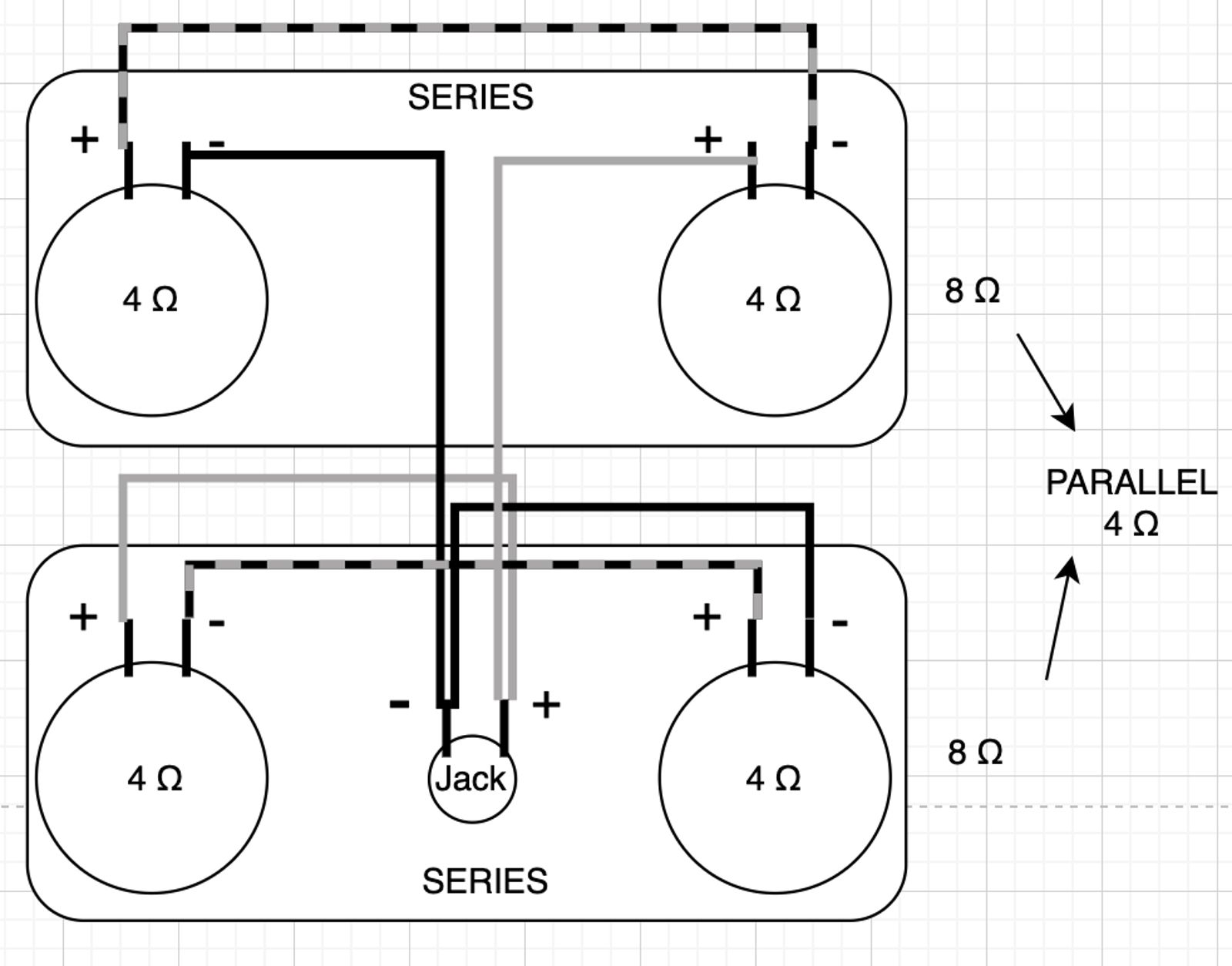
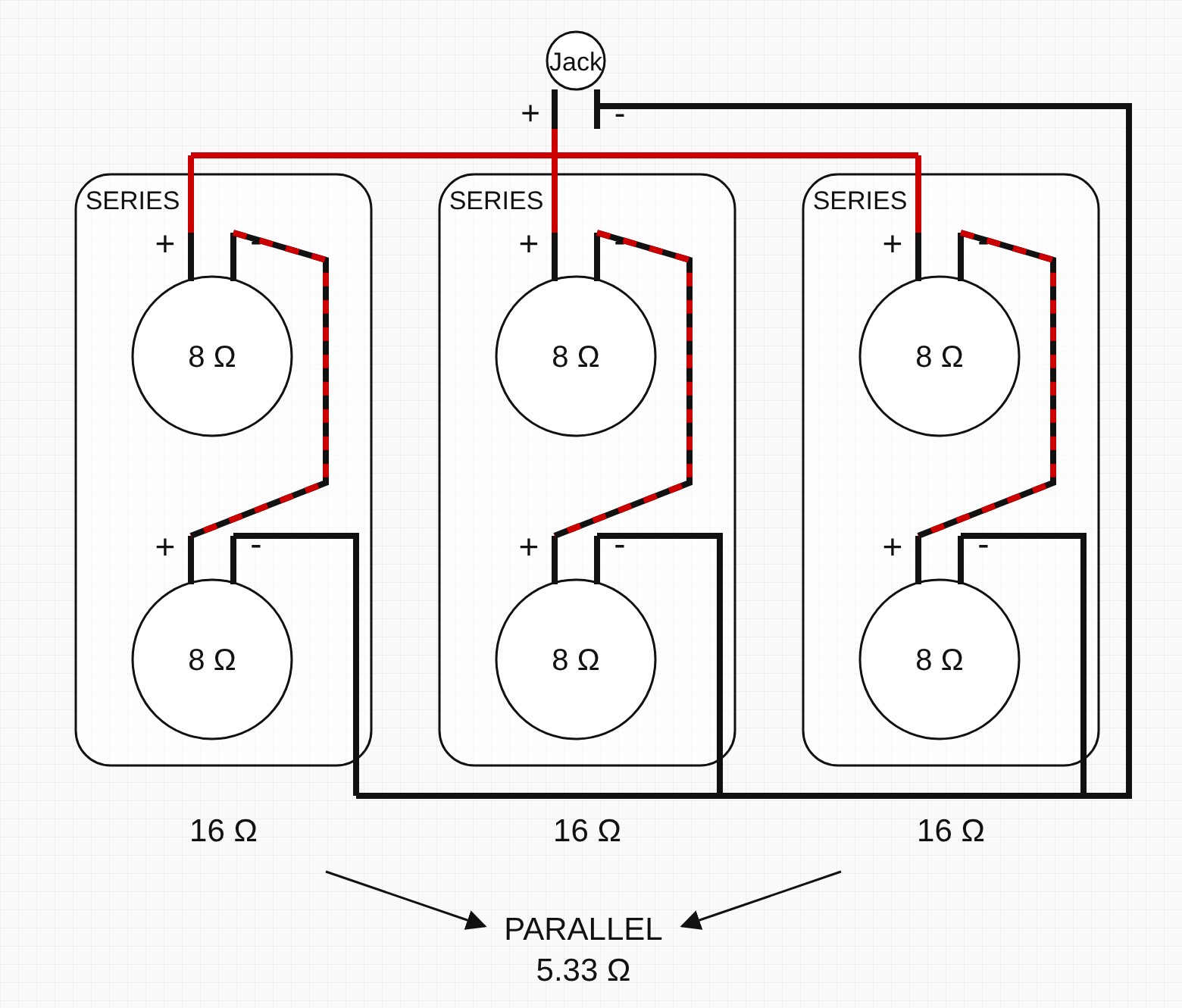
Four speakers already has five distinct layouts worth naming; six speakers adds three more on top of that (see the full articles for each). Keep adding speakers and the combinations only keep multiplying - the two rules never change, but the number of ways to arrange them does.
See Also
Other articles in the Speakers section build on this one - open them from the Reference Tools list:
- 4x (Four-By) Speaker Cabinet Wiring Layouts - applies these same series/parallel rules twice over, to four-speaker cabinets.
- 6x (Six-By) Speaker Cabinet Wiring Layouts - the same math extended to three pairs of speakers.
- Speaker Wire: AWG vs. Distance vs. Ohms - once you know the net impedance from the configuration you picked, use this to size the cable run.
- Speaker Cable Power-Loss Calculator - plug that net impedance in directly to see the loss for your specific cable run.