A relay is a switch worked by an electromagnet. A small current through its coil pulls a set of contacts from one position to another, and those contacts can switch a completely separate circuit: an audio signal, a speaker, or even the mains. That lets a tiny control signal, from a soft footswitch, a MIDI controller or a circuit, switch things a footswitch alone can't reach or shouldn't carry.
Relays are behind quiet relay-bypass pedals, amp channel switching, loopers and amp switchers, and remote speaker selectors.
Inside a Relay
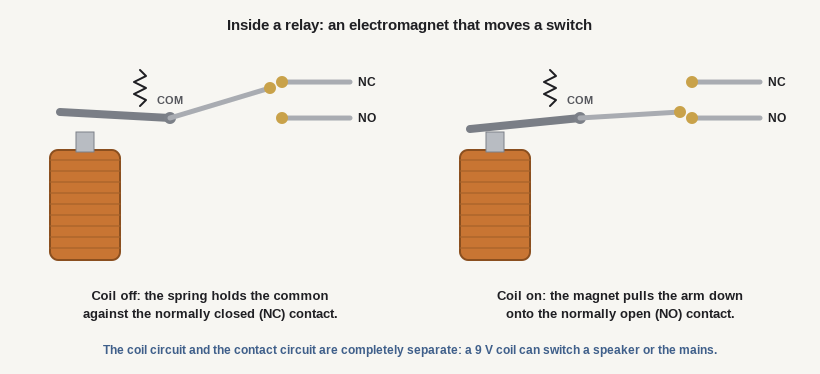
- The coil: a winding of fine wire around an iron core. Current through it makes a magnet.
- The armature: a hinged iron arm the magnet pulls down.
- The contacts: a moving common contact (COM), carried by the armature, and two fixed contacts:
- Normally closed (NC): connected to the common when the coil is off.
- Normally open (NO): connected to the common when the coil is on.
- A spring returns everything to the NC position when the coil switches off.
The coil and the contacts share nothing but a moving arm. A 9 V coil can switch a speaker, or the mains, with no electrical connection between the two sides.
Reading the Codes
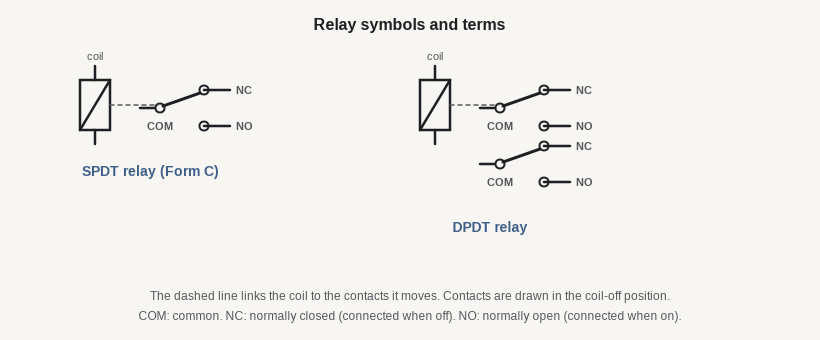
Relays use the same pole and throw codes as switches (see the Switches series):
- SPDT (also called Form C): one common, with NC and NO. The most common relay.
- DPDT: two SPDT sets moved by one coil. Used for true bypass, where the input and output both switch.
- SPST-NO (Form A) and SPST-NC (Form B): a single contact that only makes, or only breaks.
The other number on every relay is the coil voltage: 5 V, 9 V, 12 V, 24 V and so on. Feed a relay its rated coil voltage. Less may not pull it in; much more can overheat the coil.
The contact rating says what the contacts can switch: for example 16 A at 250 V AC. Level 3 covers ratings in detail.
On a schematic, a relay is drawn as a box (the coil) with a dashed line to the contacts it moves. The contacts are drawn in the coil-off position. Relays are labeled K1, K2 or RL1, RL2.
Kinds of Relay
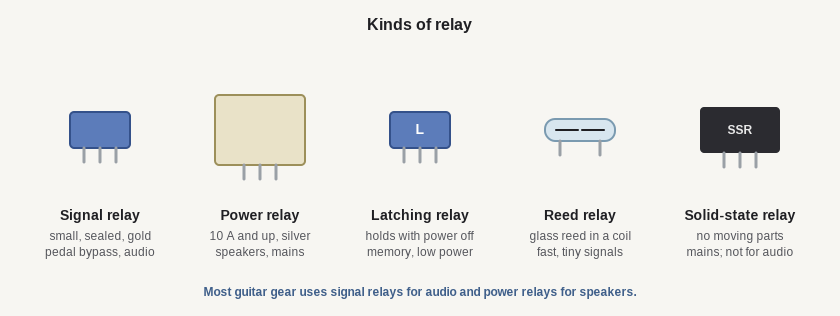
| Kind | What it is | Where it turns up |
|---|---|---|
| Signal relay | small and sealed, usually with gold contacts | relay-bypass pedals, loopers, switching guitar-level audio |
| Power relay | larger, with silver contacts rated 10 A or more | speaker switching, mains and heavy loads |
| Latching relay | stays in its last position with the power off, flipped by a short pulse | switching that remembers its state, and saves power |
| Reed relay | a tiny pair of reeds in a glass tube inside a coil | fast, very low-level switching |
| Solid-state relay | electronics, no moving parts | switching mains loads; not suited to audio |
When a Relay Beats a Switch
- Remote control: a footswitch, MIDI controller or circuit can switch something in another box, or across the stage, through a thin control cable that carries only the coil current.
- Many contacts at once: one coil can move several poles, or one footswitch can drive several relays.
- Heavy current: a relay keeps speaker or mains current out of the footswitch and its cable.
- Quiet and long-lasting: a soft-touch footswitch driving a sealed relay is quieter and wears out far more slowly than a mechanical 3PDT.
The cost: a relay needs power, and a circuit to drive it.
Where You Find Them
| In a... | What the relays are doing |
|---|---|
| Pedal | relay bypass with a soft-touch footswitch, presets, remote switching |
| Tube amp | channel and voicing switching from the footswitch, effects loop switching, output muting, and sometimes standby |
| Loopers and switchers | routing effects loops and amps under MIDI or footswitch control |
| Speaker selectors | switching an amp between cabinets, often remotely |
Try It
In Build a Circuit, drag in Relay-Switched LED. Open the relay in the Inspector and set it energized and de-energized: watch which contact the LED's circuit runs through. Then place your own Relay and give it two poles.
Level 2 covers how to use relays: driving the coil, the flyback diode, relay bypass in pedals, switching speakers safely, and channel switching in amps.