Level 1 covered batteries, plugs, volts and milliamps. This level is about what goes wrong and how to avoid it: why polarity mistakes kill pedals, daisy chains versus isolated supplies, hum and ground loops, running pedals at higher voltages, and what the power section inside a pedal is doing.
Why Polarity Mistakes Kill Pedals
Plug a center-positive adapter into a center-negative pedal and the whole circuit sees its supply backwards. Electrolytic capacitors are polarized and can fail or burst when reversed, and chips and transistors can be destroyed in an instant.
Most well-built pedals have polarity protection: a diode that blocks a backwards supply, as covered in the Diodes and LEDs series. But not every pedal has it, especially older and cheaper ones, and protection only covers polarity, not too much voltage. The habit that saves pedals is the simple one: check the label every time, and keep stray adapters away from the pedalboard.
AC adapters are a separate trap. A handful of pedals, mostly older digital units, run on 9 V AC. Feeding AC to a DC pedal, or DC to an AC pedal, does it no good. The label says AC or DC; believe it.
Inside a Pedal: the Power Section
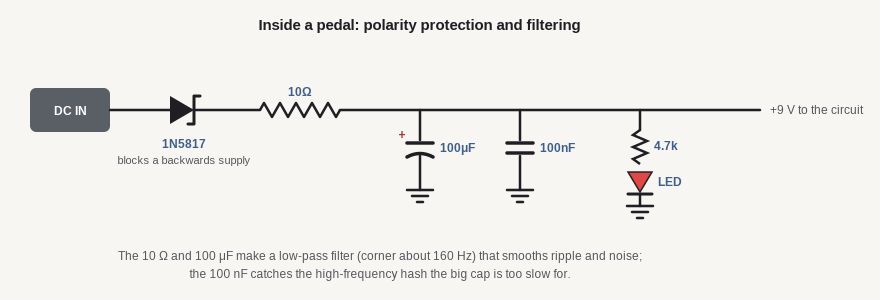
The first few parts after the DC jack in most pedals are the same:
- A diode blocks a backwards supply. A Schottky (1N5817) costs about 0.3 V; a 1N4001 about 0.7 V. Some designs use a P-channel MOSFET, which costs almost nothing (see the FETs and MOSFETs series).
- A small resistor and a big electrolytic cap (here 10 Ω and 100 µF) form a low-pass filter that smooths ripple and noise from the supply.
- A small ceramic cap (100 nF) catches high-frequency noise.
- The power LED and its resistor, which is often the single biggest current draw in a simple fuzz.
Daisy Chain or Isolated Supply
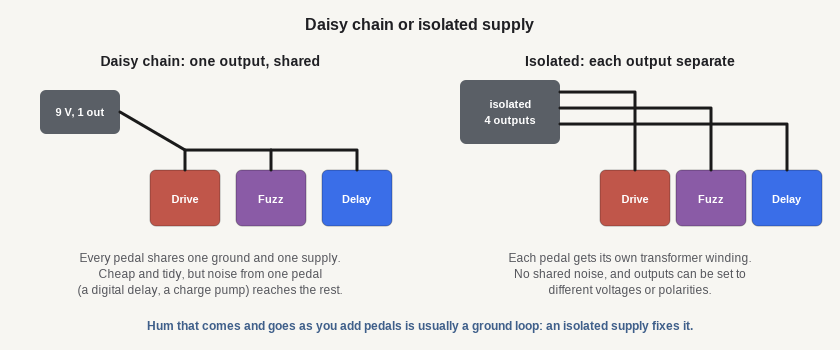
A daisy chain is one cable with several plugs, running every pedal from one supply output. It is cheap and tidy, and with a few simple analog pedals it often works fine. But every pedal shares one supply and one ground, so:
- Noise from one pedal, such as a digital delay's clock or a charge pump's whine, reaches all the others.
- Different ground paths through the audio cables and the power cable can form a ground loop, which hums.
- The total current of every pedal comes from one output, which must be big enough for all of them.
An isolated supply gives each output its own separate winding or converter, with no shared ground between outputs. Each pedal is electrically on its own, so noise doesn't spread and ground loops can't form through the power. Isolated outputs can also be set to different voltages, and can safely power a positive-ground vintage fuzz alongside normal pedals, which a daisy chain cannot (see the Transistors series).
The rule of thumb: a daisy chain for a few simple analog pedals; an isolated supply for anything bigger, anything digital, or anything that hums.
Tracking Down Hum and Noise
| Symptom | Likely cause | Try |
|---|---|---|
| Hum that changes as you add or remove pedals | ground loop | an isolated supply; power the noisy pedal separately |
| Whine or digital chirping | a digital pedal or charge pump sharing power | give it its own isolated output |
| Hum only with one pedal | that pedal's adapter, or the pedal itself | try a different supply output |
| Crackle when you move the power plug | a loose plug, often the wrong pin size | check for a 2.1 mm plug and jack (Level 3) |
| Fuzz sounds sputtery and gated | a dying battery | a new battery or an adapter |
Higher Voltages
Running a pedal at 18 V instead of 9 V gives its circuit more room to swing before it clips. That means more headroom: cleaner, louder and more dynamic, especially in clean boosts, overdrives built for it, and some compressors.
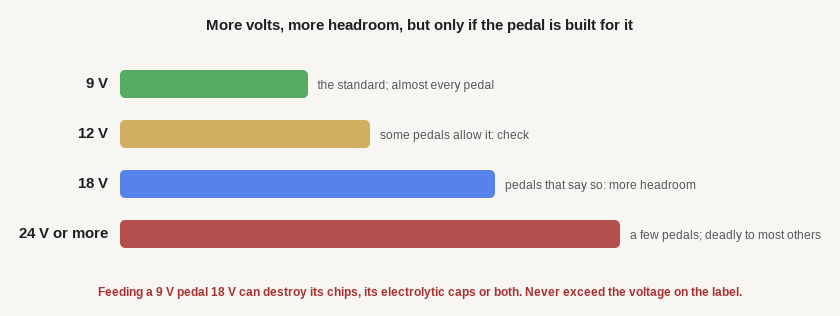
But only if the pedal is built for it. A 9 V pedal fed 18 V can lose its chips, its electrolytic caps rated for 16 V, or both. The label or manual says what a pedal accepts; if it says 9 V only, it means it.
Some pedals reach 18 V internally from a 9 V supply using a charge pump, a small chip that doubles the voltage. They are convenient, but they can whine on a shared supply, which is another reason for isolated outputs.
Battery or Adapter?
| Battery | Adapter or supply | |
|---|---|---|
| Noise | the quietest possible | depends on the supply; isolated is best |
| Cost over time | adds up | pays for itself |
| Voltage | sags as it runs down | steady |
| Good for | fuzzes, testing, a single pedal | everything on a board |
Some players hear a difference in germanium fuzzes as a battery runs down, and a few pedals include a voltage sag control to imitate it.
DANGER: LETHAL VOLTAGE. A pedal adapter takes the mains and turns it into safe low voltage. Never open an adapter or a pedalboard power supply, and never use one with a damaged case or cord. The inside of a tube amp also runs from the mains and stores lethal voltages in its filter caps even when unplugged; the Cap Drain & Bleeder Calculator shows how they are drained.
Common Mistakes
- The wrong polarity. Check the label; center negative is standard for pedals but not for everything else.
- Too many volts. An 18 V or 24 V supply on a 9 V pedal.
- Too little current. A big digital pedal on a 100 mA output resets, glitches or won't start.
- A daisy chain full of digital pedals. Noise and hum.
- A positive-ground fuzz on a daisy chain. It shorts the supply.
- A battery left in with the input plugged in. Flat by the next gig.
Try It
In Build a Circuit, load Clean Power Filter (9V DC Input) and find each part from the diagram above: the 1N5817, the 10 Ω resistor, the two caps and the LED. Then load Diode Polarity Protection for the simplest version of the same idea, running from a battery.
Level 3 covers the numbers: power budgets, battery life, the filter math, plug sizes, regulators and charge pumps, and how to measure voltage, polarity and current draw.