Every pedal needs DC power, and most of the problems pedals have come back to it: hum, noise, crackling, a pedal that won't turn on, and the one that never worked again after it met the wrong adapter. This series covers the batteries, plugs and supplies that feed pedals, how to read them, and how to avoid the mistakes that kill pedals. Tube amps run from the mains, which is a different and far more dangerous subject; it is covered only where it touches pedal power.
The 9 V Battery
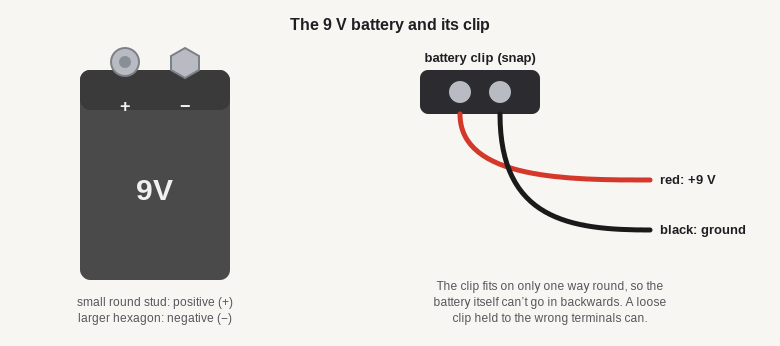
The classic pedal power source is a 9 V battery (often called a PP3):
- The small round stud is positive (+).
- The larger hexagonal terminal is negative (−).
- The battery clip (snap) only fits one way round. Its red wire is +9 V and its black wire is ground.
Batteries are clean, quiet power with no hum and no ground loops, which is why some players still prefer them for fuzzes. But they run down, their voltage sags as they do, and a dying battery is a common cause of a fuzz that sounds sputtery or a pedal that cuts out.
How the Guitar Cable Turns the Battery On
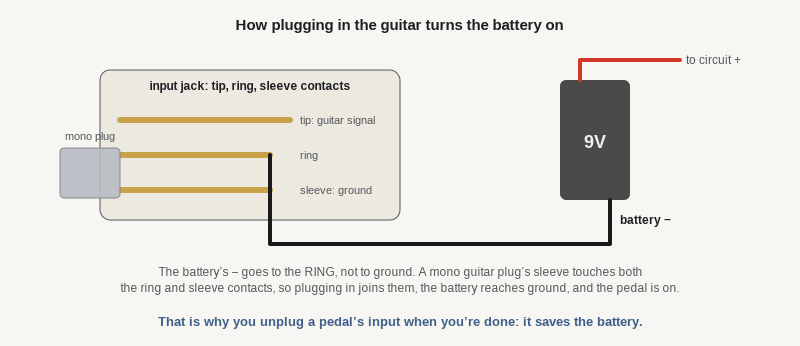
Most battery-powered pedals have no power switch. Instead, the input jack is a stereo jack, and the battery's negative wire goes to its ring contact instead of to ground. Plugging in an ordinary mono guitar cable lets the plug's sleeve touch both the ring and the sleeve contacts, which joins them, so the battery reaches ground and the pedal turns on.
The practical result: unplug a battery pedal's input cable when you're done, or the battery keeps running down. Pedals running from an adapter don't care.
The DC Jack and Plug
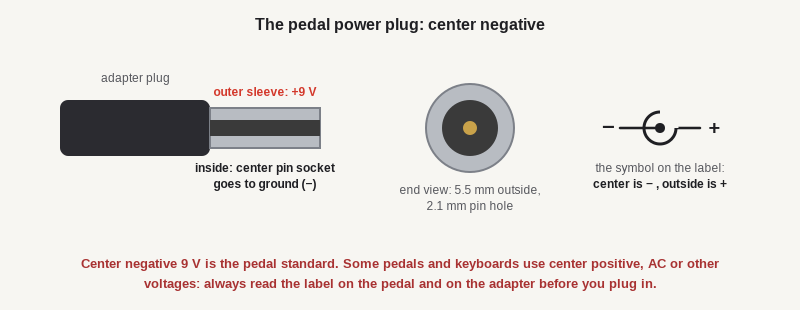
Most pedals take power through a barrel jack:
- Size: 5.5 mm outside, 2.1 mm center pin. This is the pedal standard.
- Polarity: center negative. The inside of the plug is negative (ground) and the outside barrel is positive. Most of the electronics world uses center positive, which is why a random adapter from a drawer is so dangerous to a pedal.
- The symbol on a pedal or adapter label shows the polarity: a dot inside a broken circle, with − and + marking which side connects to the center and which to the outside.
Read both labels before you plug in: the pedal's and the adapter's. Voltage, polarity and whether it is AC or DC all have to match. A center-positive adapter, or one with too many volts, can destroy a pedal the moment it is plugged in. Level 2 explains why.
Volts and Milliamps
Two numbers matter on every pedal and every supply:
- Voltage (V): what the pedal is built for. Most pedals are 9 V DC. Some accept or need 12 V or 18 V, and the label or manual says so. More volts than the pedal is rated for can destroy it.
- Current (mA): how much the pedal draws. The supply must be able to deliver at least that much. A supply rated for more current than the pedal needs is fine: the pedal only takes what it needs.
| Kind of pedal | Typical draw |
|---|---|
| Simple fuzz or boost | 1 to 10 mA |
| Overdrive or distortion with an op-amp | 5 to 15 mA |
| Analog delay or chorus | 15 to 50 mA |
| Tuner | 20 to 100 mA |
| Digital delay, reverb or multi-effect | 100 to 500 mA or more |
On a Schematic
A pedal's power section is usually drawn as a DC jack or a battery symbol (long and short plates, the long one +), followed by a diode for protection, a resistor and capacitors for filtering, and sometimes a power LED. The supply rail is labeled +9V or V+, and ground uses the ground symbol.
Where You Find It
| In a... | Power comes from |
|---|---|
| Pedal | a 9 V battery, a DC adapter, or a pedalboard power supply; some high-headroom pedals step 9 V up to 18 V inside |
| Tube amp | the mains, through a power transformer. Lethal voltages inside: not a DIY area without training |
| Guitar | passive guitars need none; active guitars use a 9 V battery, switched by a stereo output jack the same way pedals do |
| Speaker cab | none: the amp powers the speaker |
Try It
In Build a Circuit, drag in Clean Power Filter (9V DC Input): a 9 V DC jack with polarity protection, filtering and a power LED, the same section found at the start of most pedals. Compare it with a circuit powered by the 9V Battery Clip.
Level 2 covers how power goes wrong and how to get it right: polarity mistakes, daisy chains and isolated supplies, ground loops and hum, higher voltages, and what the power section inside a pedal does.