The one rule of restringing a mandolin: one pair at a time. The bridge isn't glued or screwed down; the strings hold it in place. Take them all off and the bridge moves or falls, and the intonation goes with it. Level 1 covers the strings; Level 3 covers the setup.
Tools
- A set of eight mandolin strings with loop ends, and the same gauge as before unless you plan to set up for a new one.
- Side cutters, a string winder that fits small mandolin tuner buttons, a tuner, and a cloth.
- A soft pencil, to mark where the bridge foot sits before you start.
Before You Start
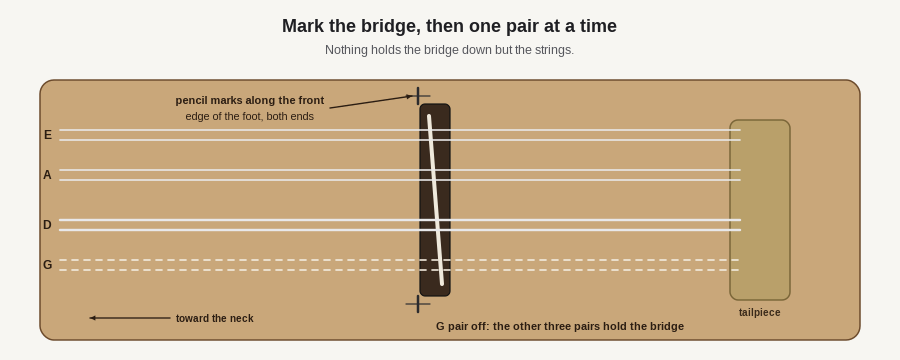
- Mark the bridge. Draw a light pencil line on the top along the front edge of the bridge foot, on both sides. If the bridge moves, you can put it back.
- Take off the tailpiece cover, if your mandolin has one. Most slide off toward the end of the body or lift off.
- Check the bridge stands straight. If it already leans, fix that after the first new pair is on.
One Pair at a Time
Work from the G pair across to the E, or from the E across: either way, only one pair is off at a time.
- Slacken one string of a pair until it's loose. Unwind it from its tuner post and lift the loop off its tailpiece pin.
- Hook the new loop over the same pin. On the pinned Gibson-style tailpiece, bend the loop slightly first, so it seats on the pin and lies flat.
- Hold light tension on the string with one hand so the loop can't slip off, and lay it into its saddle slot and its nut slot.
- Find the cut point. Pull the string past its tuner post about 2 in (5 cm), then bend it 90 degrees there and cut just past the bend.
- Feed the end into the post's hole, and wind so the wraps go downward on the post, three or four of them on the plain strings, two or three on the wound ones.
- Bring it to pitch, then do the second string of the pair the same way.
- Tune the pair together: both strings of a course must be at exactly the same pitch, or the course sounds sour.
Repeat for the next pair. Keep checking the bridge: it should stay on its pencil marks and stand straight.
Which Post Is Which
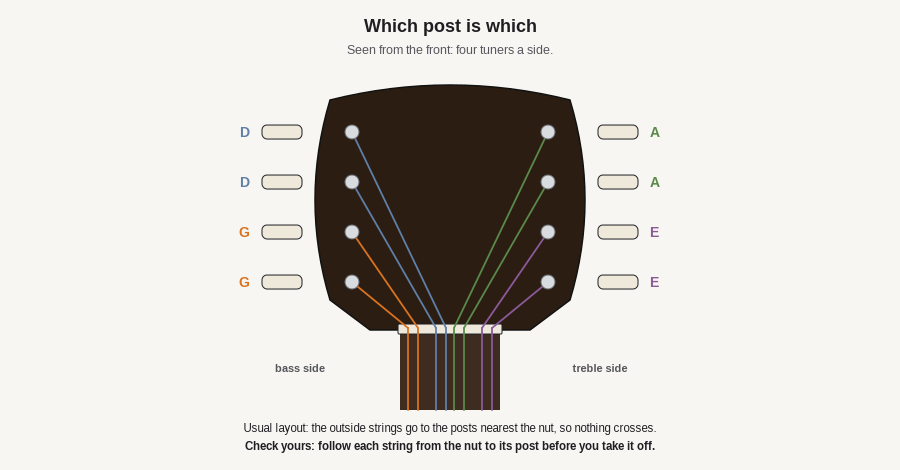
Mandolin headstocks carry four tuners per side, and the strings fan out to reach them. Before you take a string off, follow it with your eye from the nut to its post, and put the new one on the same post. Strings put on the wrong posts can cross each other and buzz.
Stretching In
New strings stretch. After all four pairs are on, stretch each string gently along its length, retune, and repeat two or three times. Plain strings stretch the most. A mandolin's short scale means small stretches show up as big changes in pitch.
Straighten the Bridge
As you bring strings up to pitch, they drag the top of the bridge toward the neck. When you're done, check it from the side: it should stand at a right angle to the top. If it leans, hold the foot still and ease the top of the bridge back upright with your thumbs, a little at a time, with the strings at pitch.
If the Bridge Moves
If the bridge does shift or fall:
- Put it back on its pencil marks, with the taller, stepped-back end of the saddle on the bass (G) side.
- If you have no marks, set the front of the saddle at about twice the distance from the nut to the 12th fret.
- Bring the strings to pitch and check the intonation as in Level 3.
Try It
Next time you restring, mark the bridge first, then change only the G pair and tune it. Look at the bridge from the side before and after: you'll see how much the strings pull it, and why the other three pairs stay on while you work.