A mandolin is small, loud and built nothing like a guitar under the strings. It has eight strings in four pairs, a floating bridge that nothing holds down but string pressure, and a tailpiece that anchors the strings past the bridge. Those three things decide how you restring it (Level 2) and how you set it up (Level 3). This level covers the instrument and its strings.
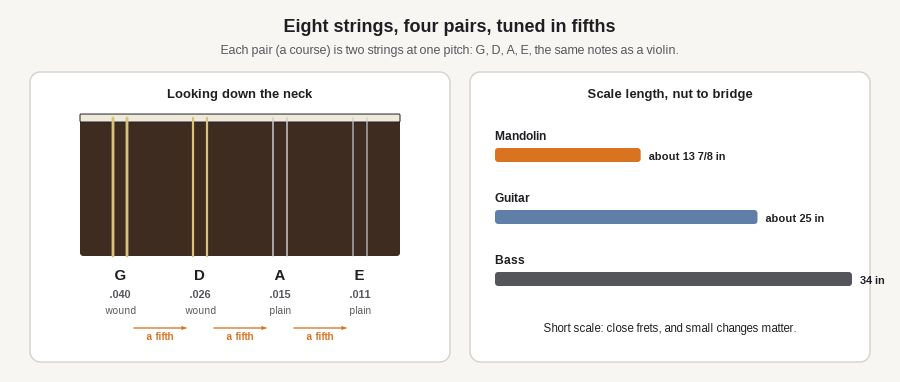
Four Pairs, Tuned in Fifths
The eight strings run in four courses, each a pair tuned to the same note: G, D, A, E from the bass side, the same notes as a violin. Each course is a fifth above the last, so one fingering shape works across the whole neck. You pick both strings of a pair at once, which gives the mandolin its shimmer: two strings never perfectly together.
The scale is short: about 13 7/8 in on most mandolins, against 25 in or so on a guitar. Frets are close together, and small changes matter more.
The Shapes
- A-style: a teardrop body. Simpler to build and to set up, and usually less expensive.
- F-style: the scroll on the upper bass side and the points on the body, after the Gibson F-5 of the 1920s, the bluegrass sound.
- Carved top and back: an arched top, carved like a violin's, usually with f-holes. Loud, with a short, punchy note: the "chop" in bluegrass.
- Flat top: a flat or slightly arched top with a round or oval soundhole. Sweeter, with more sustain, common in folk and Celtic music.
- Bowl-back: the older European (Neapolitan) mandolin with a rounded back of many ribs. Ian Anderson wrote "Fat Man" on one bought in Denmark; his story is in Martin 0, 00 and 000, Level 3.
The Strings
| E pair | A pair | D pair | G pair | |
|---|---|---|---|---|
| Type | plain | plain | wound | wound |
| Light set, about | .010 | .014 | .024 | .036 |
| Medium set, about | .011 | .015 | .026 | .040 |
- Loop ends. Mandolin strings have a small loop, not a ball, at the tailpiece end. The loop hooks over a pin on the tailpiece. A ball-end guitar string of the right gauge works in a pinch with its ball cut away.
- Wound string materials: phosphor bronze (warm, long-lasting, the most common), 80/20 bronze (brighter, wears faster), nickel or stainless (for electric mandolins and a darker tone), and flatwound (smooth, mellow, quiet under the fingers).
- Medium is the standard on carved mandolins: the top is built to be driven. Lights are easier to fret and kinder to an older or flat-top instrument.
Tension and the Top
A full set of mediums pulls about as hard as a set of light guitar strings, on a top a fraction of the size. That pressure is what holds the bridge down, which is why a mandolin's bridge can float. It's also why the bridge foot has to fit the top exactly, and why taking all the strings off at once is a bad idea: the bridge falls off, and has to be put back exactly where it was.
The Floating Bridge
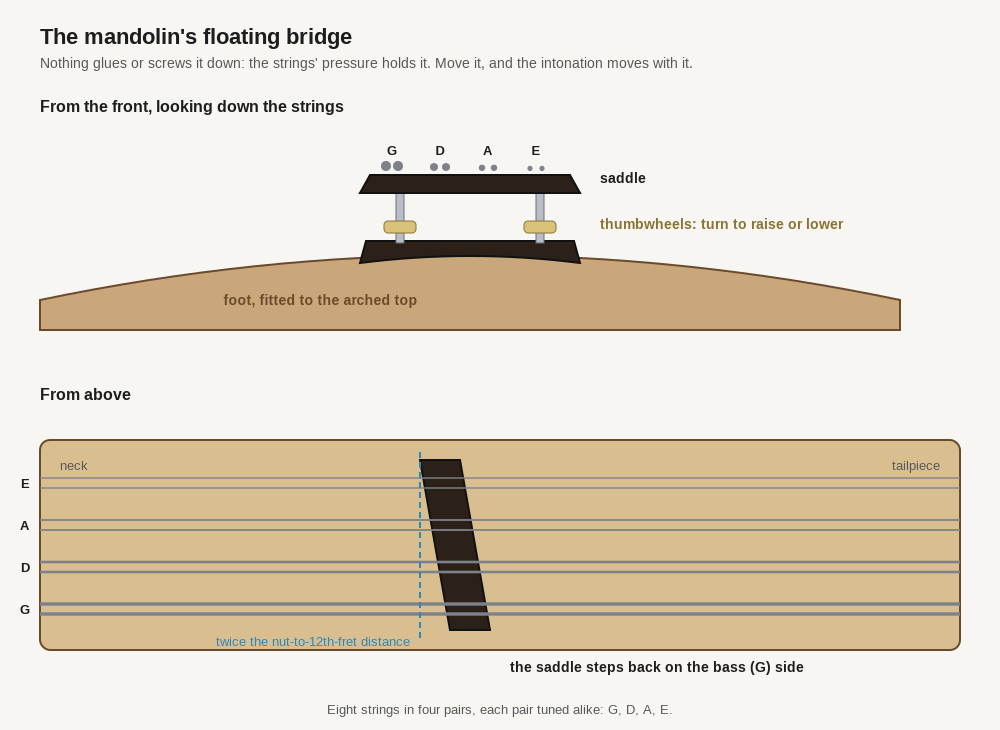
- The foot is carved to fit the arch of the top. A gap under the foot costs volume and tone.
- Two thumbwheels on threaded posts set the height of the saddle: that's the action.
- The saddle is compensated: it steps back on the bass side, because the heavier G and D strings need a little more length to play in tune.
- The position of the whole bridge sets the intonation. The saddle sits at about twice the distance from the nut to the 12th fret, plus a little compensation.
Try It
Look down the strings of a mandolin from the tailpiece end. Check that the bridge stands straight up, not leaning toward the neck or the tailpiece, and that its foot touches the top along its whole length. Then find the slight pencil or finish mark many players leave by the bridge foot: it's the record of where the bridge belongs.