A Floyd Rose can be set up three ways, and the choice changes how it plays and how it behaves when a string breaks. This level covers all three, how to balance a floating bridge, and what to do when you change string gauge or tuning. Level 1 covers how it works; Level 3 covers parts and wear.
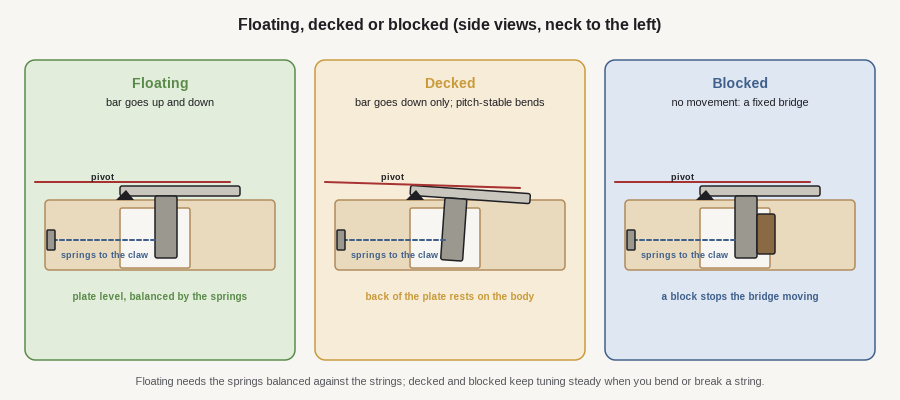
| Setup | Bar | Good for | Trade-off |
|---|---|---|---|
| Floating | up and down | flutters, pull-ups, the full range of the bar | bends and a broken string pull the other strings out of tune |
| Decked | down only | steady bends and double-stops, easier tuning | no pulling up |
| Blocked | none | a fixed bridge with locking stability; drop tunings | no bar at all |
Decking
Add spring tension (tighten the claw screws, or add a spring) until the back of the base plate rests on the body. From there, the bar can dive but not pull up, and bending one string can't drag the others flat, because the bridge can't tip any further toward the neck. A little extra spring tension past the point of touching keeps it seated during hard bends.
Blocking
Wedge a block of hardwood behind the sustain block, between it and the back wall of the cavity, so the bridge can't move toward the body's tail. Many players also keep the springs tight so the block can't move the other way. Some use a made-for-purpose stopper instead of wood. A blocked Floyd Rose keeps the locks, so tuning is very stable, and it makes drop tunings on the fly simple.
Balancing a Floating Bridge
The aim is the plate parallel to the body (or to its recess) with the strings at pitch.
- Unlock the nut and set all six fine tuners to the middle of their travel.
- Tune to pitch with the tuners, working through the strings several times. The bridge moves as you go, so each pass gets closer.
- Look at the plate from the side. Back edge high (tipped toward the neck): the strings are winning, so tighten the two claw screws a little, equally. Back edge low: loosen them.
- Retune and look again. Repeat until the plate is level with the strings at pitch. Small turns of the claw screws; a quarter turn makes a difference.
- Stretch the strings (Strings and Restringing, Level 3D), retune, and check the level once more.
- Lock the nut and fine-tune with the fine tuners.
A tip that saves passes: tune the strings slightly sharp before locking the nut. Clamping tends to pull them a touch sharp or flat depending on the nut, and you'll learn which way yours goes.
Changing Gauge or Tuning
A new gauge or a new tuning changes the strings' pull, so the bridge won't float level any more. Heavier strings or a higher tuning pull harder: add claw tension or a spring. Lighter strings or a lower tuning: take some off. Then rebalance as above. A big change usually also needs the neck relief and intonation reset: see On the Bench: Guitar Setup, Level 2C: Floyd Rose.
Tuning a Floating Floyd Rose
- Tune in passes, not one string at a time to perfection: each string you raise pulls the bridge forward and flattens the others a little.
- Fine tuners first once the nut is locked. If a fine tuner bottoms out or runs out of thread, unlock the nut, center the fine tuners, retune with the tuners, and lock again.
- Watch the level. If the plate drifts after a few days, the springs and strings have settled: rebalance.
Try It
On a floating Floyd Rose, tune all six strings to pitch, then detune the low E by a whole step and watch the other five go sharp. Tune it back and they return. That is the balance at work, and why passes beat one-at-a-time tuning.
Level 3 covers the parts that wear, and the many versions of the Floyd Rose.