The Floyd Rose is the double-locking tremolo: the bridge that lets a player dive the strings slack and pull them back up, and still come back in tune. It works nothing like a Strat-style or PRS tremolo, and it needs its own way of working on it. This level covers where it came from and how it works. Level 2 covers floating, decking and blocking it, with changing strings gauge or tuning; Level 3 covers parts, wear and the many versions.
Where It Came From
Floyd D. Rose was a jeweler and a rock guitarist who couldn't keep a vintage tremolo in tune. He started work on his own in 1976, first with a brass nut that clamped the strings with three U-shaped clamps, then with a bridge of his own that clamped them at the saddles too. He hand-made the early units, patented the double-locking design in 1979, and in 1982 struck a deal with Kramer, whose guitars made it the sound of 1980s rock.
Hand-made units could be set so precisely that they didn't need fine tuning. Once production began, the bridge gained the six fine tuners it has today, so the strings can be tuned after the nut is locked. The Original Floyd Rose is still made in Germany, and licensed versions are made by many makers (Level 3).
The Two Locks
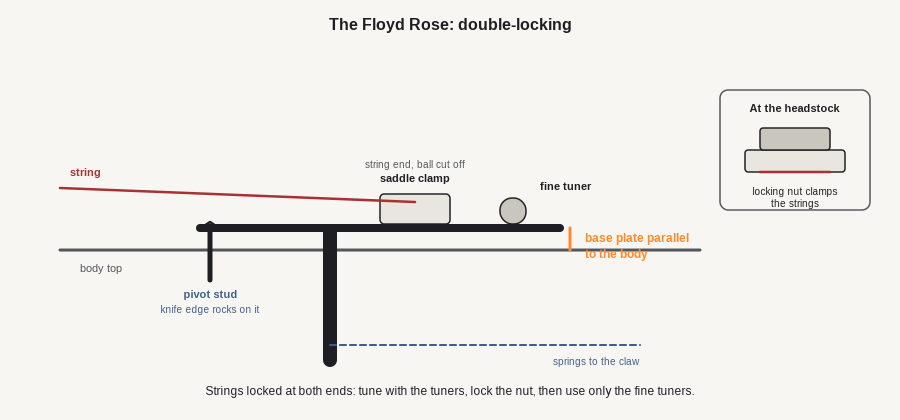
A normal tremolo goes out of tune because the strings slide: over the nut, around the tuner posts, and through the bridge. Every dive and return leaves them a little off. The Floyd Rose stops the strings sliding at both ends:
- At the bridge, each string's ball end is cut off and the string is clamped inside its saddle by a small block and bolt.
- At the nut, three clamps lock the strings in pairs.
Between the two locks, the string can only stretch and relax. It can't slide, so it comes back to the same place.
The Parts
| Part | What it does |
|---|---|
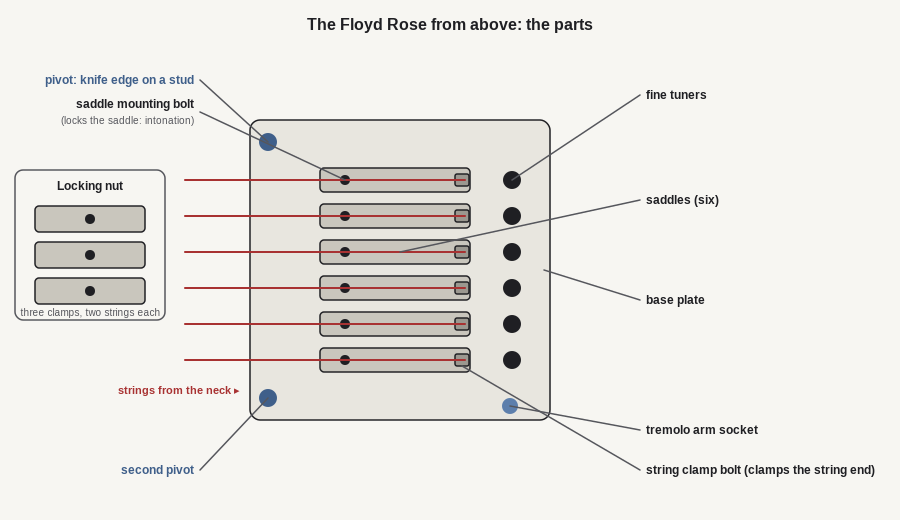
| Base plate | carries the saddles and fine tuners; rocks as one piece |
| Knife edges | the two hardened edges at the front of the plate that rock against the studs: the pivot |
| Pivot studs | screwed into the body; their height sets the action |
| Sustain block | the heavy block under the plate, inside the body; the springs hook into it |
| Springs and claw | in the back cavity; they pull the block toward the neck, balancing the strings |
| Saddles | each clamps its string with a block and bolt; slide forward and back to set intonation |
| Fine tuners | six thumb screws on the back edge; each presses on its saddle's clamp to tune the string a little |
| Locking nut | three clamps, two strings each, tightened with a hex key |
The Balance
A floating Floyd Rose is a seesaw. The strings pull the top of the bridge toward the neck; the springs pull the bottom of the block toward the neck from the other side of the pivot. When the two pulls are equal, the plate floats level. Change either one (a new gauge, a new tuning, one string going sharp) and the balance shifts, so every string's pitch shifts with it. That's why tuning one string moves the others, and why Level 2 spends so long on getting the balance right.
Not a Floyd Rose
Strat-style six-screw and two-point tremolos, and PRS tremolos, do not lock. Some of those guitars have locking tuners, which clamp the string at the tuner post: a different thing, and not double-locking. The procedures here are for the Floyd Rose and its licensed versions only.
Try It
On a Floyd-equipped guitar, look along the plate from the side: is it level with the body, tipped forward, or resting on it? That tells you whether it floats or is decked, which Level 2 covers. Then find the two knife edges against the studs, and count the springs in the back cavity.
For restringing, see On the Bench: Strings and Restringing, Level 3D: Floyd Rose; for a full setup, On the Bench: Guitar Setup, Level 2C: Floyd Rose.