Before setting the bias, you have to read it. There are four common ways, and they differ a lot in how safe and easy they are. Level 1 covers what bias is; this level covers measuring it; Level 3 covers setting it.
DANGER: LETHAL VOLTAGE. Biasing is done with the amp on, with hundreds of volts DC live inside. Use one hand, insulated tools and probes, and always have a speaker or dummy load connected. The Cap Drain & Bleeder Calculator explains why the caps stay charged after switch-off. New to working inside an amp? Start with On the Bench: Safe Practice.
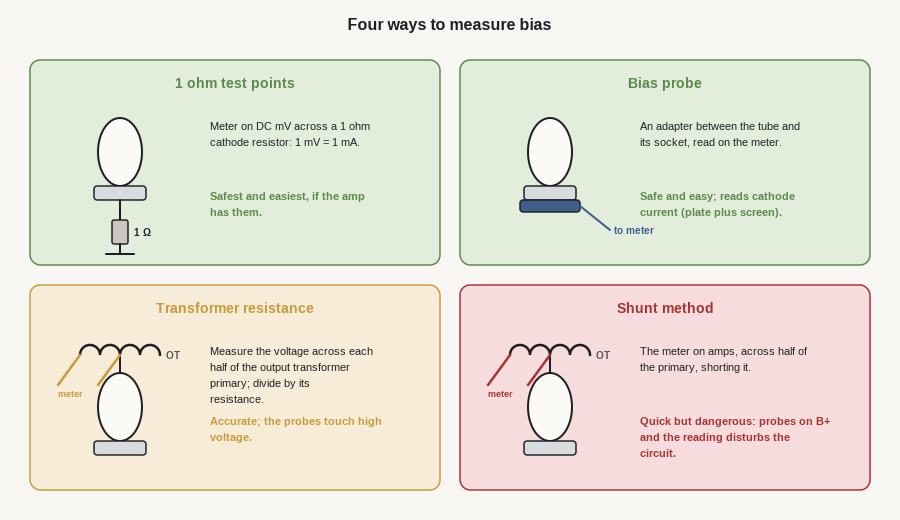
| Method | How | Safety | Reads |
|---|---|---|---|
| 1 ohm test points | meter on DC millivolts across a 1 ohm resistor in each tube's cathode: 1 mV = 1 mA | safest; the test points are near ground | cathode current |
| Bias probe | an adapter plugged in between the tube and its socket, with leads to the meter | safe; nothing to touch inside | cathode current |
| Transformer resistance | measure each half of the output transformer primary in ohms (amp off), then the DC voltage across it (amp on); current = volts ÷ ohms | probes on high voltage | plate current |
| Shunt | the meter on DC amps, across half of the primary | dangerous: probes on B+, and the meter changes what it measures | roughly plate current |
Use the first two when you can. Many amps have 1 ohm test points built in, and adding them is a common, simple mod. A bias probe works on any amp with no changes.
Cathode Current vs Plate Current
Test points and bias probes read cathode current, which is the plate current plus the screen current. At idle the screen draws roughly 5% of the total, so aim about 5% above the plate-current target. The Tube Bias Calculator shows both.
Reading the Numbers
- Plate voltage. Measure it from a power tube's plate (pin 3 on octal tubes such as the 6L6, EL34 and KT88; pin 7 on the EL84) to ground, with the amp idling. Use it, not the schematic's figure, to work out the target.
- One test point for two tubes reads both together: divide by two.
- Readings drift as the tubes warm. Read once after a couple of minutes, and again after 10 to 15.
- Wall voltage moves everything. Higher mains voltage means higher B+ and a hotter idle.
Cathode-Biased Amps
There is nothing to adjust, but you can still check the idle. Measure the DC voltage across the cathode resistor, divide by its resistance to get the current, and divide by the number of tubes sharing it. Plate voltage minus that cathode voltage, times the current per tube, is the idle in watts.
Tools
- A meter with a DC millivolt range and probes rated for the voltage.
- Alligator-clip leads, so the black lead can be clipped to the chassis before power goes on.
- A bias probe if the amp has no test points (single or dual, matched to the tube's base: octal or 9-pin).
- An insulated trim tool for the bias pot.
Try It
Find your amp's schematic and look for 1 ohm resistors between the power tube cathodes and ground. If they're there, find the test points they feed. If not, note the tube's base type, because that's the bias probe you'd need.
Level 3 covers setting the bias: matched tubes, the pots, and a step-by-step routine.