Every power tube needs to idle at the right current: enough to play cleanly, not so much that it wears out or overheats. Setting that idle is biasing. This level covers what bias is, the two ways amps set it, and where the idle should sit. Level 2 covers measuring it, and Level 3 setting it.
DANGER: LETHAL VOLTAGE. Biasing is done with the amp on, with hundreds of volts DC live inside. Use one hand, insulated tools and probes, and always have a speaker or dummy load connected. The Cap Drain & Bleeder Calculator explains why the caps stay charged after switch-off. New to working inside an amp? Start with On the Bench: Safe Practice.
Bias Is the Idle
Think of bias as a car's idle. Too low and the engine stalls: the tube runs cold, sounds thin and fizzy, and quiet notes break up oddly (crossover distortion). Too high and it is always revving: the tube runs hot, wears out early, and in the worst case its plates glow red. Set right, it idles smoothly, ready the moment you hit the strings.
The control is the grid. A negative voltage on each power tube's control grid holds back the current flowing from cathode to plate. More negative, less current, colder; less negative, more current, hotter.
The Engineer's Word: Quiescent
"Idle" is the bench word. Data sheets, schematics and textbooks call the same thing the quiescent state: the tube powered up and ready, with no signal coming in. It is the car at the lights: engine running, foot off the gas, ready to go. The quiescent current is the idle speed, and the signal is the gas pedal. The heater warms the cathode so it gives off electrons, the grid sits at its steady negative bias voltage, and the plate, at high positive voltage, draws a steady stream of electrons through it.
| Term | What it means |
|---|---|
| Quiescent current (Iq, idle current; "zero-signal plate current" on many data sheets) | the steady DC current from cathode to plate with no signal: the number you bias to |
| Quiescent plate voltage (Vq) | the resting DC voltage on the plate, before a signal swings it up and down |
| Idle dissipation (Vq x Iq) | the heat the plate makes at rest; compared with the tube's maximum, it says whether the tube is biased cold or hot |
| Q-point (quiescent point, operating point) | where the tube rests on its curves; the signal swings it either side of this point |
Biasing a tube amp is setting the quiescent current, so that the quiescent dissipation lands where the next section shows.
Fixed Bias and Cathode Bias
| Fixed bias | Cathode bias | |
|---|---|---|
| How it works | a separate negative supply feeds the grids | a resistor under the cathodes lifts them above ground, so the grid sits negative by comparison |
| Adjustable? | usually, with a bias pot (some have none) | no: the amp sets its own idle |
| Typical amps | most bigger amps: Fender Twin and Bassman, Marshall 50 and 100 W, Mesa, Hiwatt | many EL84 and small amps: Vox AC30, Fender Champ |
| New tubes need | biasing | only a matched set, and a check |
| Idle | set by you, usually 60 to 70% of max | often hotter, close to the tube's maximum, by design |
How to tell: a bias pot or bias test points on the chassis mean fixed bias. A large resistor, often with a big capacitor beside it, from the power tube cathodes to ground means cathode bias. The schematic says for certain.
Where the Idle Should Sit
Every power tube has a maximum plate dissipation: the most power, in watts, its plate can safely turn into heat. The idle is set as a share of it.
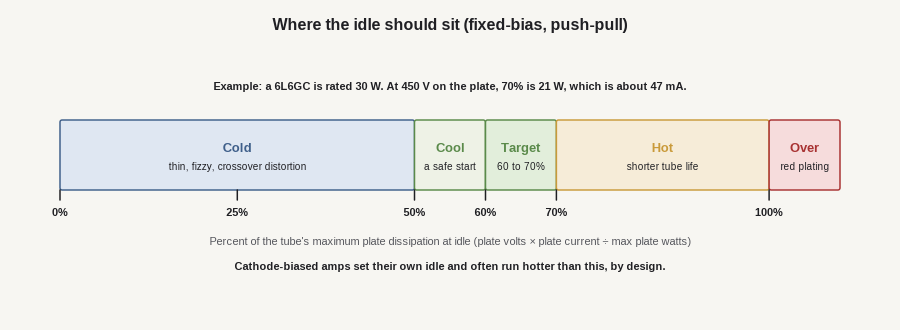
Idle watts = plate volts x plate current. For a push-pull class AB amp, 60 to 70% of the maximum is the usual target. Start cooler and go up only if the amp sounds thin.
| Tube | Max plate watts |
|---|---|
| EL84 | 12 W |
| 6V6GT | 14 W |
| EL34 | 25 W |
| 6L6GC | 30 W |
| KT88, 6550 | 35 W (some makers rate 42 W) |
When ratings vary, use the lower figure. The Tube Bias Calculator has the full list and works out the target in milliamps from your plate voltage.
Why New Tubes Need Biasing
No two tubes draw quite the same current at the same grid voltage. A new set, even a matched set from a different batch, can idle well hotter or colder than the old ones. That is why tubes are sold in matched sets, and why a fixed-bias amp gets checked every time its power tubes change.
Signs the Bias Is Off
- Too cold: thin, harsh or fizzy tone; a buzzy edge on notes as they die away; less punch.
- Too hot: tubes wear out quickly; tone gets mushy; a red or orange glow on the plates (a soft blue glow on the glass is normal); fuses blowing.
Try It
Open the Tube Bias Calculator, pick your amp's power tubes and plate voltage, and see what 60% and 70% mean in milliamps. Then check your amp's schematic: is it fixed or cathode bias, and does it have a bias pot?
Level 2 covers measuring the bias: test points, bias probes and the transformer methods.