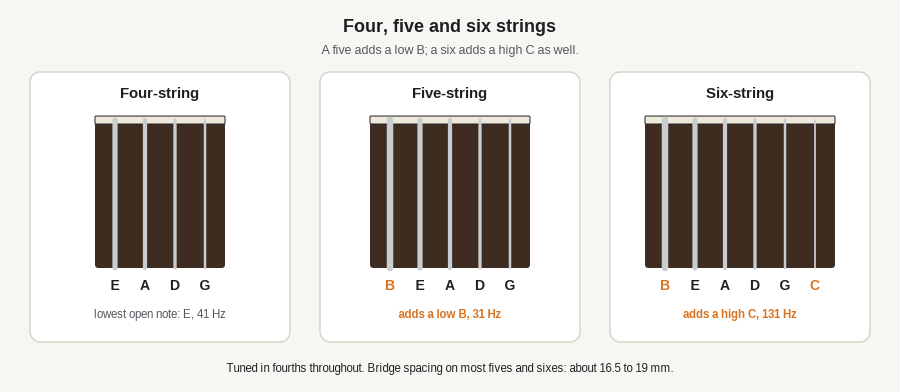
A five-string bass adds a low B below the E; a six-string adds a high C above the G as well. Everything in Level 4 still applies, but the extra strings bring their own problems: a low B that wants to flop, a wider neck and nut, and more strings sharing one pickup. This level covers what's different, string by string.
The Low B
The low B is the hardest string on any bass to get right. It's tuned a fourth below the E, so at the same scale it has far less tension for its thickness unless the gauge goes up a lot. A B that's too slack sounds floppy: it buzzes, wobbles in pitch as the note starts, and turns to mud through the amp.
What firms it up:
- Gauge. A .125 to .135 B is common on a 34 in scale; .130 and up gives more tension and a tighter note.
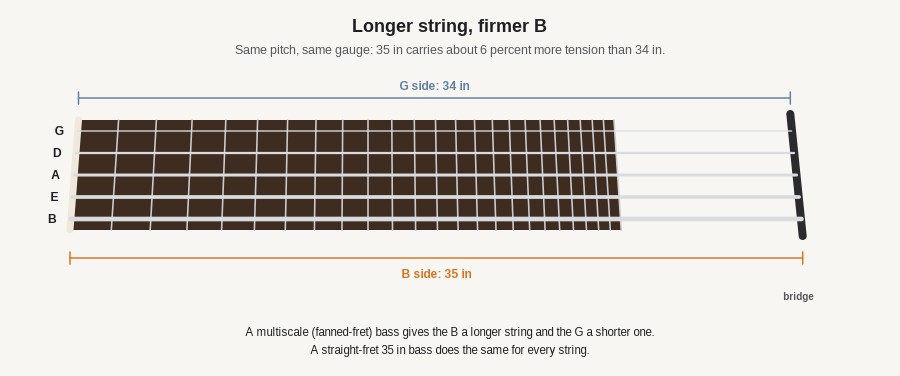
- Scale length. Many five-strings use a 35 in scale, and some a multiscale (fanned frets), longer on the bass side, such as 35 in for the B and 33 or 34 in for the G. The longer string carries more tension at the same pitch.
- A stiff neck. A neck that moves less with the strings' pull lets the B ring cleaner. Many five-strings have graphite rods or two truss rods for this.
- A tapered B. Many B strings narrow to an exposed core at the ball end, so the string bends over the saddle cleanly and sits fully on it. Non-tapered B strings need a saddle with enough break angle to seat them.
Strings and String Length
- Buy for the scale. A B string on a 35 in bass needs an extra long or super long scale set, and some do even on a 34 in bass, because the B's tuner is often the last one on the headstock. Measure from the bridge anchor to the B's tuner post before you buy.
- Check the silk. As on any bass, the silk wrap at the ball end must sit behind the saddle, not on it. On a long scale with a tapered B, the taper must start past the saddle as the maker intends.
- String-through bodies add length: check the set reaches.
- Wraps on the post: a B is thick, so one or two downward wraps is plenty. A high C is thin, so give it three or four.
The High C (Six-Strings)
The high C is usually a light roundwound, about .025 to .032, and wound strings are normal even at the top. It's the closest a bass comes to a guitar string. Its action can sit a little lower than the G's, and it often needs the pickup's treble side brought up a little to match the volume of the others.
The Neck and Nut
- String spacing at the bridge runs from about 16.5 mm to 19 mm on most five- and six-strings. Narrow spacing is easier for chords and fast lines. Wide spacing is easier for slapping and plucking hard.
- The nut is wider and the B slot must fit the B exactly. A slot too narrow pinches and binds when you tune; too wide and the string sits low and buzzes. Slot work for a heavy B is a technician's job.
- A wide neck has more wood to move. Give it extra time to settle after each truss rod turn.
Setup Specs for Five and Six
| Measurement | Where | Starting point |
|---|---|---|
| Neck relief | B string, capo at fret 1, fretted at the last fret, gap at fret 8 | about 0.014 in (0.35 mm), a touch more than a four-string |
| Action, B side | B string, top of the 17th fret | about 7/64 in (2.6 to 2.8 mm) |
| Action, treble side | G string, or high C on a six, same place | about 5/64 in (2.0 mm) |
| Pickup height, B side | B held at the last fret, to the pole piece | about 8/64 in (3.0 mm): the B is the loudest string, so it sits furthest away |
| Pickup height, treble side | G or C held at the last fret | about 5/64 in (2.0 mm) |
The B needs a little more relief and a little more height than the E on a four-string, because it swings the widest of all. If the B is still floppy with good relief, raise only the B saddle a little before changing anything else.
Setup, Step by Step
The order is the same as Level 4: relief, action, nut, pickups, intonation. Two differences:
- Measure relief on the B, since it's the string that buzzes first.
- Balance the pickups across all five or six strings. Play each string open and at the 12th fret, and tilt the pickup so the B isn't booming and the top string isn't thin.
Intonation works the same way, harmonic against fretted note at the 12th fret. The B saddle usually ends up furthest back, often near the end of its travel. If it runs out of room, a different B string (tapered, or another gauge) is the usual fix.
Try It
Play your B string open, hard, through the amp. If the note starts out sharp and wobbles down, the B is too slack: try one gauge heavier, a tapered B, or raise the B saddle a little. Then set it in the Guitar Setup tool under Bass, 5-string or Bass, 6-string.