Restringing a bass is much like a guitar, with two differences that matter: where the silk sits at the bridge, and cutting the string to length without the winding coming apart. This level covers the job step by step, and the setup after a gauge change. Level 1 covers what bass strings are made of; Level 2 covers choosing a set.
Tools
- Side cutters that can cut heavy bass strings cleanly.
- A string winder (a bass-sized one fits the bigger tuner buttons), a tuner, and a cloth.
One at a Time
Change one string at a time: the neck keeps its tension, and the bridge saddles stay where they are.
- Slacken the old string until it's loose, then take it off.
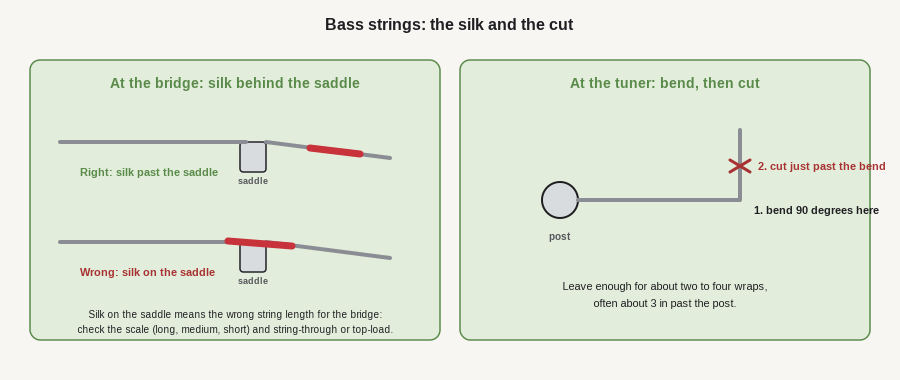
- Feed the new string through the bridge (top-load, or through the body from the back) and over its saddle. Check the silk sits behind the saddle, not on it. If the silk reaches the saddle, the string is the wrong length for that bass.
- Find the cut point. Pull the string past its tuner post and measure about 3 in past the post, or to the next post along, for about two to four wraps.
- Bend the string sharply 90 degrees at the cut point, then cut just past the bend. The bend keeps the outer winding from unraveling; a string cut without one can come apart.
- Push the end down the post's center hole (most bass tuners have one), and wind so the wraps go downward, each below the last, for a good angle over the nut.
- Tune up, stretch the string gently along its length, retune. Repeat two or three times until it holds pitch.
Tapered strings: some strings have an exposed, thinner core at the ball end so they bend over the saddle easily. Seat the taper over the saddle as the maker intends.
After a Gauge Change: Setup
A new gauge or tuning changes the neck relief, action and intonation. As starting points, Ibanez's own figures for its basses are 0.3 to 0.5 mm of relief at the 8th fret, and action of about 2.0 mm on the treble side and 2.5 mm on the bass side at the 12th fret. The method is the same as a guitar's: see On the Bench: Guitar Setup, Level 1. Heavier strings may also need the nut slots widened, which is a job for a fine nut file or a tech.
Try It
Next time you restring, bend and cut one string as above, and check every silk sits behind its saddle before you tune up. Then check the relief: a new set often moves it.