Levels 1 and 2 covered what a multimeter does and how to use one. This level is the reference for the meter itself: counts and resolution, how to read an accuracy spec, input impedance and ghost voltages, true RMS, burden voltage on the current ranges, safety categories and fuses, and what to look for when buying one. Level 3B covers the LCR meter.
Counts and Resolution
A meter's count is the largest number its display can show on a range, plus one. A 2000-count meter (often called 3½ digit) shows up to 1999; a 6000-count meter up to 5999; a 20000-count up to 19999.
The count sets the resolution: the smallest change the meter can show.
| Counts | 9 V battery | 450 V supply |
|---|---|---|
| 2000 | 9.00 V (20 V range) | 450 V (1000 V range) |
| 6000 | 9.00 V (60 V range) | 450.0 V (600 V range) |
| 20000 | 9.000 V | 450.0 V |
More counts help when you need to see small differences, such as a few millivolts of bias drift, or matching resistors to a fraction of a percent.
Reading an Accuracy Spec
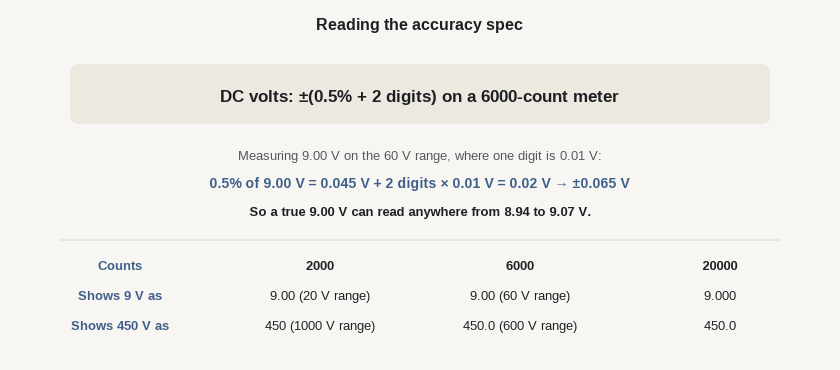
Accuracy is written as a percentage of the reading plus a number of digits:
±(0.5% + 2 digits)
On the 60 V range of a 6000-count meter, one digit is 0.01 V. Measuring 9.00 V:
- 0.5% of 9.00 V = 0.045 V
- 2 digits = 0.02 V
- Total: ±0.065 V, so the display could show anything from about 8.94 to 9.07 V.
Accuracy is usually best on DC volts and worse on AC, current, resistance and capacitance; each has its own line in the spec. For guitar work, a basic meter's ±0.5% to ±1% on DC volts is plenty. What matters more is that the meter is consistent, so you can compare readings over time.
Input Impedance and Ghost Voltages
On the volts ranges, most digital meters present a very high resistance, usually 10 MΩ, so they draw almost no current from what they measure. That is good: they don't disturb the circuit.
Two side effects:
- Very high-impedance points, such as a tube's grid through a 1M resistor or a JFET's gate, can read a little low, because the meter's 10 MΩ is in parallel with the circuit.
- Ghost voltages: a disconnected wire running beside a live one can pick up enough voltage by capacitance to show a reading on a 10 MΩ meter, even though it can deliver no real current. Some meters have a LoZ (low impedance) setting that loads the circuit enough to make ghost voltages vanish; it is mainly an electrician's feature.
True RMS
An AC voltage's RMS value is the equivalent DC value for heating effect. Cheaper meters measure AC by averaging and scaling the result, which is correct only for a pure sine wave. A true RMS meter calculates the real RMS of any waveform.
For mains and transformer windings, which are close to sine waves, either type works. For distorted waveforms, such as a square wave or a clipped amp output into a dummy load, only a true RMS meter reads correctly, and an averaging meter can be off by 10% or more. Most meters are also only accurate on AC up to a limited frequency, often a few hundred hertz to a few kilohertz; the spec says.
Burden Voltage on the Current Ranges
On a current range, the meter puts a small resistor (its shunt) in series with the circuit and measures the voltage across it. That voltage, the burden voltage, is taken away from the circuit. On a mA range it might be a few millivolts per milliamp. In a 9 V pedal drawing 20 mA, a burden of a few hundred millivolts barely matters; in a low-voltage circuit it can change how the circuit behaves.
Continuity and Diode Test Details
- Continuity beeps below a threshold resistance, typically around 30 to 50 Ω, which varies by meter. A beep means "low resistance", not necessarily "a wire".
- Diode test pushes a small current (around 1 mA) with an open-circuit voltage of about 2 to 3 V. That is enough for silicon and germanium diodes and red LEDs, but often not for blue and white LEDs (see the Diodes and LEDs series).
- Capacitance ranges on multimeters are slow at large values and less accurate at small ones. For small or precise measurements, or for checking ESR, an LCR meter is better (Level 3B).
Safety Categories and Fuses
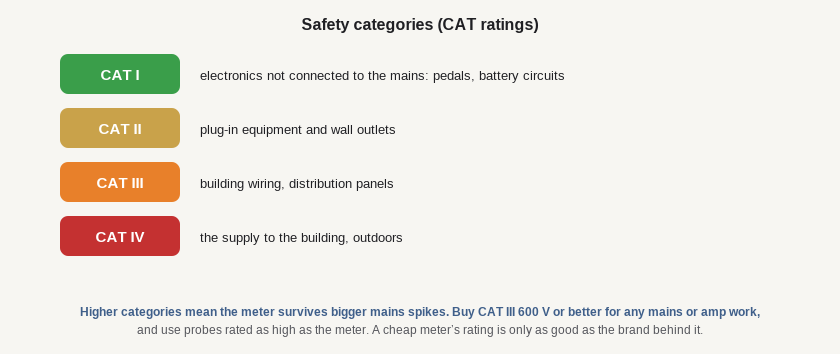
A meter's CAT rating says how big a voltage spike it can survive, by where it will be used:
| Category | Where |
|---|---|
| CAT I | electronics not connected to the mains |
| CAT II | plug-in equipment, wall outlets |
| CAT III | building wiring and distribution |
| CAT IV | the supply into the building |
It is written with a voltage, such as CAT III 600 V. For pedals alone, any decent meter will do. For anything mains-powered, including amps, look for CAT III 600 V or better, from a maker whose ratings you can trust, with probes rated at least as high.
The current jacks are protected by fuses. Good meters use high-breaking-capacity (HRC) fuses that can interrupt a large fault current safely. If a meter's current range stops working, check its fuse, and replace it only with the exact type the manual lists.
DANGER: LETHAL VOLTAGE. A CAT rating protects the meter and you from spikes; it does not make it safe to work inside a live tube amp. B+ supplies of several hundred volts, and filter caps that hold them after unplugging, are lethal. Leave live amp work to someone trained for it. The Cap Drain & Bleeder Calculator explains how filter caps are made safe.
Choosing a Multimeter
| Feature | Worth having for guitar work |
|---|---|
| Autoranging | yes: faster, fewer mistakes |
| Counts | 4000 to 6000 is a good middle ground |
| DC volts accuracy | ±0.5% to ±1% is plenty |
| Continuity | a fast beep, so you can listen instead of watching |
| Diode test | yes |
| Capacitance | useful; an LCR meter does it better |
| True RMS | useful for AC work on amps and dummy loads |
| Safety | CAT III 600 V or better if it will ever touch mains-powered gear |
| Leads | silicone leads with sharp tips, plus a set of clip leads |
| Extras | a lead-in-wrong-jack warning, a backlight, auto power-off |
A mid-priced meter from a known maker, plus a set of alligator clip leads, covers almost everything in this library.
Try It
Measure a fresh 9 V battery and note the reading with all its digits. Then work out your meter's accuracy at that reading from its manual, using the method above, and see how close a second meter, if you have one, comes.