A multimeter is the one tool every series in this library keeps reaching for: checking a resistor's value, a cap's health, a diode's direction, a pedal's supply, a cable's wiring. It is several meters in one box (a voltmeter, an ohmmeter, a continuity tester and an ammeter), and learning its dial takes ten minutes. This series covers the multimeter in Levels 1 to 3A, and the LCR meter, its specialist cousin for capacitors and coils, in Level 3B.
The Parts of a Multimeter
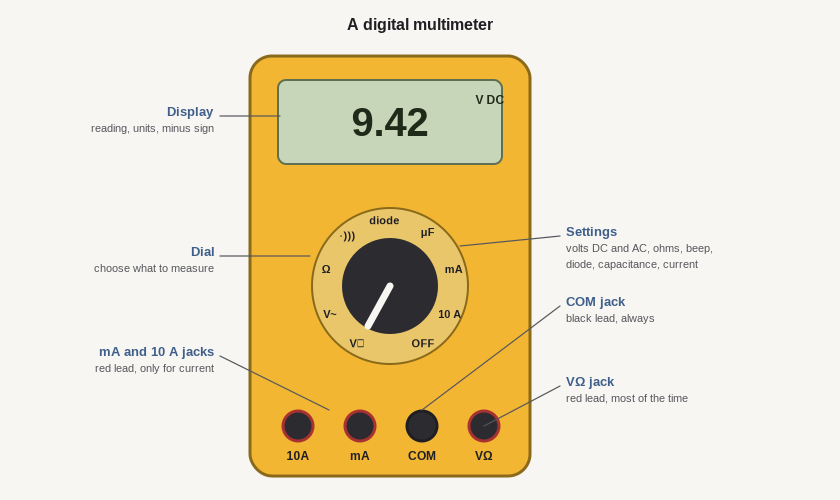
- The display shows the reading, its units, and a minus sign when the voltage is the other way round from the leads.
- The dial chooses what to measure. Many meters are autoranging: you pick volts, and the meter picks the range. Manual-ranging meters make you choose a range too, such as 20 V.
- The jacks are where the leads plug in:
- COM: the black lead, always.
- VΩ (often also marked for diode and continuity): the red lead, for almost everything.
- mA and 10 A (or 20 A): the red lead, only when measuring current.
The Settings
| Setting | Symbol | Measures | Typical use |
|---|---|---|---|
| DC volts | V with a straight line | steady voltage | batteries, pedal supplies, transistor bias |
| AC volts | V~ | alternating voltage | mains, transformer windings, a speaker signal |
| Ohms | Ω | resistance | resistors, pots, pickups, speaker coils |
| Continuity | a speaker or sound waves | whether two points are connected | cables, switches, solder joints |
| Diode test | a diode symbol | a diode's forward voltage | diodes, LEDs, transistor junctions |
| Capacitance | F or µF | capacitance | caps, out of circuit |
| Current | A, mA, µA | current flowing through | a pedal's current draw |
Some meters add frequency (Hz), temperature, and a transistor gain (hFE) socket.
Volts Across, Amps Through
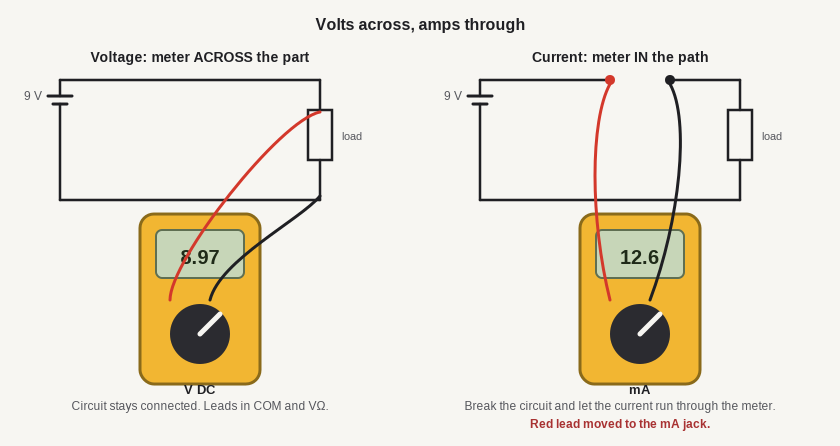
This is the one idea that keeps you and the meter safe:
- Voltage is measured across something. Touch the two probes to the two points you are comparing, with the circuit running and connected as normal. The meter barely affects the circuit.
- Resistance, continuity and diode tests are made with the power off. The meter supplies its own small test current; outside power confuses the reading and can damage the meter.
- Current is measured through something. The circuit has to be broken and the meter put in the gap, so the current flows through the meter. That means moving the red lead to the mA or A jack, where the meter is a near short circuit. Level 2 explains why that is the most common way to blow a meter.
Reading the Display
- OL (overload, or open loop) means the value is beyond the range, or, on ohms or continuity, that there is no connection at all.
- A minus sign on DC volts means the red lead is on the more negative point. It is handy: a minus reading across a DC plug with red in the center hole tells you the plug is center negative.
- Units: check the prefix. kΩ is thousands of ohms, MΩ millions, mV thousandths of a volt.
- Leads touching each other on ohms should read close to 0 Ω, usually 0.1 to 0.3 Ω for the leads themselves.
DANGER: LETHAL VOLTAGE. A multimeter is safe on pedals, batteries and unplugged gear. Inside a tube amp, voltages of several hundred volts sit on the circuit board and filter caps hold them after unplugging. Never measure inside a powered tube amp unless you are trained for live high-voltage work, and always drain and check the filter caps before working on an unplugged one. The Cap Drain & Bleeder Calculator explains how.
Analog Meters
Older meters use a needle and printed scales instead of a display. They read more slowly and less precisely, and their ohms scale runs backwards, but a needle shows a value that is changing, such as a cap charging, very clearly. Digital meters are the better choice for nearly everything today.
Try It
In Build a Circuit, drag a Multimeter onto the canvas and set it to Resistance. Put its two probes on the two legs of a resistor and read the value; change the resistor's value and watch the reading follow. Then set it to Continuity and probe along a jumper wire.
Level 2 covers using a multimeter on real gear: checking a pedal's voltages, testing cables and switches, measuring current safely, the habits that protect the meter, and what Build a Circuit's meters can and can't do.