Levels 1 and 2 covered the three big modern tubes and how they behave. This level is about applications: where they do something a KT88 can't, where they are the wrong choice, fitting them to an existing amp, and buying them.
Where They Shine
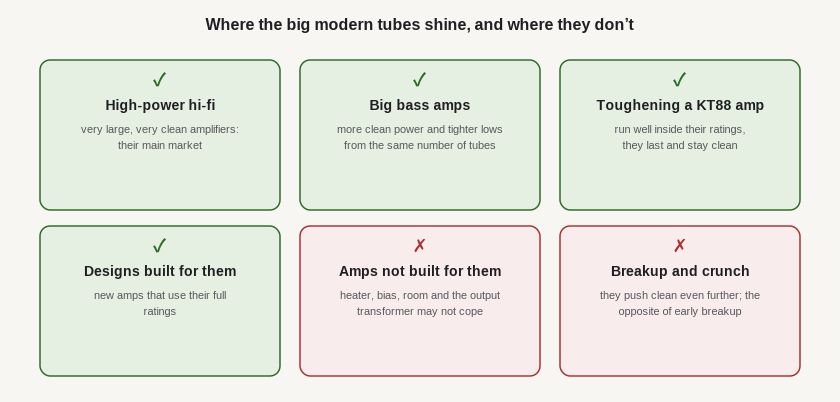
High-Power Hi-Fi
The job: very large, very clean amplifiers driving loudspeakers.
Why they shine: that's what they were designed for. Bigger plate ratings let a pair make power that once needed a quad, with low distortion and firm control of the bass.
Big Bass Amps
The job: large, clean low end at stage volume, night after night.
Why they shine: more plate dissipation means more clean power and tighter lows from the same number of tubes, and more margin when the amp is worked hard. In bass amps that have the heater current and room for them, they are an appealing upgrade from 6550s.
Toughening a KT88 Amp
The job: a KT88 or 6550 amp that eats tubes, or a player who wants even more headroom.
Why they shine: a 50 W to 70 W tube running at a KT88 amp's voltages works well below its limits. Approved by the amp's maker and properly biased, that means longer life and an even cleaner power stage.
New Designs Built for Them
The job: amps designed from the start around a 60 W or 70 W tube.
Why they shine: only a design built for them uses their full ratings, with transformers, voltages and heater windings to match.
Where They Don't
- Amps not built for them. Heater current, bias range, room and the output transformer all need to suit the tube. Without the maker's approval, fitting them is a job for a technician.
- Breakup and crunch. These tubes push clean headroom even further than a KT88. If you want the power stage to break up, they are the opposite of what you need.
- Small amps. They are far too big, and far too hungry, for EL34, 6L6 or 6V6 amps.
Fitting One to a KT88 Amp
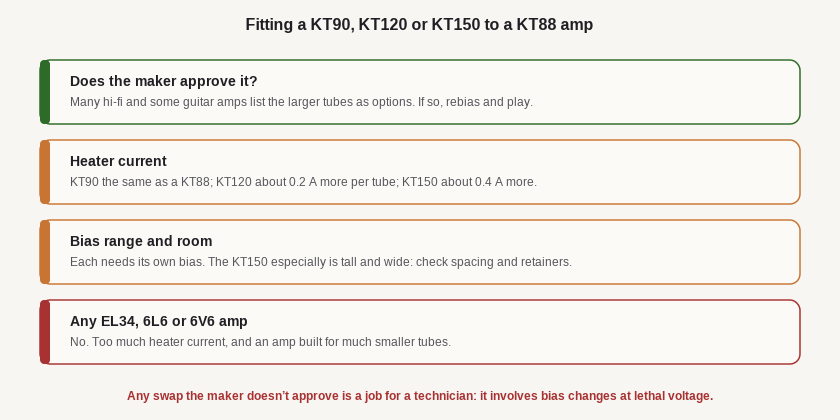
- Check the maker's approval. Many hi-fi amps, and some guitar and bass amps, list the larger tubes as options.
- Check the heater current. The KT90 draws the same as a KT88. The KT120 draws about 0.2 A more per tube, and the KT150 about 0.4 A more. The transformer's 6.3 V winding has to supply the total.
- Check the room. The KT150 especially is tall and wide.
- Rebias for the new tube, using its own rating.
DANGER: LETHAL VOLTAGE. Rebiasing and checking a transformer's heater capacity is work at lethal voltage. If the maker doesn't say a swap is supported, have a technician check the amp.
Buying Them
- Makers: the KT120 and KT150 are Tung-Sol designs; the KT90 has been made by Ei and others. Several brands also sell their own versions.
- Matched sets: buy matched pairs, quads or larger sets for push-pull amps.
- Heater current: read it on the data sheet before buying; it varies by maker.
- Spares: keep the old KT88s as a spare set. If the new tubes don't suit the amp, you can go straight back.
Try It
If your amp's maker lists KT120s or KT150s as an option, compare them with a fresh set of KT88s at the same volume. Listen for the point where each set starts to compress: with the bigger tubes it should come later, if at all. Whether that is an improvement depends on whether you want your power stage to stay clean.