Level 1 covered the three big modern tubes. This level is about the numbers that matter when fitting or running them: plate ratings, voltage, heater current, room, and bias.
DANGER: LETHAL VOLTAGE. Bias is measured with the amp on, at very high voltage. If you are not trained for it, have a technician do it. Never run a tube amp without a speaker or dummy load: it can destroy the output transformer (see the Output Transformers series).
The Numbers
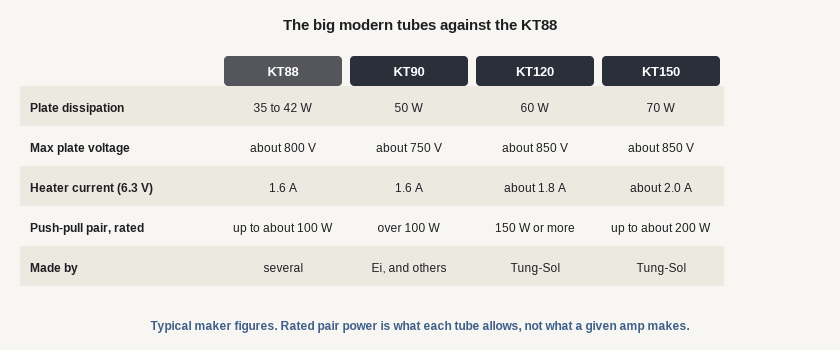
Two points about these figures:
- Rated pair power is what the tube allows, not what an amp makes. An amp designed around KT88s and refitted with KT120s still has the KT88 amp's transformers and voltages. It gains headroom and margin, not a doubling of power.
- Bigger ratings mean more margin. Run inside a KT88 amp's operating conditions, a 60 W or 70 W tube is working well below its limits, which is part of their appeal for hard-working bass amps.
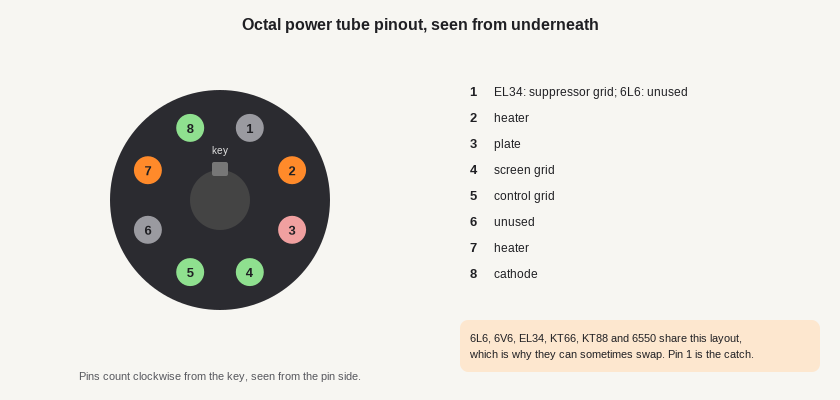
The pinout is the standard octal power tube layout, with pin 1 unused:
Heater Current: Check It First
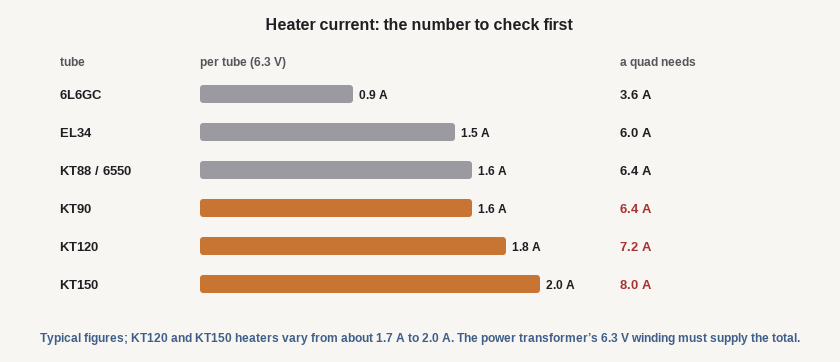
The power transformer's 6.3 V winding supplies every heater in the amp. A quad of KT150s needs about 8 A against 6.4 A for KT88s. That extra 1.6 A has to come from somewhere: if the winding hasn't the margin, it runs hot and the heater voltage sags. The KT90 draws the same as a KT88; the KT120 a little more; the KT150 the most. The Power Transformers series explains heater windings.
Room and Heat
The KT120 is taller than a KT88, and the KT150's egg-shaped bottle is the widest of all. Check the socket spacing, the tube retainers and the height inside the cabinet before buying. These tubes dissipate a lot of heat, and they need the airflow to get rid of it.
Bias
Each tube needs its own bias setting: the KT88's target is not right for a KT120 or KT150. The usual class AB target of 60% to 70% applies, worked out from the actual plate voltage and the tube's own rating. Many players run them more conservatively than that in amps built for KT88s, for long life and a clean sound. The Tube Bias Calculator has the KT90 built in; for the KT120 and KT150, use the same method with their 60 W and 70 W ratings. The Power (W) Calculator checks the watts from a measured voltage and current.
Buy matched sets, as with any push-pull power tubes.
Try It
Take your amp's tube count and multiply by each tube's heater current from the chart above. Then look up your power transformer's 6.3 V winding rating, if the maker publishes it. The difference is your margin.
Level 3 covers where these tubes shine, where they don't, and fitting them to a KT88 amp.