This level is the reference: forward voltage curves, the ratings on a diode's data sheet, zeners, rectifiers in tube amps, and how to test, buy and substitute diodes and LEDs.
The Forward Voltage Curve
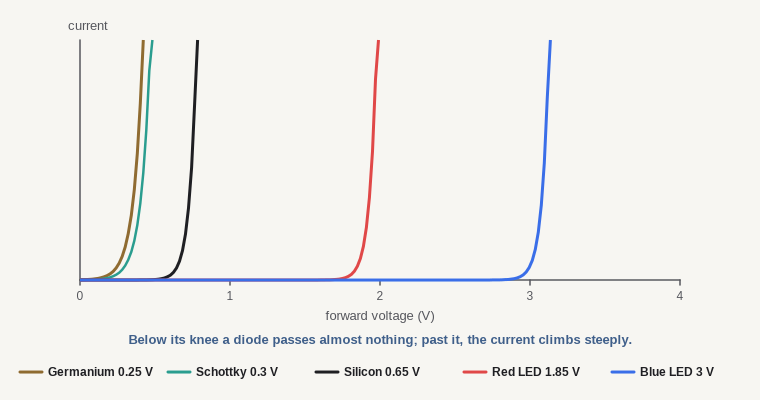
A diode's forward voltage is not one fixed number. Below its knee, almost no current flows. Past the knee, the current climbs steeply for a small rise in voltage. That is why 0.6 to 0.7 V is quoted for silicon: across a huge range of currents, the voltage stays in that window.
The shape of the knee is what clipping sounds like. Germanium and Schottky diodes have a softer, lower knee, so they start clipping earlier and more gradually. Silicon's knee is sharper. LEDs have a sharp knee at a much higher voltage. The forward voltage also drops by about 2 mV for every degree of warming, so a hot germanium diode clips a little lower than a cold one.
Reading a Data Sheet
The numbers that matter for guitar work:
| Rating | Means | 1N4148 | 1N4007 | 1N5817 |
|---|---|---|---|---|
| VRRM | highest reverse voltage it can block | 100 V | 1,000 V | 20 V |
| IF or IF(AV) | continuous forward current | about 200 mA | 1 A | 1 A |
| VF | forward voltage at a stated current | about 0.7 V at 10 mA | about 1 V at 1 A | about 0.45 V at 1 A |
| trr | reverse recovery time: how fast it stops conducting | 4 ns | microseconds | very fast |
Two things to notice: the 1N5817's low reverse rating makes it fine in a 9 V or 18 V pedal but useless in an amp, and the 1N4007's slow recovery is why some builders use a fast-recovery UF4007 in amp power supplies, where it switches more cleanly.
Power
The power a diode turns into heat is P = VF × I. A 1N4001 carrying 100 mA at 0.8 V dissipates 0.08 W, nothing to worry about. A small zener is a different matter, covered below.
Zener Diodes
A zener conducts normally in the forward direction, but in reverse it holds a set voltage, its zener voltage, once current is flowing. That makes it a simple voltage limiter or reference.
The 1N47xx family is the common 1 W range:
| Part | Voltage | Part | Voltage |
|---|---|---|---|
| 1N4732 | 4.7 V | 1N4739 | 9.1 V |
| 1N4733 | 5.1 V | 1N4740 | 10 V |
| 1N4735 | 6.2 V | 1N4742 | 12 V |
| 1N4737 | 7.5 V | 1N4744 | 15 V |
| 1N4738 | 8.2 V | 1N4746 | 18 V |
A zener always needs a resistor to limit its current, the same idea as an LED:
R = (supply − zener voltage) ÷ current
and its power is P = zener voltage × current. A 9.1 V zener carrying 50 mA dissipates about 0.46 W, so a 1 W part is right, and a 0.5 W one would run too hot.
In pedals, a zener across the supply clamps a voltage spike or an adapter that is too high. In tube amps, zeners turn up in some bias and screen supplies, and occasionally in place of a cathode resistor.
Rectifiers in Tube Amps
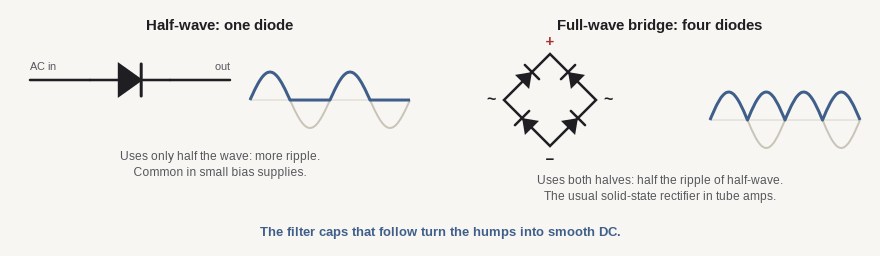
Three arrangements cover nearly every amp:
- Half-wave: one diode, using half of each cycle. Too much ripple for the main supply, but common for the small negative bias supply.
- Full-wave with a center-tapped transformer: two diodes, each handling half the cycle. Each diode must block about twice the peak voltage of half the winding.
- Bridge: four diodes, no center tap needed. Each diode blocks about the peak voltage once.
The peak voltage is the AC reading times 1.414. A 350 V winding peaks at about 495 V; in a center-tapped full-wave circuit each diode sees nearly 1,000 V in reverse. That is why amp builders use 1N4007s, often two in series per position for extra margin.
Diodes or a tube? A rectifier tube, such as a 5AR4 or 5Y3, drops more voltage and lets the supply sag when the amp is pushed, which many players hear as a softer, more compressed feel. Silicon diodes give a stiffer, slightly higher supply. Swapping one for the other changes the amp's voltages, so it is a job for someone who can check the bias afterwards.
DANGER: LETHAL VOLTAGE. Never measure or touch a tube amp's rectifier or power supply with the amp on unless you are trained to work on live high voltage. Unplug it, drain the filter caps through a resistor and check each with a meter before you start. The Cap Drain & Bleeder Calculator shows how long the caps take to drain.
LED Numbers
| Rating | Typical 5 mm LED |
|---|---|
| Maximum forward current | 20 mA continuous |
| Comfortable indicator current | 1 to 5 mA |
| Maximum reverse voltage | about 5 V |
| Forward voltage | red 1.8 to 2.2 V, blue and white 3.0 to 3.4 V |
The resistor's power is small but worth a check on higher supplies: (supply − LED voltage) × current. An LED at 5 mA on 18 V puts 0.08 W into its resistor, fine for a 1/4 W part.
Brightness and color depend on the LED's lens and its efficiency as much as its current. A diffused LED looks softer than a clear one. Blue and white LEDs look much brighter than red at the same current, so they usually want a larger resistor.
Testing
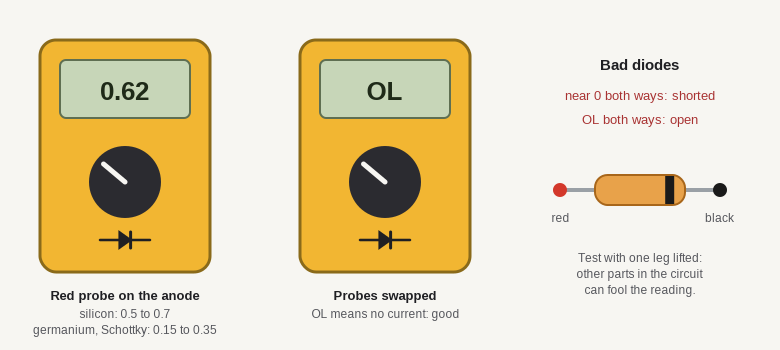
Set the meter to its diode setting (the diode symbol). It pushes a small current and shows the forward voltage.
- Red probe on the anode, black on the cathode (the band). A good silicon diode reads about 0.5 to 0.7. Germanium and Schottky read about 0.15 to 0.35.
- Swap the probes. A good diode reads OL: no current.
- Near 0 both ways means the diode is shorted. OL both ways means it is open. Either way, replace it.
- Test with one leg lifted. In the circuit, parts in parallel can make a good diode read wrong.
- LEDs: many meters light a red LED faintly on the diode setting and read about 1.6 to 1.9. Blue and white LEDs need more voltage than some meters supply, so a dark blue LED on the meter is not proof it is dead. Try it with a battery and a resistor.
- Zeners: the diode setting only checks the forward direction. To check the zener voltage, feed it from a supply higher than its rating, through a resistor, and measure across it.
Buying and Substituting
| Replacing | With | Notes |
|---|---|---|
| 1N4148 | 1N914 | effectively the same part |
| 1N4001 to 1N4006 | 1N4007 | same diode, higher voltage rating; stock only 1N4007s |
| 1N4007 in an amp | UF4007 | same ratings, faster recovery |
| 1N5817 | 1N5818 or 1N5819 | higher reverse voltage, same job |
| A germanium clipping diode | another germanium, or a Schottky | germaniums vary a lot from one to the next; match by ear, or by forward voltage on the meter |
| A zener | the same voltage, same or higher wattage | wattage matters: a 0.5 W zener in place of a 1 W one can overheat |
| An LED | any LED of the same size | check the forward voltage; a blue LED in place of a red one may need a different resistor |
For clipping, buy a handful of each type and socket the diodes, so you can swap them without soldering. Germanium diodes in particular vary from one to the next, so measuring a few and picking a matched pair by forward voltage pays off.
Try It
In Build a Circuit, put two LEDs in series with a resistor and a 9 V battery, then open Circuit Math to see the total forward voltage and the current. Then set one LED's forward voltage to 3.2 V in the Inspector, as for a blue LED, and watch the numbers change. Dial the Diode Sub Box through its zener positions to compare their part numbers with the table above.