A diode is a one-way valve for electricity. Current flows through it in one direction and is blocked in the other. That simple rule protects pedals from a backwards power supply, turns AC into DC in every amp, and, used another way, gives overdrive and distortion pedals their clipping. An LED is a diode that also gives off light.
How to Spot One
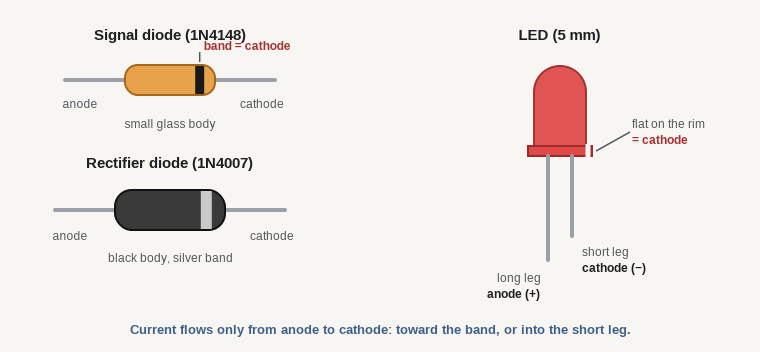
A diode has two ends with names:
- Anode: where current goes in.
- Cathode: where current comes out. It is marked with a band painted around one end of the body.
The two you will see most:
- Signal diodes, like the 1N4148, are small, with an orange glass body and a black band. They handle small currents: clipping, switching and signal jobs.
- Rectifier diodes, like the 1N4001 to 1N4007, are bigger, with a black body and a silver or white band. They handle power: turning AC into DC and protecting circuits.
LEDs
An LED (light-emitting diode) lights up when current flows through it the right way. It is a diode, so it has an anode and a cathode too:
- The long leg is the anode (+).
- The short leg is the cathode (−).
- Most LEDs also have a flat spot on the rim on the cathode side, which helps once the legs have been trimmed.
An LED always needs a resistor in series. Connected straight to a battery, it draws as much current as it can and burns out in a moment. Level 2 shows how to work out the value.
Which Way Round
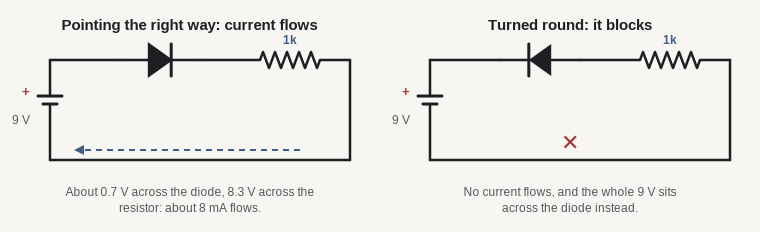
A diode only conducts when its anode is more positive than its cathode, which is called forward biased. Even then it takes a small voltage to get it started. That voltage, the forward voltage, is the number to know about any diode:
| Type | Forward voltage |
|---|---|
| Germanium (1N34A, 1N270) | about 0.2 to 0.3 V |
| Schottky (1N5817, BAT41) | about 0.2 to 0.4 V |
| Silicon (1N4148, 1N4001) | about 0.6 to 0.7 V |
| Red LED | about 1.8 to 2.2 V |
| Blue or white LED | about 3.0 to 3.4 V |
Turned the other way, reverse biased, a diode blocks, up to a limit called its reverse voltage rating. Push past that and an ordinary diode breaks down and is usually ruined. One kind, the zener, is built to break down at a set voltage on purpose.
On a Schematic
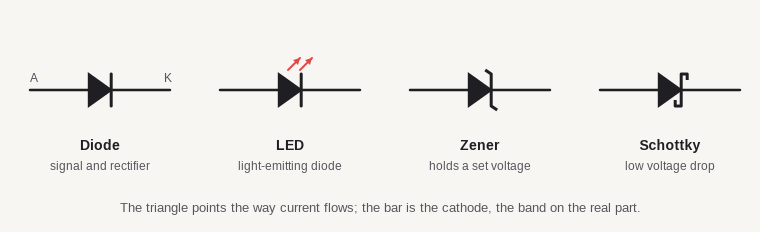
The triangle points in the direction current flows. The bar at its tip is the cathode, the same end as the band on the real part. Extra marks on the bar tell you the type: bent ends for a zener, little hooks for a Schottky, and two arrows coming off an LED. Diodes are numbered D1, D2 and so on, and LEDs often LED1, LED2.
Reading the Part Number
Diodes do not use a color code for their value. Instead the part number is printed on the body, though on small glass diodes it can take a magnifier and good light to read.
| Part number | What it is | Where it turns up |
|---|---|---|
| 1N4148 (or 1N914) | silicon signal diode | clipping in overdrives, switching, the most common small diode there is |
| 1N4001 to 1N4007 | silicon rectifier, 1 A | pedal polarity protection, amp power supplies. The last digit sets the voltage rating, from 50 V to 1,000 V |
| 1N5817 | Schottky rectifier | pedal polarity protection, losing less voltage than a 1N4001 |
| 1N34A | germanium | vintage-style clipping |
| 1N4733 to 1N4746 | 1 W zeners, 5.1 V to 18 V | voltage protection and regulation |
Where You Find Them
| In a... | What the diodes are doing |
|---|---|
| Pedal | blocking a backwards power supply, clipping the signal in overdrives, distortions and fuzzes, and the LED that shows the effect is on |
| Tube amp | turning the mains AC into high-voltage DC (unless the amp uses a rectifier tube), making the negative bias voltage, and pilot lights in newer amps |
| Guitar | rarely any. Some active guitars use one for battery protection, and a few have LED position markers |
| Speaker cab | usually none |
Try It
In Build a Circuit, wire a battery, a resistor and an LED in a loop and watch it light. Then turn the LED round: it goes dark, just like the diagram above. Put a 1N4148 Diode in the same loop and flip it to see it block. The Diode Sub Box has a dial of real part numbers, from germanium and Schottky diodes to zeners and LED colors.
Level 2 covers what diodes do in a circuit: clipping, protection, sizing an LED's resistor, and which diode to use for which job.