Level 1 covered what the 5AR4/GZ34 is and how it feels. This level is about how it behaves: sag, its slow warm-up, the heater winding, current limits, and two cautions that affect how long it lasts.
DANGER: LETHAL VOLTAGE. Everything in this article sits at the full high-voltage supply. Never measure or work on it unless you are trained to, and always drain the filter caps first. The Cap Drain & Bleeder Calculator shows how.
Sag, But Not Much
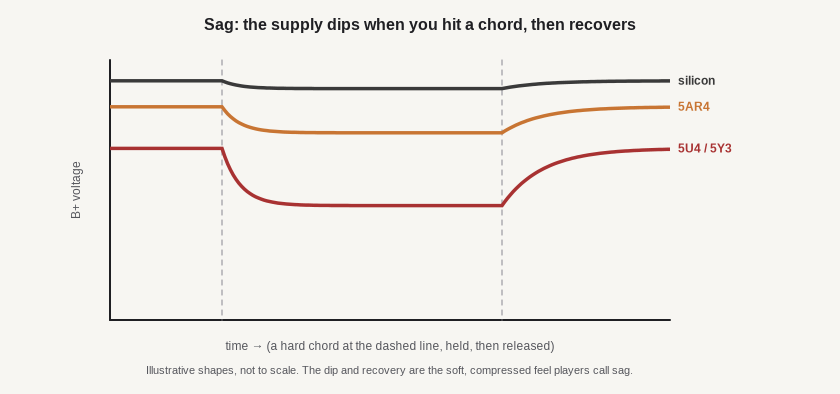
A 5AR4's internal resistance is low for a tube rectifier, so when a hard chord makes the power tubes draw more current, the supply dips only a little and recovers quickly. The amp keeps nearly all its punch, with just enough compression on the peaks to soften the edge. Small filter capacitors, as in many vintage designs, deepen the effect a little.
The Slow Warm-Up
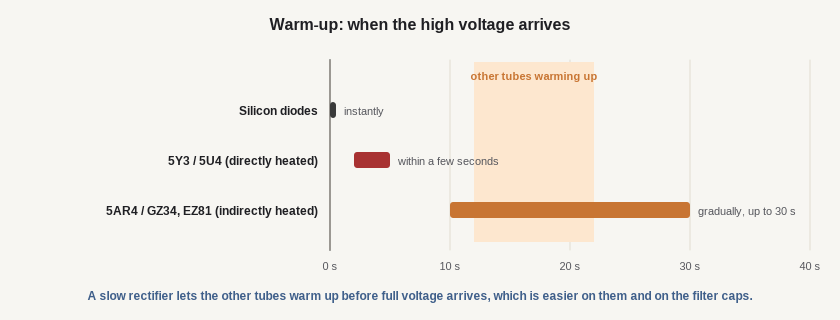
The 5AR4 has an indirectly heated cathode, a sleeve heated by a separate heater. It takes time to reach working temperature, so the high voltage arrives gradually, over up to about 30 seconds, while the other tubes are warming up too. The power tubes never sit cold with full voltage on them, and the filter caps charge gently. Directly heated rectifiers like the 5Y3 and 5U4 conduct within a few seconds, before the rest of the amp is ready.
The Heater Winding
The 5AR4 needs 5 V at 1.9 A from its own winding on the power transformer. That is less than a 5Y3 (2 A) and far less than a 5U4GB (3 A), which matters when swapping (Level 3).
Current Limits
A 5AR4 is good for about 250 mA: enough for a pair of 6L6s or EL34s, or four EL84s, in a medium-power amp. Amps with four or more large power tubes draw more than one rectifier tube can supply, which is why big amps use silicon.
Two Cautions
- The first filter cap. Rectifier data sheets give a maximum value for the first filter capacitor. A much larger one draws a heavy charging current through the tube every cycle, which shortens its life and can make it arc. When restoring a 5AR4 amp, keep that first cap within the rectifier's rating.
- Standby switches. Flipping a standby switch with the rectifier already hot sends a sudden surge into empty filter caps. In some amps that surge passes through the rectifier in a way that shortens its life. With a slow-warming 5AR4, the amp already protects itself at switch-on, so many technicians suggest simply leaving such amps out of standby.
Signs of Wear
A worn 5AR4 lets the voltage drop further, so the amp gets quieter and softer. A failing one may hum, flicker or arc inside, or blow the fuse. Replace an arcing rectifier at once and have the filter caps and fuse checked.
Try It
Switch on a 5AR4 amp and watch the power tubes: their heaters glow first, then the amp comes to life over the next half minute or so as the rectifier warms. That gradual start is the 5AR4 doing its job.
Level 3 covers where the 5AR4 shines, swapping it, and buying them.