The 5AR4 is the firmest of the common rectifier tubes, and the most widely used in amps built today. It is the same tube as the European GZ34. Where the 5Y3 and 5U4 drop a lot of voltage and sag heavily, the 5AR4 drops only about 10 V to 17 V, so an amp keeps most of its power and headroom while still getting a touch of the give that silicon doesn't have. It also warms up slowly and gently, which is kind to the rest of the amp.
This series covers the 5AR4/GZ34. The Rectifier Tubes series compares all the common types, and the Vacuum Tubes series covers how tubes work in general.
DANGER: LETHAL VOLTAGE. A rectifier tube carries the full high-voltage supply, and its socket is live whenever the amp is on. The filter capacitors it charges hold a lethal charge long after unplugging. The Cap Drain & Bleeder Calculator explains how long the charge lasts.
The Tube and Its Neighbors
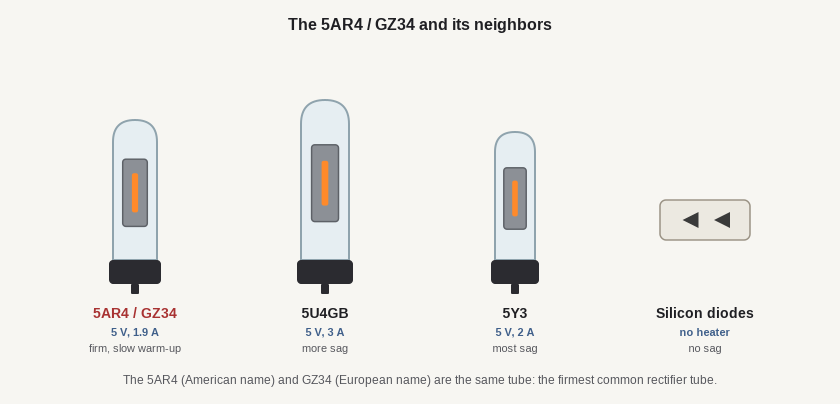
| 5AR4 / GZ34 | |
|---|---|
| Heater | 5 V, 1.9 A |
| Cathode | indirectly heated: a separate cathode, like an amplifying tube |
| Voltage drop | small, about 10 V to 17 V |
| Current rating | about 250 mA |
| Warm-up | gradual, over up to about 30 seconds |
| Base | octal |
What It Feels Like
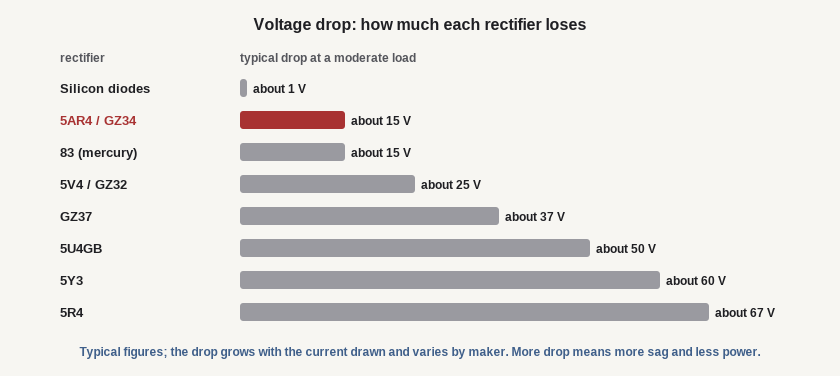
With so little voltage drop, a 5AR4 amp feels firm and punchy, close to a silicon-rectified one, but players hear a little more give when they dig in: a slight softening on hard chords and a bit of bloom as notes sustain. Among the tube rectifiers, it is described as one of the firmest and most efficient, while still sagging a little more than silicon when pushed hard.
Where You've Heard It
- Medium-power American amps: Fender moved its tweed Bassman to a GZ34 in 1958 with the 5F6-A circuit, and many 40 W-class Fenders and their reissues use a 5AR4.
- The classic British 30 W combo: the AC30 uses a GZ34.
- The first Marshall heads and combos, and countless boutique amps since.
- Hi-fi amplifiers, where its low drop and slow warm-up are valued.
How It Compares
| Rectifier | Drop | In one sentence |
|---|---|---|
| Silicon | about 1 V | no sag at all |
| 5AR4 / GZ34 | about 10 V to 17 V | firm, with a touch of give and a gentle warm-up |
| 5V4 / GZ32 | about 25 V | a slightly softer cousin |
| 5U4GB | about 50 V | lots of sag, at high current |
| 5Y3 | about 60 V | the most sag, for small amps |
Try It
In the Power (W) Calculator, compare a power tube at 450 V and 100 mA with the same tube at 435 V. That 15 V is roughly what a 5AR4 costs you against silicon: a small loss, which is why 5AR4 amps still feel firm.
Level 2 covers how the 5AR4 behaves: warm-up, heater, current, and the filter cap and standby cautions.